Items Similar to Juggler / - Artistic naturalness -


Want more images or videos?
Request additional images or videos from the seller
1 of 15
Claire Jeanne Robertine ColinetJuggler / - Artistic naturalness -c. 1910
c. 1910
$3,455.62
£2,573.94
€2,900
CA$4,758.67
A$5,179.70
CHF 2,744.54
MX$62,293.69
NOK 34,896.07
SEK 31,978.39
DKK 22,096.08
About the Item
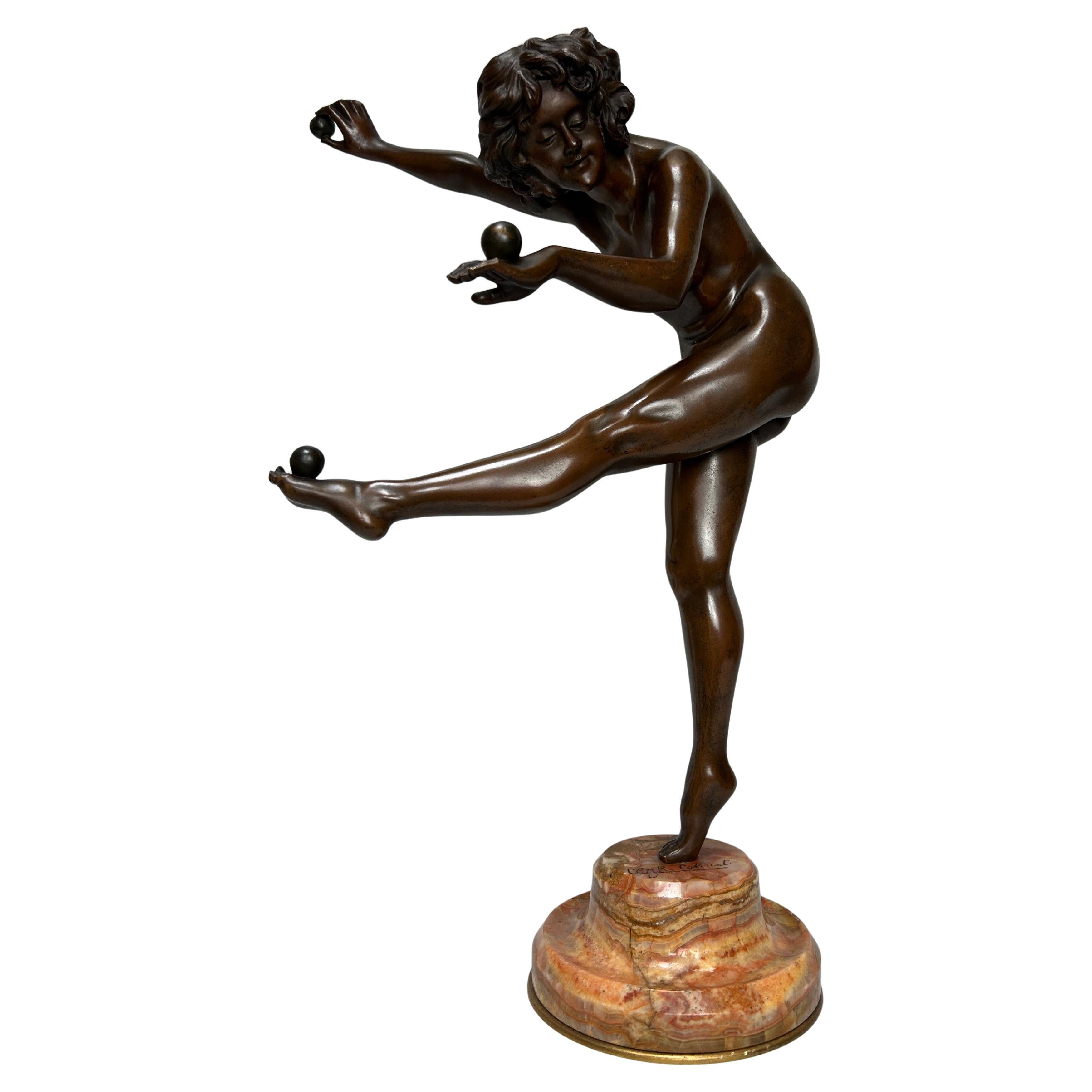
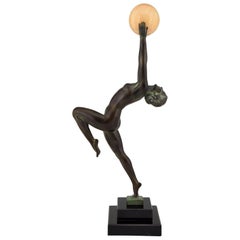
Claire Jeanne Robertine Colinet (1880 Brussels - 1950 Asnières-sur-Seine), Juggler, around 1920. Brownish patinated bronze with gilded balls on a round, multi-profiled stone base (10 cm high). 47 cm (total height) x 20 cm (width) x 25 cm (depth), weight 5.7 kg. Inscribed on the plinth “CL. JR. COLINET” on the plinth, numbered and with the foundry mark ‘J. B. Deposee, Paris’.
- Gilding on the balls partially lost, patina somewhat rubbed in places, hairline crack on the upper part of the left arm
- Artistic naturalness -
Balancing on one toe only, the naked beauty performs an acrobatic dance figuration with three golden balls. The posture of the fingers and toes shows the necessary body tension, yet the movement appears completely natural, as if it were performed by itself. It was precisely this effect of seemingly natural artificiality that the Italian Renaissance hailed as the highest art. Although the bronze figure itself does not move, when viewed from different perspectives, it performs an expansive choreography that unfolds with the grace of a juggling dancer. Her nearly closed eyes lend the movement a fluid, dreamlike quality, so that the harmonious movement seems to be a direct expression of her inner self.
About the artist
Claire Jeanne Robertine Colinet was a student of Jef Lambeaux in Brussels and subsequently worked as an independent sculptor. From 1913, she exhibited regularly at the Salon of the “Société des Artistes Français”. Her dancing, animated female figures made her an esteemed artist.
GERMAN VERSION
Claire Jeanne Robertine Colinet (1880 Brüssel - 1950 Asnières-sur-Seine), Jongleuse, um 1920. Bräunlich patinierte Bronze mit vergoldeten Bällen auf rundem mehrfach profilierten Steinsockel (10 cm Höhe). 47 cm (Gesamthöhe) x 20 cm (Breite) x 25 cm (Tiefe), Gewicht 5,7 kg. Auf der Plinthe mit „CL. JR. COLINET“ signiert, nummeriert und der Gießereimarke „J. B. Deposee, Paris" versehen.
- Vergoldung der Bälle teilweise verloren, Patina mitunter etwas berieben, Oberseite des linken Armes mit Haarriss
- Kunstvolle Natürlichkeit -
Einzig auf einer Zehenspitze balancierend, vollführt die nackte Schönheit eine akrobatisch-tänzerische Figuration mit drei goldenen Bällen. Dabei ist der Haltung der Finger und Zehen die dazu notwenige Körperspannung abzulesen und doch wirkt die Bewegung ganz natürlich, als ob sie wie von selbst vollzogen werden würde. Gerade diese Wirkung einer wie natürlich erscheinenden Artifizialität wurde von der italienischen Renaissance als höchste Kunst gerühmt. Obwohl sich die Bronzefigur selbst nicht bewegt, vollführt sie bei ihrer Wahrnehmung aus verschiedenen Perspektiven doch eine raumgreifendende Choreographie, die die Grazie der jonglierenden Tänzerin entfaltet. Ihre nahezu geschlossenen Augen verleihen der Bewegung etwas Fließend-Träumerisches, so dass die harmonische Bewegung der unmittelbare Ausdruck ihren Inneren zu sein scheint.
zur Künstlerin
Claire Jeanne Robertine Colinet war in Brüssel Schülerin von Jef Lambeaux und anschließend als selbstständige Bildhauerin tätig. Ab 1913 stellte sie regelmäßig im Salon der „Société des Artistes Français“ aus. Ihre tänzerisch-bewegten Frauenfiguren ließen sie zur geschätzten Künstlerin werden.
- Creator:Claire Jeanne Robertine Colinet (1880 - 1950, Belgian)
- Creation Year:c. 1910
- Dimensions:Height: 18.51 in (47 cm)Width: 7.88 in (20 cm)Depth: 9.85 in (25 cm)
- Medium:
- Movement Style:
- Period:
- Condition:
- Gallery Location:Berlin, DE
- Reference Number:1stDibs: LU2438215483512
About the Seller
5.0
Vetted Professional Seller
Every seller passes strict standards for authenticity and reliability
Established in 2014
1stDibs seller since 2023
23 sales on 1stDibs
- ShippingRetrieving quote...Shipping from: Berlin, Germany
- Return Policy
More From This Seller
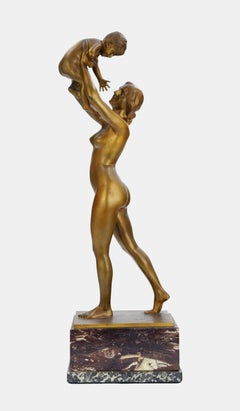
View AllMother Happiness / - The ecstasy of maternal joy -
Located in Berlin, DE
Johannes Boese (1856 Ostrog - 1917 Berlin), Mutterglück, um 1910. Goldbraun patinierte Bronze auf gegossener rechteckiger Plinthe, montiert auf zweifarbigem Marmorsockel (9,5 cm Höhe...
Category
1910s Art Nouveau Nude Sculptures
Materials
Bronze
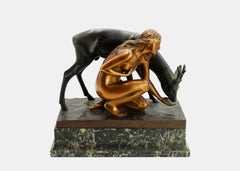
The Feeding / - Natural grace -
Located in Berlin, DE
Erich Schmidt-Kestner (1877 Berlin - 1941 Nordhausen), The Feeding, around 1915. Gold and black patinated bronze with cast brown patinated plinth mounted on a lightly veined black-gr...
Category
1910s Art Nouveau Nude Sculptures
Materials
Bronze
Gladiator ready for battle / - Ready for anything -
By Bruno Zach
Located in Berlin, DE
Bruno Zach (1891 Zhitomir - 1945 Vienna), Gladiator ready for battle, c. 1930. Blackish patinated bronze with silver-plated helmet, shield rim and shield pommel mounted on a fluted m...
Category
1930s Art Deco Nude Sculptures
Materials
Bronze

Forest idyll / - Soulmate -
By Rudolf Kaesbach
Located in Berlin, DE
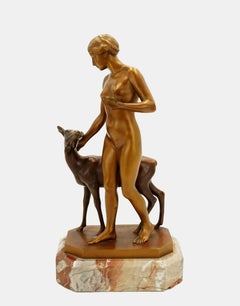
Rudolf Kaesbach (1873 Gladbach - 1955 Berlin), Forest idyll, around 1915. Bronze, gold and golden brown patina, with cast plinth, mounted on a marble base (5 cm high), total height 36 cm, dimensions of the bronze: 31 cm (height) x 17 cm (length) x 12 cm (width). Weight 4,6 kg, signed on the plinth "R.[udolf] KAESBACH".
- a few rubbed areas, overall in excellent condition for its age
- Soulmate -
The bronze sculpture depicts a young woman in an intimate exchange with a deer that accompanies her. The animal pauses to turn toward her, while the nude beauty slows her pace to look into the deer's eyes and tenderly caress it with her hand. The woman and the deer are in inner harmony. Even though her lips remain motionless, she speaks the language of the animal with which she is deeply connected.
The golden patina, which contrasts with the more naturalistic coloring of the deer, gives the young woman the appearance of a saint, even if she cannot be identified as such. At the same time, she evokes memories of Diana, the goddess of the hunt, or a nymph. But she lacks the ferocity. In her innocent naivety, she is more like a vestal virgin, who is not at home in the solitude of the forest. And yet, the young beauty, moving unclothed in the heart of nature, looks like a priestess with her hair tied up and a carefully carried bowl on her way to a sacred grove.
In order to open up the above-mentioned associations, Kaesbach deliberately designed the female figure in such a way that she cannot be identified as a specific person. He has created an allegory of natural femininity, characteristic of Art Nouveau, in which the deer is far more than a companion animal. It displays the same gracefulness as the young woman, and the inner resemblance between the two makes the deer appear as her other self. In animal terms, it embodies her inner being, which also gives the deer an allegorical character.
About the artist
Rudolf Kaesbach studied sculpture at the Hanau Academy and worked in a bronze foundry in Paris in 1900. In order to work as an independent artist, he opened a workshop in Düsseldorf, where he cast bronzes from models he designed. In 1902 he made his debut at the German National Art Exhibition in Düsseldorf. The following year Kaesbach went to the academy in Brussels. There he was inspired by contemporary Belgian sculpture, especially the work of Constantin Meunier. He moved to Berlin, where he opened a studio in the villa district of Grunewald and devoted himself to life-size marble sculptures and the design of bronzes. From 1911, he regularly presented his works at the major art exhibitions in Berlin, as well as in Düsseldorf and Malmö. Between 1936 and 1939, he also created models for the Rosenthal porcelain factory. From 1939 to 1944, Kaesbach was represented at the major German art exhibitions in Munich.
GERMAN VERSION
Rudolf Kaesbach (1873 Gladbach - 1955 Berlin), Waldidyll, um 1915. Gold und goldbraun patinierte Bronze mit gegossener Plinthe, auf einem Marmorsockel montiert (5 cm Höhe), Gesamthöhe 36 cm, Maße der Bronze: 31 cm (Höhe) x 17 cm (Länge) x 12 cm (Breite). Gewicht 4,6 kg, auf der Plinthe mit „R.[udolf] KAESBACH“ signiert.
- vereinzele beriebene Stellen, insgesamt in einem altersgemäß ausgezeichneten Zustand
- Seelenverwandtschaft -
Die Bronzeplastik veranschaulicht eine junge Frau im innigen Austausch mit einem sie begleitenden Reh. Das Tier hält inne, um sich zu ihr hochzuwenden, während die nackte Schönheit ihren Schritt verlangsamt, um dem Reh ebenfalls in die Augen zu schauen und es zärtlich mit der Hand zu liebkosen. Die Frau und das Reh sind in einem inneren Gleichklang. Auch wenn ihre Lippen unbewegt bleiben, spricht sie die Sprache des Tieres, mit dem sie auf eine tief empfundene Weise verbunden ist.
Die im Kontrast zur naturalistischeren Einfärbung des Rehs aufstrahlende goldfarbene Patina lässt die junge Frau wie eine Heilige erscheinen, auch wenn sich nicht als Heilige identifizierbar ist. Zugleich ruft sie Erinnerungen an die Jagdgöttin Diana oder eine Nymphe hervor. Dafür fehlt ihr allerdings die Wildheit. In ihrer unschuldigen Naivität gemahnt sie vielmehr an eine Vestalin, die freilich nicht in der Waldeinsamkeit zu Hause ist. Und doch wirkt die sich unbekleidet im Herzen der Natur bewegende junge Schönheit wie eine Priesterin, die sich mit hochgebundenem Haar und der vorsichtig getragenen Schale und dem Wege zu einem Heiligen Hain befindet.
Um die gennannten Assoziationen zu eröffnen, hat Kaesbach die Frauenfigur bewusst so gestaltet, dass sie nicht als konkrete Person identifizierbar ist. Damit hat er eine für den Jugendstil charakteristische Allegorie natürlicher Weiblichkeit geschaffen, bei der das Reh weit mehr als ein Begleittier ist. Es weist dieselbe grazile Anmut wie die junge Frau auf und der innere Gleichklag der beiden lässt das Reh als ihr anderen Ich erscheinen. Es verkörpert – ins Animalische übertragen - ihr inneres Wesen, wodurch auch dem Reh ein allegorischer Charakter zukommt.
zum Künstler
Rudolf Kaesbach studierte an der Akademie Hanau Bildhauerei und war im Jahr 1900 in einer Pariser Bronzegießerei tätig. Um sich als eigenständiger Künstler betätigen zu können, eröffnete er in Düsseldorf eine Werkstatt, in der er Bronzen nach selbstentworfenen Modellen goss. 1902 debütierte er auf der Deutschen Nationalen Kunstaustellung in Düsseldorf. Im Folgejahr ging Kaesbach an die Akademie nach Brüssel. Dort wurde er von der zeitgenössischen belgischen Bildhauerei, insbesondere vom Werk Constantin Meuniers, inspiriert. Zurückgekehrt zog er nach Berlin, wo er im Villenviertel Grunewald ein Atelier eröffnete und sich neben dem Entwurf für Bronzen der lebensgroßen Marmorbildhauerei widmete. Ab 1911 präsentierte er seine Werke regelmäßig auf den Großen Berliner Kunstausstellungen, aber auch in Düsseldorf und Malmö. Zwischen 1936 und 1939 fertigte er zudem Modelle für die Porzellan-Manufaktur Rosenthal an. Von 1939 bis 1944 war...
Category
1910s Jugendstil Nude Sculptures
Materials
Bronze
Naked warrior with short sword / - The New Hercules -
Located in Berlin, DE
Hermann Volz (1847 Karlsruhe - 1914 ibid.), Naked warrior with short sword, c. 1935. Partially (?) patinated bronze with cast plinth mounted on a black marble base (6.8 cm high). 32....
Category
1930s Art Deco Nude Sculptures
Materials
Bronze

Florentine singer / - The Renaissance of the Renaissance -
By Paul Dubois
Located in Berlin, DE
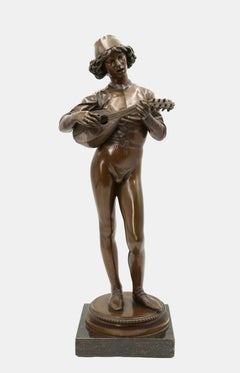
Paul Dubois (1829 Nogent-sur-Seine - 1905 Paris), Florentine singer, 1865. Light brown patinated bronze with cast round plinth mounted on a square marble base (3.5 cm high). Total height 53 cm. Bronze dimensions: 49.5 cm (height) x 20 cm (length) x 10 cm (width), weight 5.6 kg. Inscribed on the plinth "P.[aul] DUBOIS", dated "1865", with the foundry's mark "F. BARBEDIENNE FONDEUR" and the signet "REDUCTION MECANIQUE A. COLLAS".
- Patina very occasionally darkened, lute with loss of one tuning peg, otherwise in excellent condition.
- The renaissance of the Renaissance -
The bronze is a precisely executed and masterfully cast contemporary reduction of Paul Dubois 155 cm tall masterpiece "Florentine Singer", which is exhibited in the Musée d'Orsay and for which the artist was awarded the Medal of Honor at the Paris Salon in 1865. The work acted as a beacon, and was followed by a plethora of depictions of juveniles.
Inspired by Donatello and Luca della Robbia, but also by painters such as Piero della Francesca, Benozzo Gozzoli, and Pinturicchio, the "Florentine Singer" is not an epigonal work that pays homage to a vanished era, but a successful attempt to draw vitality from the art of the past and thus give it new life.
The effect of vitality is the core of Italian Renaissance art theory. In order to fulfill itself as art, art had to appear like nature. This naturalism also characterizes the "Florentine Singer". The young man appears to have been taken from life, which is reinforced by the momentary nature of his action. He has just struck a now fading chord. In addition, the natural appearance is enhanced by the detailed shaping of the figurative details, such as the laces with the slightly curved leather of the shoes, the belt buckle, or the ornamentation on the body of the lute. Even the fingernails are clearly defined. Unlike the Renaissance, however, the effect of liveliness here is not based on the "discovery" of nature and the human body, but primarily on the rediscovery of the art of the Quattrocento. The liveliness of the artwork is therefore at the same time a revitalization of this art, so that we can speak of a Renaissance of the Renaissance, just as the Pre-Raphaelites in England at the same time transferred the Quattrocento to contemporary art.
Dubois takes on the most difficult of all subjects, the depiction of singing through silent sculpture. He was preceded in this by Luca della Robbia and Donatello with their pulpits of singers created in the 1430s in the Museo dell'Opera del Duomo in Florence. Compared to these works, the physiognomy of Dubois singer is far less animated, yet he also depicts singing in a convincing manner. He uses the whole body. He takes the ancient contrapposto, which was essential to Renaissance sculpture, and transforms the standing leg-playing posture into a late medieval S-swing, giving the body an elegant beauty and at the same time setting it in melodic motion. In the equally elegant finger position, the music is expressed in a much more literal way with the beating of the lute. Finally, the musicality of the sculpture culminates in the face with the mouth open to sing.
Through the act of singing, which is a great challenge to the artistic will to depict perfect beauty, the gracefulness of the classical face is not diminished, but enhanced. Starting from the face with the singing mouth and the gaze absorbed by the sounds, the inner vitality spreads, giving the bronze sculpture an intense aura, enhanced by the music. Dubois transfers the beauty of the Renaissance to the musical, sublimating the visible sculpture to the invisible of music.
He took up the challenge of transcending the Renaissance with the Renaissance, thus responding to the Querelle des Anciens et des Modernes, which arose at the end of the 17th century around the French Academy and remained virulent into the 19th century, in which antiquity was regarded either as an unattainable ideal or as a standard to be surpassed. With his work, Dubois proved that the Renaissance, which had championed the art of the ancients, could lead to a new renaissance of art.
About the artist
Paul Dubois' great-uncle was the famous French Baroque sculptor Jean-Baptiste Pigalle, in whose footsteps the talented great-nephew followed. When he debuted at the Paris Salon in 1858, he signed his work "Dubois-Pigalle". At his father's request, however, he first studied law before devoting himself to sculpture under the tutelage of François Christophe Armand Toussaint in 1856 and entering the École des Beaux-Arts in 1858. From 1859 to 1863, he lived in Rome and traveled to Naples and Florence. Inspired by Florentine art of the quattrocento, Dubois initiated a school-forming neo-Florentine style that combined the elegantly simple forms of youthful grace with a precise wealth of detail.Two purchases by the French state (“envois de Rome”) were made during his stay in Rome, which brought him recognition in Paris. After his return there, he quickly became an internationally sought-after artist.
Dubois was also active as a creator of monuments. His most famous work is the equestrian statue of Joan of Arc (1896) on the forecourt of Reims Cathedral. He was also a sought-after portraitist who produced around 50 busts and - Dubois was also a passionate painter - around 100 portraits in oil.
From 1873 to 1878 he was curator of the Museum du Luxembourg, in 1876 he became a member of the Institut de France and from 1878 to 1905 he was director of the École des Beaux-Arts.
In 1865, Dubois was awarded the Paris Salon Medal of Honor for his “Florentine Singer”. In 1867 he became Chevalier, in 1874 Officier, in 1886 Commandeur of the Légion d'honneur, which awarded Dubois the Grande Croix in 1896.
Selected Bibliography
Stole, Elmar: Paul Dubois. In: Saur. Allgemeines Künstlerlexikon, vol. 30, Munich - Leipzig 2001, pp. 677-678.
GERMAN VERSION
Paul Dubois (1829 Nogent-sur-Seine - 1905 Paris), Florentinischer Sänger, 1865. Hellbraun patinierte Bronze mit gegossener runder Plinthe auf quadratischem Marmorsockel montiert (3,5 cm Höhe). Gesamthöhe 53 cm. Maße der Bronze: 49,5 cm (Höhe) x 20 cm (Länge) x 10 cm (Breite), Gewicht 5,6 kg. Auf der Plinthe mit „P.[aul] DUBOIS“ bezeichnet, auf „1865“ datiert, mit dem Gießereistempel „F. BARBEDIENNE FONDEUR“ und dem Signet „REDUCTION MECANIQUE A. COLLAS“ versehen.
- Patina sehr vereinzelt nachgedunkelt, Laute mit Verlust eines Stimmwirbels, ansonsten ausgezeichnet erhalten.
- Die Renaissance...
Category
1860s Realist Figurative Sculptures
Materials
Bronze
You May Also Like
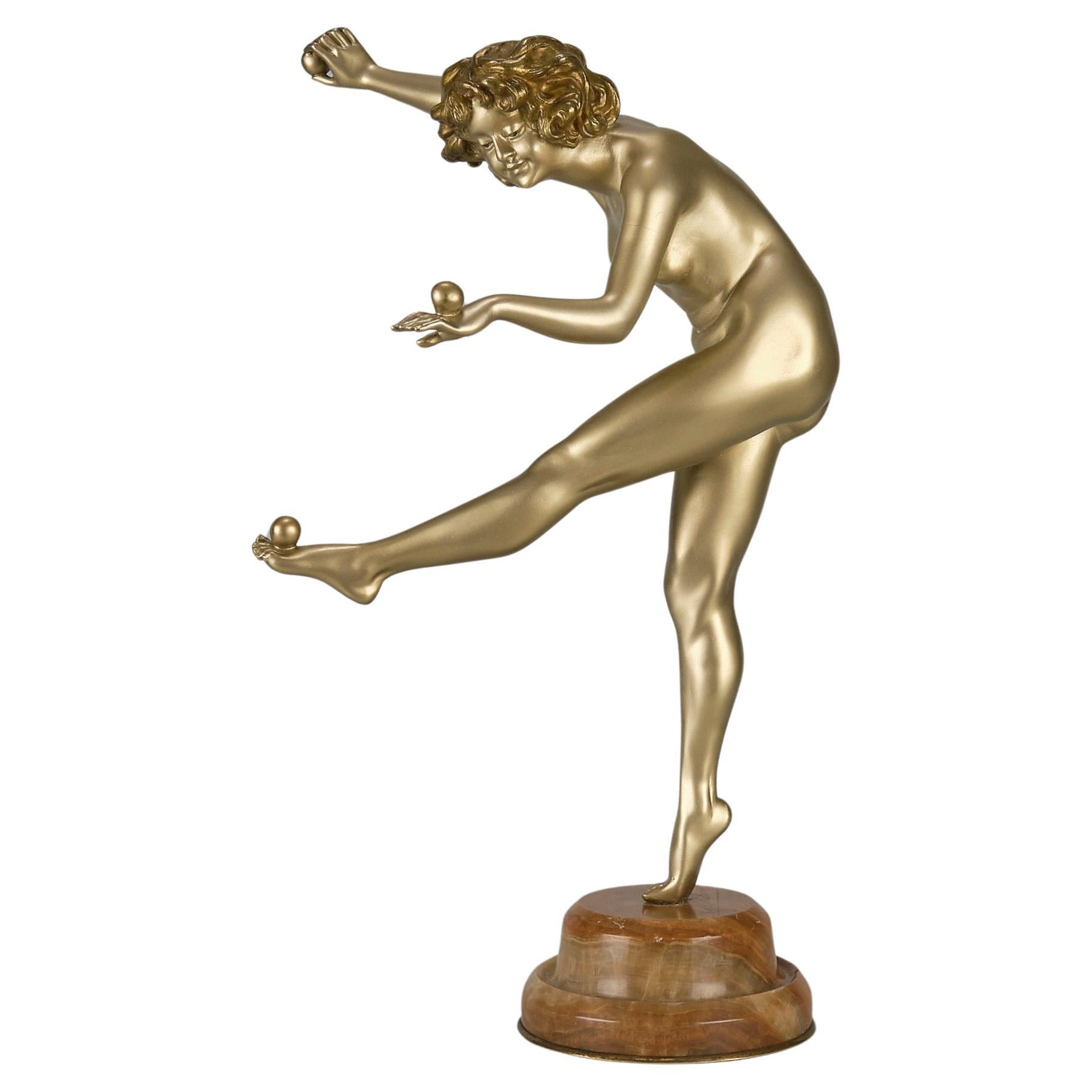
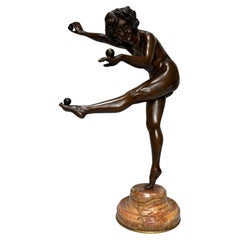
Claire Jeanne Colinet Bronze Art Deco Juggler
By Claire Jeanne Roberte Colinet
Located in NANTES, FR
Art Deco bronze circa 1930.
This "Juggler" model is the largest sculpture created by C.J. Colinet.
Bronze with chocolate patina.
On a circular marble ba...
Category
Mid-20th Century Belgian Art Deco Figurative Sculptures
Materials
Marble, Bronze
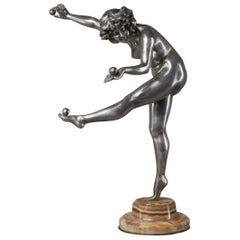
The Juggler
, an Art Deco Bronze Figure, by Claire J. R. Colinet, circa 1925
By Claire Jeanne Roberte Colinet
Located in Brighton, West Sussex
'The Juggler' - A fine Art Deco silvered bronze figure, by Claire J. R. Colinet.
French, circa 1925.
Engraved to base 'CL J.R. Colinet'.
This dramatic and large silvered b...
Category
Early 20th Century French Art Deco Figurative Sculptures
Materials
Bronze
Early 20th Century Art Deco Bronze entitled "The Juggler" by Claire Colinet
By Claire Colinet
Located in London, GB
Charming early 20th Century French Art Deco gilt and enamel bronze figure of a dancer in balanced pose holding juggling balls, with very fine gilt and enamel colour and excellent det...
Category
Early 20th Century Belgian Art Deco Figurative Sculptures
Materials
Bronze

French Art Deco Bronze Figure
Trickstress
by CJR Colinet
By Claire Jeanne Roberte Colinet
Located in Van Nuys, CA
Original Art Deco Era 'The Trickstress' nude Female silver-colored bronze Sculpture by Belgian artist Claire Jeanne Roberte Colin featuring a woman juggling small gilt balls and bala...
Category
Early 20th Century French Art Deco Sculptures
Materials
Marble, Bronze

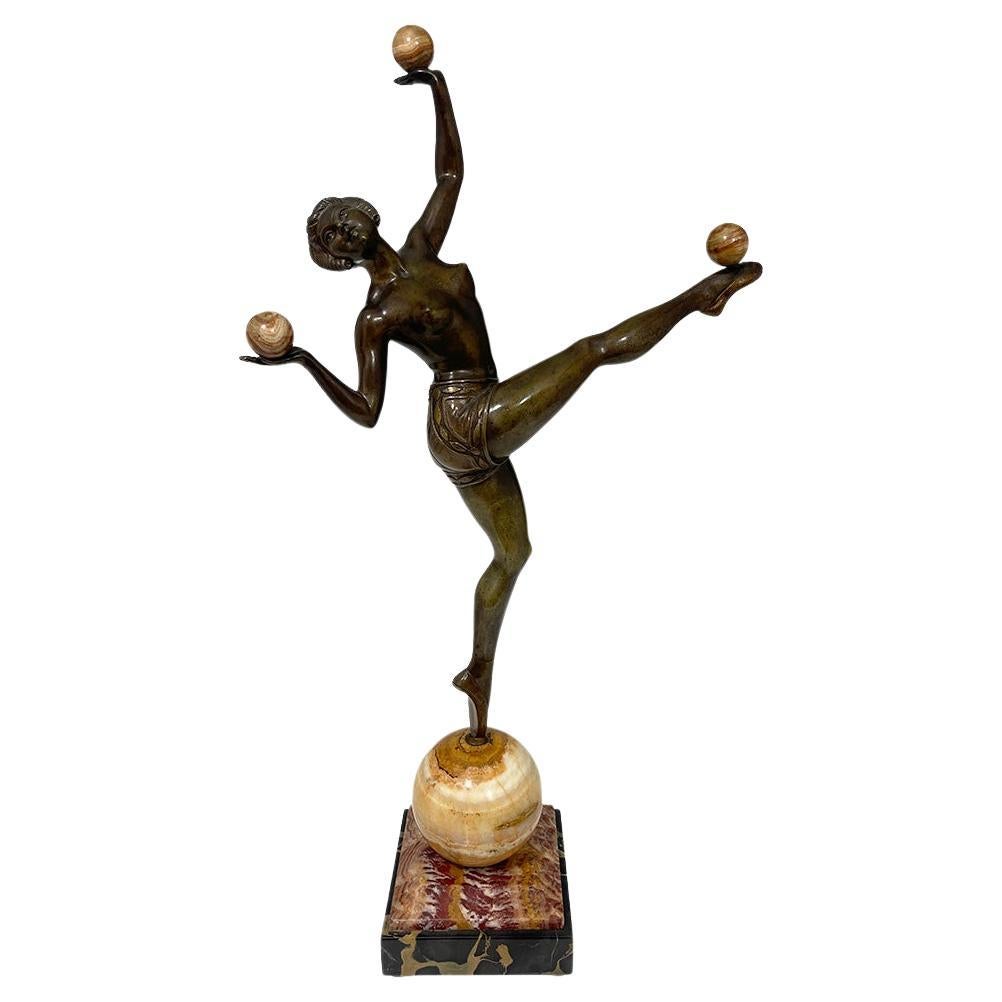
An Art Deco French bronze statue by Charles Henri Molins
Located in Delft, NL
An Art Deco French bronze statue by Charles Henri Molins
A bronze statue with a dancer juggling marble balls in Art Deco Style, raised on a square marble foot by Charles Henri Molin...
Category
Early 20th Century French Figurative Sculptures
Materials
Bronze
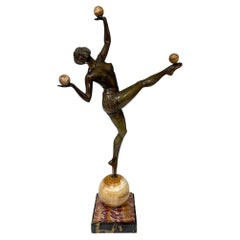
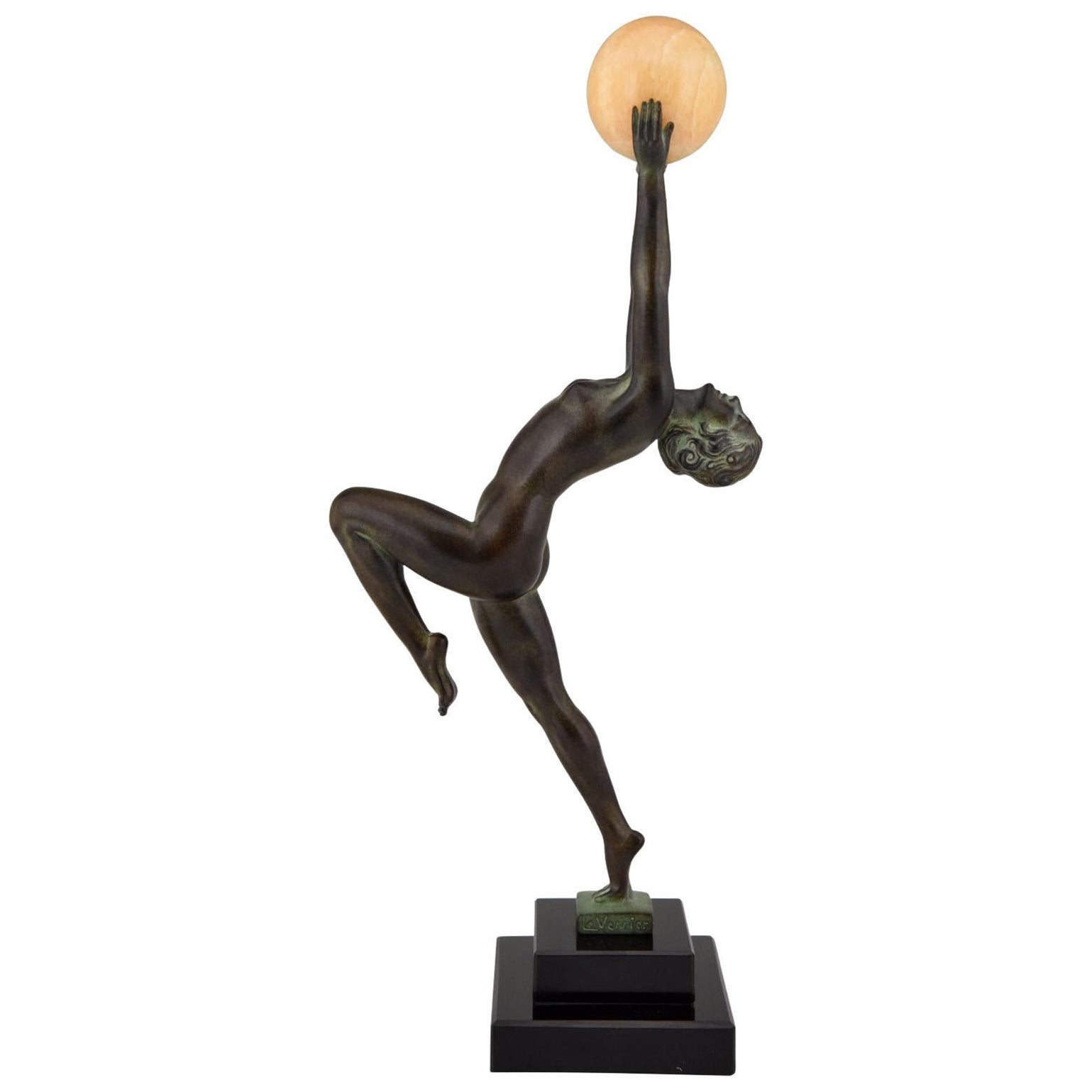
Art Deco style sculpture of a dancer JEU by Max Le Verrier
By Max Le Verrier
Located in Antwerp, BE
Art Deco style sculpture of a dancer with ball Jeu signed by Max Le Verrier.
With the Le Verrier foundry mark.
Design 1930.
Posthumous contemporary cast of the Le Verrier foundry.
...
Category
2010s French Art Deco Figurative Sculptures
Materials
Belgian Black Marble, Metal
More Ways To Browse
Art Deco Bronze Sculpture Nude
Art Deco Sculpture Nude
Antique Bronze Nude
Art Deco Bronze Nude
Juggler Sculpture
Piano Artwork
Planetary Folklore
Pomeranian Dog
Portrait Of Cows
Portrait Of Dora Maar
Raccoon Painting
Racing Race Painting
Richard Bankes Harraden
Robert Buck
Robert Colquhoun
Robert Rey
Roman Architectural Engraving
Ruby Throated Hummingbird