Items Similar to Laocoön and his Sons, an exceptional bronze sculpture by Giacomo Zoffoli
Want more images or videos?
Request additional images or videos from the seller
1 of 11
Giacomo ZoffoliLaocoön and his Sons, an exceptional bronze sculpture by Giacomo Zoffolicirca 1775 - 1785
circa 1775 - 1785
$80,136.02
£59,505.48
€67,000
CA$110,094.87
A$119,695.33
CHF 63,462.60
MX$1,434,843.50
NOK 806,577.08
SEK 738,934.26
DKK 510,754.95
About the Item
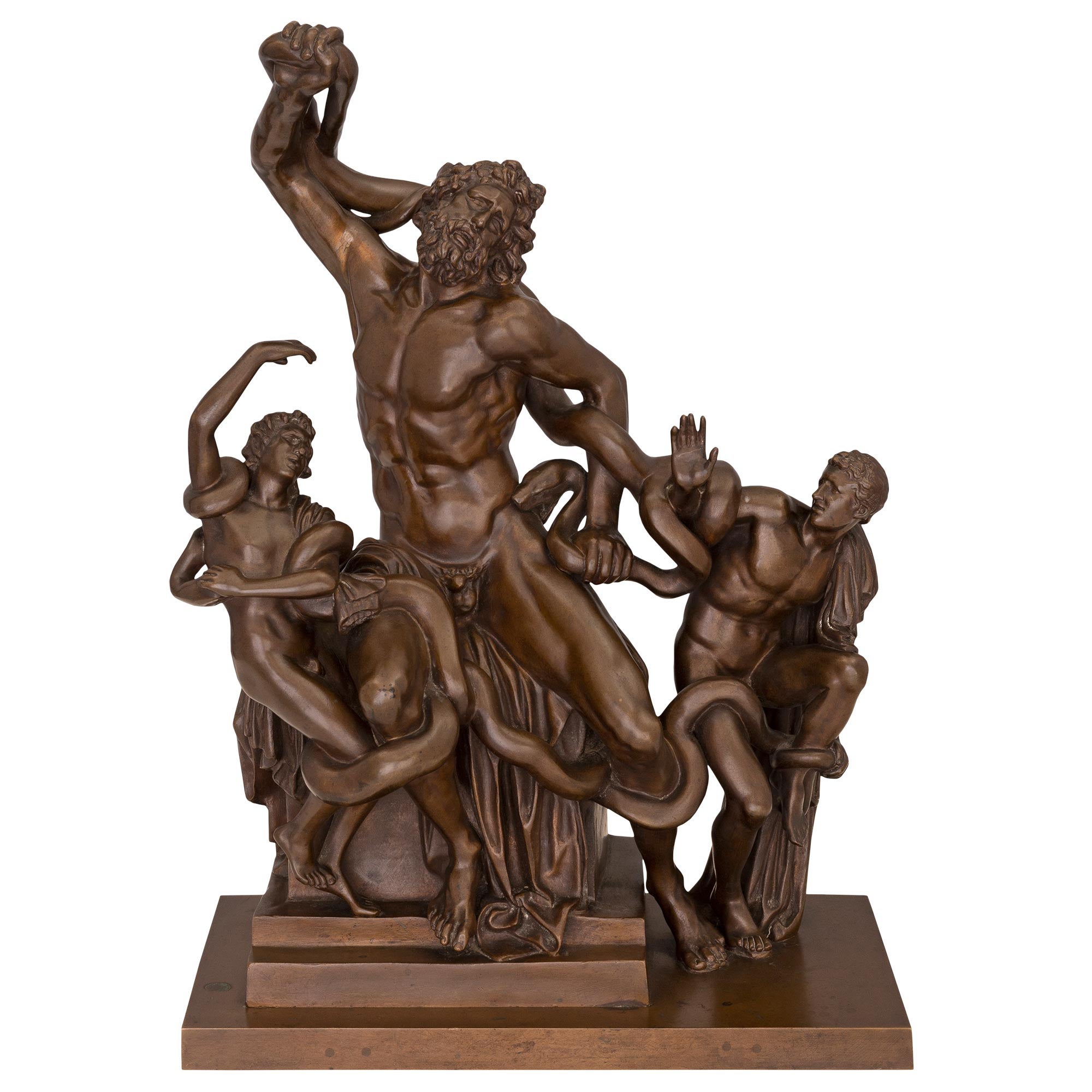
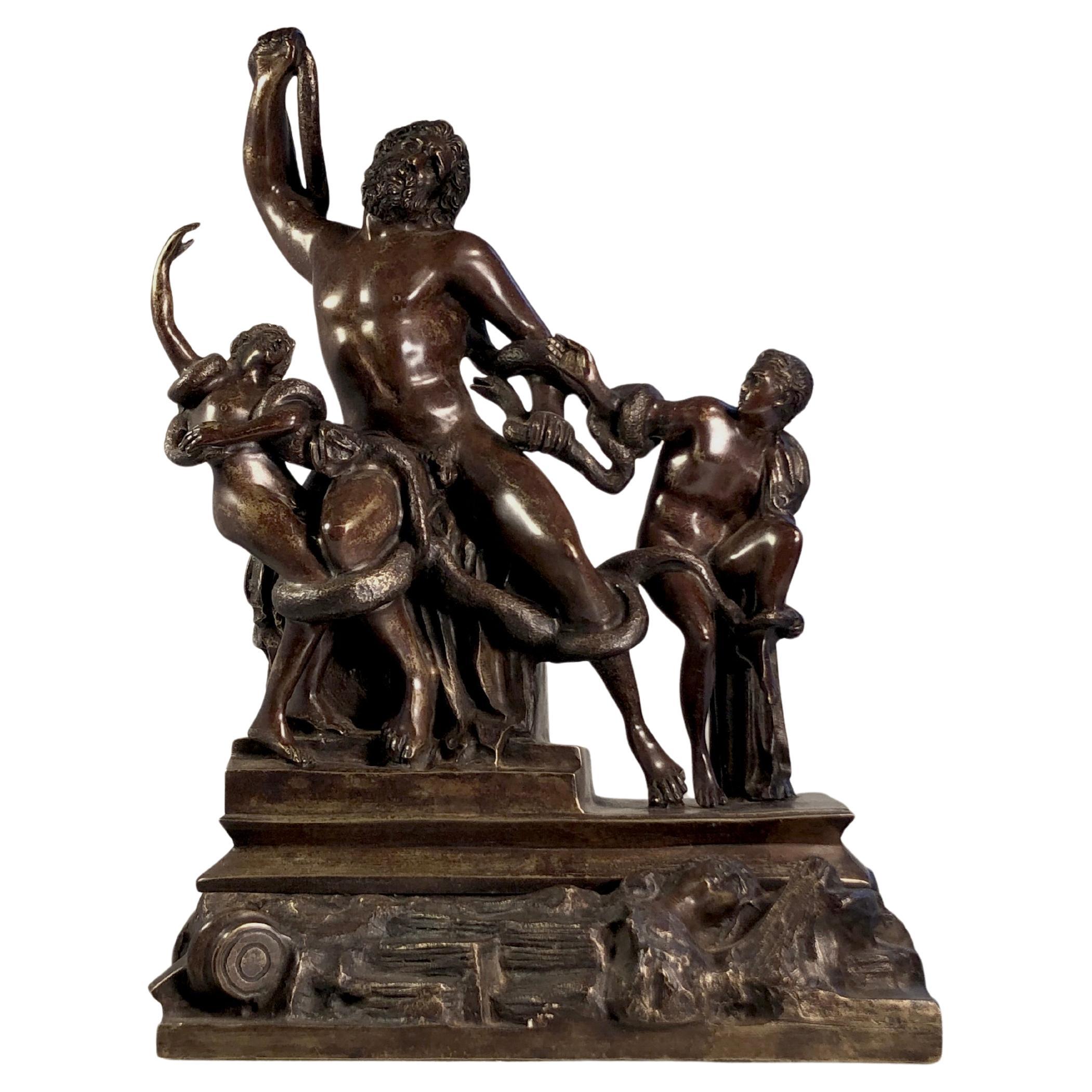
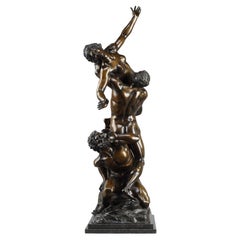
This exceptional bronze group (unpublished), executed in Rome in the second half of the 18th century, bears witness to the fascination with the Laocoön since its discovery on January 14, 1506 on the Esquiline, the site of Nero's Golden House and Titus' baths.
The Grand Tour, the initiatic journey undertaken by young English aristocrats, led to the development in Rome of workshops specializing in antique reproductions. The Zoffoli workshop was the first to receive its patent in 1775; this Laocoön (of which we have identified only two copies, including the one we are presenting) is one of the most prestigious pieces produced by the Zoffoli, as attested by their signature on its side.
1. The Laocoon, a famous group from Antiquity
Appearing in the Little Iliad by Arctinos of Miletus, an epic poet of the 8th or 7th century BC, and repeated in the famous account of Troy's destruction by Aeneas in Dido's palace, in Canto II of Virgil's Aeneid, the story of Laocoön is that of a priest of Poseidon (or Apollo) who dies smothered by two snakes emerging from the sea after warning the Trojans against the Trojan Horse, which had been deposited on the shore as an offering to Poseidon. His two accompanying sons also fall prey to the same monsters.
The discovery in 1506 of fragments of a colossal marble group depicting Lacoön was a real event: a link was immediately established with the statue mentioned by Pliny the Elder in Book XXVI of his Natural History. He claims to have seen a sculpture featuring Laocoön and his Sons caught in the rings of prodigious reptiles in the house of Titus, and attributes this sculpture to the three sculptors Hagèsandros, Polydôros and Athanadôros, all from Rhodes. However, the analysis of the monument reveals that, contrary to what Pliny the Elder wrote, it is composed of several blocks of marble, and not carved from a single block ("ex uno lapide"). This point has led to controversy over the exact nature of the discovery: was it indeed the marble admired by Pliny the Elder, or just a copy?
This controversy took a new turn after the discovery of a stone bearing the signatures of the three artists cited by Pliny the Elder in connection with the Laocoön, in the grotto of Sperlonga, south of Rome, which was part of a villa last built by the emperor Tiberius.
Since then, two main theories have been put forward, with no decisive evidence to support a definitive choice. For some, the Vatican marble is a copy made by Rhodian sculptors at the beginning of the 1er century, at the time of Tiberius, from a bronze (now lost) executed around 140 BC in Pergamon. This sculpture would then have been handed down to Titus. For the others, the Laocoon is indeed a creation produced between 40 and 20 BC by the three Rhodian sculptors established in Italy since the middle of the 1er century BC.
Whatever its date of creation, this sculpture was executed with immense virtuosity, and the sculptors succeeded in extracting complex, expressive forms from the marble that still touch us today. A tour de force without equal in antique statuary, this group has been the object of fascination ever since its creation, as evidenced by the admiration of Pliny the Elder, Michelangelo and Goethe.
2. An eventful history since its rediscovery
The genesis of the group's reconstruction from fragments found on the Esquiline is poorlydocumented, although the names of Baccio Bandinelli and Giovanni Angelo Montorsoli, one of Michelangelo's collaborators, have been put forward. The discovery by L. Pollack in 1905 of Laocoon's right arm amidst the antique debris of a Roman stonemason’s workshop remains an astonishing milestone in the reconstruction of the group. The arm was reinstalled as part of a complete restoration of the monumental group between 1957 and 1959 (as shown in the last photography of the gallery).
The more bent-back position of the arm placed Laocoön's hand at the nape of his neck. This position is more consistent with the strong contraction of his torso muscles. Our bronze is an interesting testimony of the historical state, prior to this reintegration, of this much-admired group since its rediscovery during the Renaissance.
The quality of the Laocoön has always aroused covetousness. The King of France Francis 1st wished to acquire it and Pope Clement VII proposed him a copy, which was completed by Baccio Bandinelli in 1525. The quality of this copy led the Pope to change his mind : this statue became part of his family's collections in Florence (where it is still kept at the Uffizi Museum) and Clement VII sent some other antique statues to the King. François 1st nevertheless obtained the right to have a plaster cast made around 1540, under the direction of Primaticcio, from which the bronze preserved until now at Château de Fontainebleau is derived.
Napoleon completed François 1st's dream and brought the Laocoön back to Paris to adorn the Louvre National Museum; however, the group was returned to the Vatican's Pio-Clementin Museum after the emperor's abdication in 1815.
3. A major source of inspiration since the Renaissance
The statue's impact on the history of the arts is considerable: while numerous sculptors (Sansovino, Susini...) created small-scale bronzes inspired by the Laocoön as early as the Renaissance, the group also greatly inspired draftsmen, engravers and painters through the distribution of these engravings. In addition to the Greco's Laocoön, Laocoön's position can also be found in paintings as diverse as Titian's Coronation of Thorns and Rubens' Hercules and Omphale, to name just two examples in the Louvre.
This vogue for the Laocoön was of course exacerbated when, in the second half of the 18th century, Rome became, along with Naples and ahead of Venice, the main destination for young aristocrats on their Grand Tour. A good illustration of this craze is Pompeo Batoni's portrait of Thomas Dundas, executed in 1764 in Rome, with the Laocoön in the background.
4. A masterpiece from the Zoffoli workshop, of outstanding rarity
The development of Grand Tour "tourism" also spawned a souvenir industry. Aimed at a wealthy clientele, they were often made from precious materials (marble, bronze, hard stones, porcelain). The Zoffoli brothers were the first to open a workshop offering bronze reproductions of antiques, followed by the Righetti family, who obtained their patent in 1783, then by the Volpato family, who founded a porcelain factory in 1785, and finally by Giuseppe Boschi, who was active between 1785 and 1810.
The quality of the Zoffoli brothers' bronzes had already impressed their contemporaries. In 1795, Charles Heathcote Tatham wrote to Henry Holland: "the bronze used by the Italians [in comparison with French foundries] is of the best metal, with what they call a patina, meaning the outward color, of a good nature [...] and above all their execution is superlatively good, having artists employed who study the antique with attention and model with great ingenuity and taste".
As evidence of the Zoffoli brothers' activity, we have a catalog of their productions , in which our Laocoön appears at the top of the list, to the right of the no less famous Apollo of Belvedere. Offered at a price of 50 gold sequins, while the Apollo cost was only 16 sequins, the Laocoön was the second most expensive item, after the statues of Orestes and Electra from the Ludovisi collection, which were offered at 80 sequins (no copy of which has been found).
This high price probably explains why so few copies are known today, as we have only found another one, also signed by Zoffoli, with a slightly different signature. At the time of its presentation for sale at Sotheby's in London in April 2004, the catalog editor believed it to be a unique example, based on his exhaustive survey of major collections of Zoffoli bronzes, such as those held at Saltram Park (Devon - UK), the Nationalsmuseum in Stockholm (Sweden) and Schloss Wörlitz (Dessau - Germany).
Also featured prominently in this catalog was a pair of Centaurs, known as Capitoline or Furietti (after their first owner), which was sold for 45 gold sequins. A pair of these Centaurs sold for the equivalent of €156,750 on November 9, 2012 at Sotheby's.
This pair of centaurs has in common with our Laocoön a black patina (probably executed in the 19th century), under which the orange sheen of the bronze can be seen. The quality of execution of the details in our copy, which was probably achieved by the meticulous assembly of 6 or 7 separately cast pieces, is remarkable from every point of view. Below are a few photos (featuring the head of Laocoön, the one of his son or details of the snake, the toenails, and the finesse of the armature) which illustrate the extraordinary quality of execution of this piece.
Main bibliographical references :
H. Honour - Bronze statuettes by Giacomo and Giovanni Zoffoli - The Connoisseur, November 1961, pages 198 - 205
F. Haskell
N. Penny - Taste and the Antique - Newhaven
London 1981
I. Pfeiffer - Giacomo Zoffoli. Kleinbronzen aus Schloss Wörlitz - Weltkuntz - December 24, 1996 pages 3232 - 3234
J.P. Cuzin, J.R. Gaborit, A. Pasquier - D'après l'Antique - catalog of the Musée du Louvre exhibition (October 16, 2000 to January 15, 2001) - RMN, 2012
A. Hilliam - Longing for the Antique: Collecting the bronze statuettes of eighteenth-century Rome - Master of Studies, University of Oxford 2013
- Creator:Giacomo Zoffoli (1731 - 1785, French)
- Creation Year:circa 1775 - 1785
- Dimensions:Height: 10.13 in (25.74 cm)Width: 14.82 in (37.65 cm)Depth: 6.5 in (16.51 cm)
- Medium:
- Movement Style:
- Period:1770-1779
- Condition:Signed on the base: GIACOMO : ZOFFOLI : F Provenance : private collection - Paris - France.
- Gallery Location:PARIS, FR
- Reference Number:1stDibs: LU1568213166252
About the Seller
5.0
Vetted Professional Seller
Every seller passes strict standards for authenticity and reliability
Established in 2020
1stDibs seller since 2021
11 sales on 1stDibs
Typical response time: 1 hour
- ShippingRetrieving quote...Shipping from: PARIS, France
- Return Policy
More From This Seller
View AllSébastien (Sebastian), a nude bronze sculpture by Lili Mirante
Located in PARIS, FR
Lili Mirante (Paris, 1966 – last picture in the gallery) is a woman artist who lives and works in Paris. Born into a family of artists (her father was a renowned watercolorist), she ...
Category
2010s Modern Nude Sculptures
Materials
Bronze
Diana and Actaeon, a Mannerist painting after Joseph Heintz the Elder
Located in PARIS, FR
This painting seduced us with its rich colors. Depicting Diana and her companions surprised by Actaeon, it was inspired by an engraving by Aegidius Sadeler II after a painting by Jos...
Category
17th Century Old Masters Nude Paintings
Materials
Oil, Wood Panel
Harmonie (Harmony), a bronze nude sculpture by Lili Mirante
Located in PARIS, FR
Lili Mirante (Paris, 1966 – last picture in the gallery) is a woman artist who lives and works in Paris. Born into a family of artists (her father was a renowned watercolorist), she ...
Category
2010s Modern Nude Sculptures
Materials
Bronze
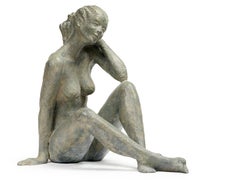
Loulou, a nude bronze sculpture by Lili Mirante
Located in PARIS, FR
Lili Mirante (Paris, 1966 – last picture in the gallery) is a woman artist who lives and works in Paris. Born into a family of artists (her father was a renowned watercolorist), she ...
Category
2010s Modern Nude Sculptures
Materials
Bronze
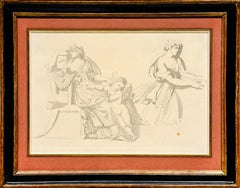
Frieze of antique figures, a drawing by the sculptor Antoine-Denis Chaudet
Located in PARIS, FR
Faithful to the neo-classical taste, sculptor Antoine-Denis Chaudet presents us with a frieze of antique figures executed in gray wash over pencil strokes, which is likely inspired b...
Category
Early 1800s Old Masters Figurative Drawings and Watercolors
Materials
Paper, Ink, Pencil
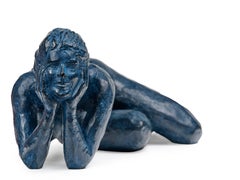
Douceur féminine (Feminine Softness) a bronze nude sculpture by Lili Mirante
Located in PARIS, FR
Lili Mirante (Paris, 1966 – last picture in the gallery) is a woman artist who lives and works in Paris. Born into a family of artists (her father was a renowned watercolorist), she ...
Category
2010s Modern Nude Sculptures
Materials
Bronze

You May Also Like
French 19th Century Patinated Bronze Statue of Laocoön and His Sons
By Ferdinand Barbedienne
Located in West Palm Beach, FL
A most impressive and high quality French 19th century patinated bronze statue of Laocoön and his sons, signed Barbedienne. The bronze is raised b...
Category
Antique 19th Century French Figurative Sculptures
Materials
Bronze
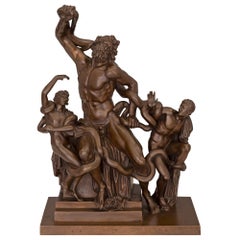
THE LAOCOON GROUP Bronze SCULPTURE by FONDERIA CHIURAZZI, Italy 1880-1890
By Fonderia Chiurazzi
Located in PARIS, FR
A patinated bronze sculpture reproduction of the Laocoon group by the Napolitan world famous Fonderia Chiurazzi, Italy 1880-1900.
Rediscovered in 1506 in Rome The Laocoon Group is believed to be created sometime between 42-20 BCE by three sculptors from Rhodos – Hagesander, Athenodoros and Polydorus, after the work of more ancien Hellenistic sculptors.
Recreated and issued (with several sizes and creative variations) by Fonderia Chiurrazzi, this piece is more than just an incredibly precise and expressive reproduction of the iconic antic sculpture...
Category
Antique 1880s Italian Neoclassical Figurative Sculptures
Materials
Bronze
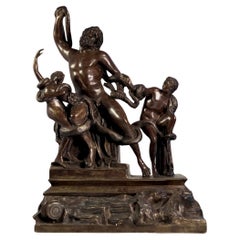
Monumental Bronze Sculpture of Laocoön, Italy, 1950s
Located in Madrid, ES
An extraordinary monumental bronze sculpture depicting the iconic figure of Laocoön and his sons, inspired by the classical Hellenistic masterpiece. Cast in Italy during the 1950s, t...
Category
Vintage 1950s Statues
Materials
Bronze
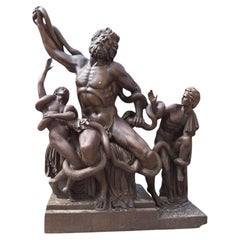
Monumental Bronze Sculpture of Laocoön, Italy, 1950s
Located in Madrid, ES
An extraordinary monumental bronze sculpture depicting the iconic figure of Laocoön and his sons, inspired by the classical Hellenistic masterpiece. Cast in Italy during the 1950s, t...
Category
Vintage 1950s Statues
Materials
Bronze
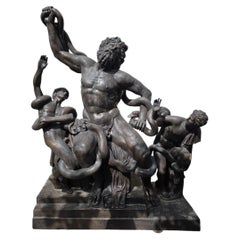
$59,152 Sale Price
20% Off
Giambologna "Rape of the Sabine Woman" Bronze
By Jean de Bologne
Located in Astoria, NY
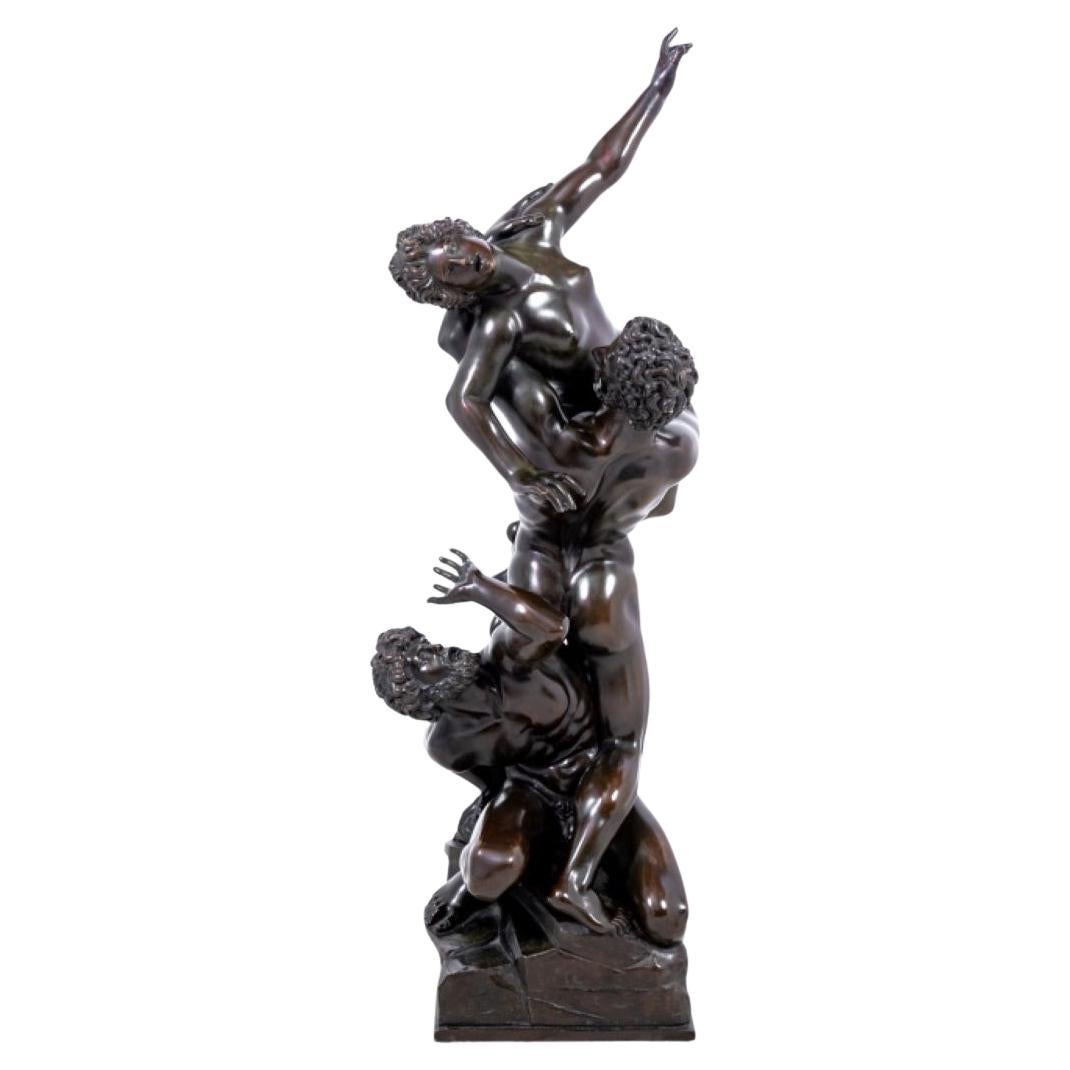
After Giambologna (Jean de Boulogne, Italian, 1529-1608) "Rape of the Sabine Woman" Patinated Bronze Sculpture, French, late 19th century. 42.5" H x 12" W x 12" D. Note: This bronze ...
Category
Antique 19th Century Figurative Sculptures
Materials
Bronze
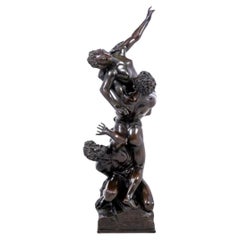
Very Large Bronze "Abduction of a Sabine Woman" After Giambologna, 19th Cent
By Ferdinando de Luca, Giambologna
Located in Paris, FR
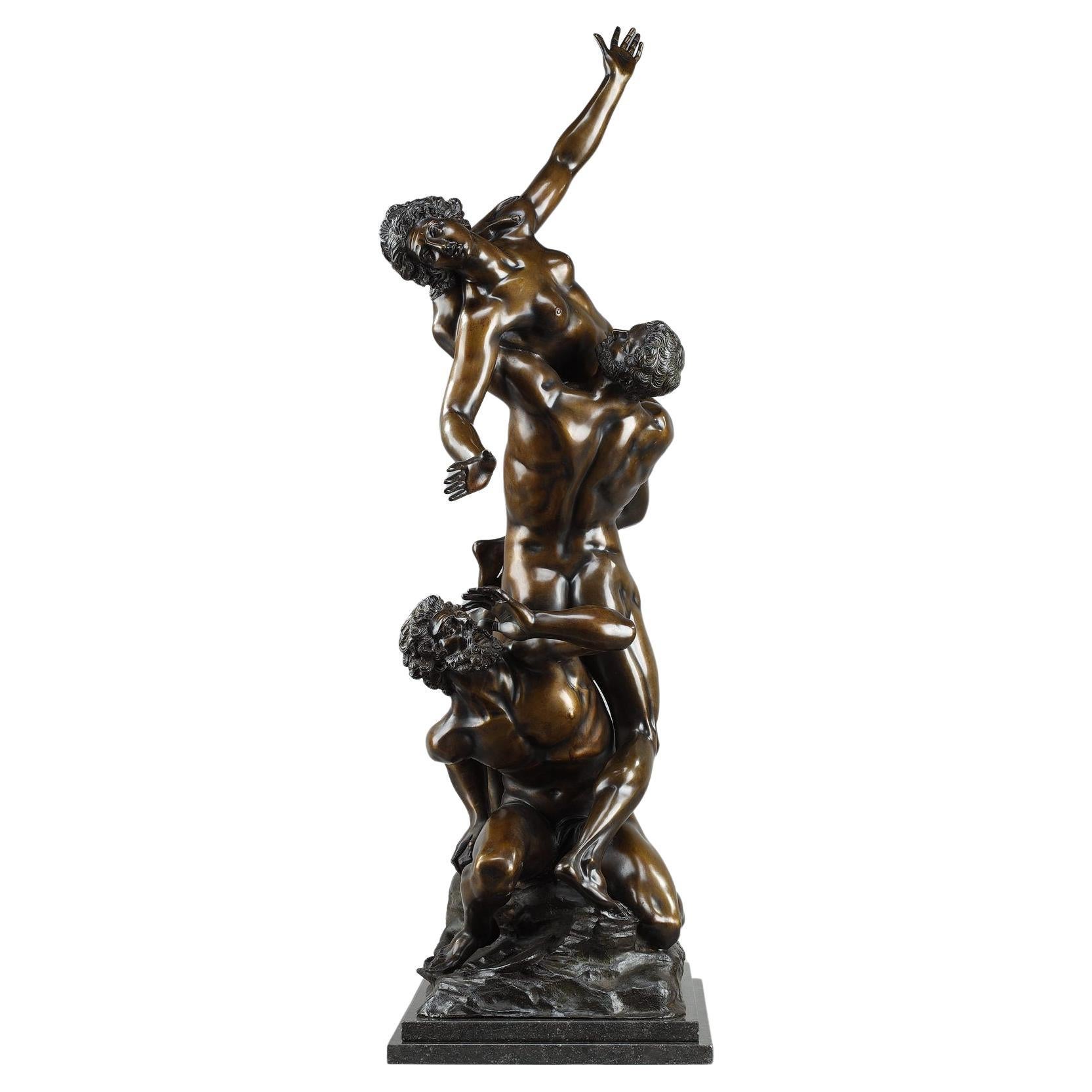
Very large bronze sculpture with brown patina, based on the group "The Rape of the Sabine Women" by John of Bologna (Giambologna). This pivoting composition shows three figures in motion: a man on the ground defeated with his shield turned upside down, a second one arched clutching a woman launched towards the sky trying to escape, all on a naturalistic base. The Sabine man, the Roman and the Sabine woman are all depicted naked. This staging plays on serpentine lines known as "figura serpentinata" and diagonals giving a beautiful variety of volumes and a multiplicity of angles of view. The bronze is signed F. De Luca...
Category
Antique 1880s French Baroque Figurative Sculptures
Materials
Bronze
More Ways To Browse
Antique Bronze Sculpture Signed Art Sculptures
Antique Bronze Nude
Stone Head Sculpture Hand Carved
19th Century Bronze Horse Sculpture
Antique Centaur
Antique Fragment Marble
Statue King
Trojan Horse
Dior Snake
Antique Gold Roman Ring With Two Heads
Laocoon And His Sons
Dido Aeneas
Most Expensive Item
Rodin Iris
African Water Jugs
Marie Paule Deville
Joseph Holmes
Male Marble Nude Wrestling