Want more images or videos?
Request additional images or videos from the seller
1 of 19
UnknownMonumental and Striking Patinated Bronze Figure of Two Male Nude Erotic LoversC. 1920
C. 1920
About the Item
- Creation Year:C. 1920
- Dimensions:Height: 35 in (88.9 cm)Width: 26 in (66.04 cm)Depth: 12 in (30.48 cm)
- Medium:
- Movement Style:
- Period:
- Condition:
- Gallery Location:Queens, NY
- Reference Number:1stDibs: LU115129821172
About the Seller
5.0
Vetted Professional Seller
Every seller passes strict standards for authenticity and reliability
Established in 1980
1stDibs seller since 2019
15 sales on 1stDibs
Authenticity Guarantee
In the unlikely event there’s an issue with an item’s authenticity, contact us within 1 year for a full refund. DetailsMoney-Back Guarantee
If your item is not as described, is damaged in transit, or does not arrive, contact us within 7 days for a full refund. Details24-Hour Cancellation
You have a 24-hour grace period in which to reconsider your purchase, with no questions asked.Vetted Professional Sellers
Our world-class sellers must adhere to strict standards for service and quality, maintaining the integrity of our listings.Price-Match Guarantee
If you find that a seller listed the same item for a lower price elsewhere, we’ll match it.Trusted Global Delivery
Our best-in-class carrier network provides specialized shipping options worldwide, including custom delivery.You May Also Like
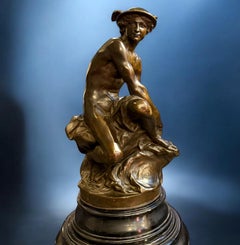
Fabulous Italian Neoclassical Marble Sculpture of Hermes
Located in Rome, IT
19th century French finely chiseled bronze figure of Hermes .
Signed Pigalle G . Cuspinera
Hermes , the messenger of the gods, is sitting on a rock, ready to leap up. He is att...
Category
19th Century Academic Nude Sculptures
Materials
Bronze
Fabulous Italian Neoclassical Marble Sculpture of Hermes
Located in Rome, IT
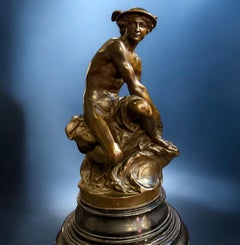
19th century French finely chiseled bronze figure of Hermes .
Signed Pigalle G . Cuspinera
Hermes , the messenger of the gods, is sitting on a rock, ready to leap up. He is att...
Category
19th Century Academic Nude Sculptures
Materials
Bronze
$6,627 Sale Price
20% Off
H 33.47 in Dm 17.72 in
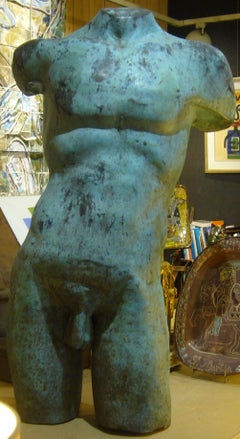
TORSO OF YOUNG BRONZE MAN
Located in Nice, FR
Bust of a young man with green bronze patina.
Category
1960s Academic Nude Sculptures
Materials
Bronze
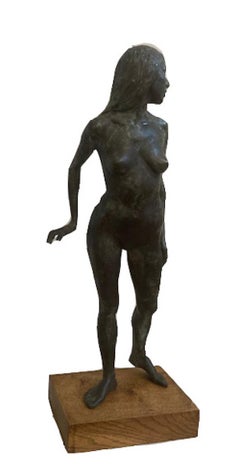
"Wife of Lot"
By Robert Bodem
Located in Sag Harbor, NY
Robert Christian Bodem is a sculptor of figurative work, primarily showing in bronze. He received both his Bachelors and Masters in Fine Arts in Sculpture at Boston University. Durin...
Category
21st Century and Contemporary Academic Figurative Sculptures
Materials
Bronze
Victory - Athletic Young Man in Classical Pose, ( Female Sculptor )
By Evelyn Beatrice Longman
Located in Miami, FL
Evelyn Beatrice Longman was a trailblazing female artist getting major commissions at the very begining of the 20th century.
Having lived in New York City, I used to walk by the life size version of this in Philip Johnson's ATT Building and it left me breathless every time. This classical bronze statue of a victorious and handsome young man is called "Victory...
Category
Early 1900s Academic Figurative Sculptures
Materials
Bronze
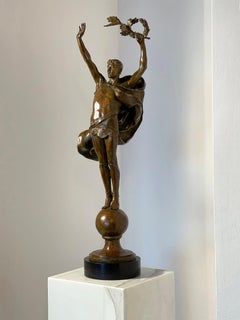
$30,000
H 28 in W 7 in D 7 in
Standing Ballerina Sculpture, Bronze, Academic Style, Signed, 2/5
Located in Zofingen, AG
Sculpture from the Ballet series. The series is dedicated to classical ballet and includes over 30 sculptur...
Category
Early 2000s Academic Figurative Sculptures
Materials
Metal, Bronze
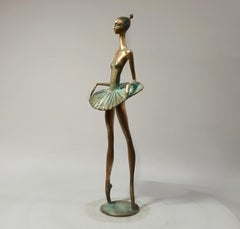
$2,603
H 10.63 in W 3.55 in D 1.97 in
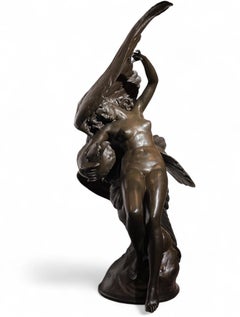
Jean Coulon - Aegina and Zeus Bronze Statue
Located in New York, NY
Aegina was one of the daughters of the river god Asopus and his wife, the river nymph Metope. The couple had many daughters, and most of them became the object of desire of either Ze...
Category
19th Century Academic Nude Sculptures
Materials
Bronze
"Echo" Oscar Lenz, Lyrical Early American Allegorical Female Nude Sculpture
Located in New York, NY
Oscar Lenz
Echo, 1904
Signed and dated on base: Oscar L Lenz 1904
Bronze
70 1/4 x 25 x 25 1/4 inches
Oscar Lenz was an American sculptor born at Providence, Rhode Island. He receiv...
Category
Early 1900s Academic Nude Sculptures
Materials
Bronze
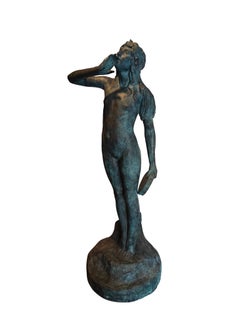
$45,000
H 70.25 in W 25 in D 25.25 in
Life Size Female Figure Sculpture – Contemporary Figurative Art by Zura
Located in Brooklyn, NY
“Female Figure” (2023) by Zura is a life-size sculpture measuring 39 × 16 × 12 inches (99.1 × 40.6 × 30.5 cm), crafted in plaster with an option for bronze casting. This unique work ...
Category
21st Century and Contemporary Academic Figurative Sculptures
Materials
Bronze
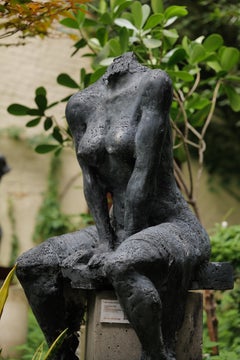
$29,000
H 47 in W 19 in D 20 in
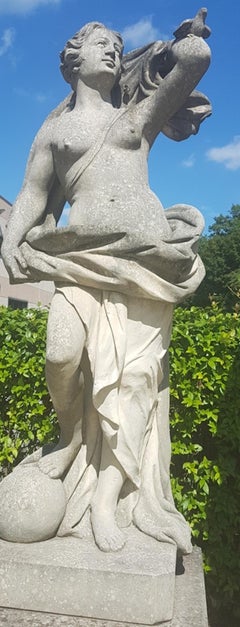
Italian Limestone Garden Sculptures of Aria a Roman Goddness
Located in Rome, IT
Finely carved mythological subject in Lecce limestone of Aria a Roman Goddness .
Excellent condition from an estate of Veneto.
Measurements: Statue cm 160, base cm 85.
Category
20th Century Academic Figurative Sculptures
Materials
Limestone
More From This Seller
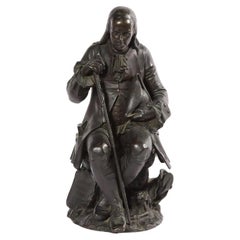
View AllRare Patinated Bronze Sculpture of Benjamin Franklin, by A. Carrier-Belleuse
By Albert-Ernest Carrier-Belleuse
Located in Queens, NY
Albert-Ernest Carrier-Belleuse (France, 1824-1887)
A rare seated bronze statue of Benjamin Franklin holding his walking stick and hat, with a book in his ri...
Category
19th Century Academic Figurative Sculptures
Materials
Bronze
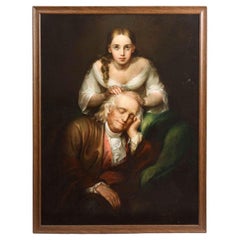
Lilly Martin Spencer (American, 1822-1902) God Bless My Father Portrait Painting
By Lilly Martin Spencer
Located in Queens, NY
Lilly Martin Spencer (American, 1822-1902) A Rare Portrait God Bless My Father.
**Figure 84 from principal book/catalogue on Lilly Martin Spencer.
19th Century.
Oil on canvas, signed
Lilly Martin Spencer was one of the most popular and American female genre painters in the mid-nineteenth century. She primarily painted domestic scenes, paintings of women and children...
Category
19th Century Academic Portrait Paintings
Materials
Oil
Lilly Martin SpencerLilly Martin Spencer (American, 1822-1902) God Bless My Father Portrait Painting
$59,200 Sale Price
60% Off
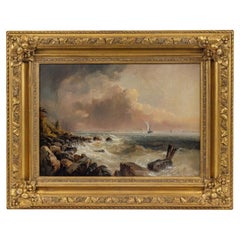
Alfred Copestick, Coastal Scene: New York, Oil on Canvas, 1857
Located in Queens, NY
Alfred Copestick (1837–1859)
Coastal Scene: New York, 1857
Oil on canvas, in the original giltwood frame
14 ¼ x 20 ⅛ in. (canvas)
Signed lower right: A. Copestick NY 1857
Painted at just twenty years of age, Coastal Scene: New York demonstrates Alfred Copestick’s remarkable promise as a marine painter in antebellum America. The scene brims with energy: a single sailboat heels sharply into the wind, its rigging taut against the storm, while foamy waves break against a rugged shoreline. Above, clouds mass and dissolve, illuminated by shafts of storm-lit light. Copestick’s treatment is both romantic and naturalistic, conveying the sublime tension between man, sea, and sky. His confident brushwork captures atmosphere with an immediacy and sensitivity rarely found in so young an artist.
The work survives in its original giltwood frame, richly carved in a mid-nineteenth-century American style, which not only underscores its historical authenticity but also heightens the tonal drama of the painting.
Alfred Copestick came of age during a fertile moment in American painting, when marine art and landscape were central to cultural identity. Though little is known of his formal training, his works suggest familiarity with and admiration for leading marine painters such as James E. Buttersworth, famed for his racing yachts; Francis Augustus Silva, who later developed a luminist style of coastal painting; and earlier masters like Thomas Birch, whose shipwrecks and storm scenes set a precedent for drama at sea.
Copestick also absorbed broader currents in American landscape painting. The Hudson River School, led by Thomas Cole, Asher B...
Category
19th Century Academic Landscape Paintings
Materials
Canvas, Oil
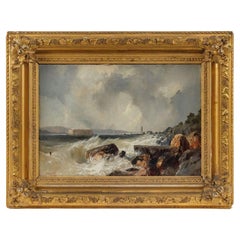
Alfred Copestick, Fort Hamilton from the Narrows, New York, 1857
Located in Queens, NY
Alfred Copestick (1837–1859)
Fort Hamilton from the Narrows, New York, 1857
Oil on canvas, in the original giltwood frame
14 ¼ x 20 ⅛ in. (canvas)
Signed lower left: A. Copestick NY 1857
Painted when Copestick was only twenty years old, Fort Hamilton from the Narrows, New York captures both the military fortifications and maritime vitality of New York Harbor at mid-century. In the foreground, the fortress bastion commands the shoreline, while sail and steam vessels traverse the Narrows — the strategic waterway linking Upper New York Bay to the Atlantic. Copestick conveys not only the architectural solidity of Fort Hamilton but also the shifting atmosphere above, where cloud formations build and dissolve across a wind-driven sky.
The painting is a remarkable marriage of documentary precision and romantic sensibility. The young artist’s brush imbues the fortress with weight and presence, yet the broader scene is alive with the transience of weather and the ceaseless motion of the sea. In its original giltwood frame, richly carved and preserving the period character, the canvas is a rare survival of a gifted hand cut short in its prime.
This canvas reveals Copestick’s deep engagement with the maritime traditions of American art. The careful delineation of sailing vessels recalls the precision of James E. Buttersworth, while the atmospheric breadth echoes the influence of Fitz Henry Lane and John F. Kensett. The choice of subject — the strategic Narrows and its fortress — also reflects the national mood of the 1850s, when American identity was bound up with its coasts, harbors, and defenses.
The romantic skies and dramatic contrasts suggest the impact of the Hudson River School, particularly the legacy of Thomas Cole and Asher B...
Category
19th Century Academic Landscape Paintings
Materials
Canvas, Oil
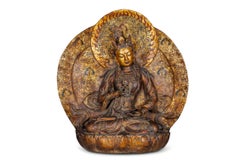
A Monumental Gilt-Lacquered Bronze Ornamental Sculpture of Vajravidarana
Located in Queens, NY
A Monumental Gilt-Lacquered Bronze Ornamental Buddha Sculpture of Vajravidarana:
A Masterpiece of Sino-Tibetan Craftsmanship, Late 19th Century, Qing Dynasty
This monumental gilt-lacquered bronze ornamental sculpture of Vajravidarana is an extraordinary and commanding piece of art, showcasing the pinnacle of Sino-Tibetan craftsmanship from the late 19th century. The figure of Vajravidarana, a powerful purification deity in Tibetan Buddhism, is meticulously sculpted to embody both spiritual authority and artistic excellence.
Vajravidarana is primarily known for his role in removing spiritual impurities and negativities. Unlike other deities associated with wisdom or compassion, Vajravidarana’s function is centered on purification and healing. He is typically depicted holding a vajra and a bell, symbolizing the cutting away of delusions and the resonance of divine truth. In this striking sculpture, Vajravidarana is shown holding a vishva vajra (the double vajra), a unique and powerful variation of the traditional iconography, which signifies ultimate protection and the dispelling of negative karma.
Vajravidarana: The Supreme Purifier and Protector
Vajravidarana is revered in Tibetan Buddhism as the deity of spiritual purification, called upon to cleanse practitioners of defilements and negative influences. His vajra represents the indestructibility of truth, while his bell signifies the wisdom that resonates through purification rituals. In this sculpture, the presence of the vishva vajra, or double vajra, enhances his association with supreme protection, ensuring the destruction of all spiritual obstacles and afflictions.
The figure’s powerful yet composed expression conveys a sense of unwavering resolve and divine authority. His posture, along with the carefully sculpted details of his robes and ornaments, highlights his function as a guardian against impurity. The inclusion of the vishva vajra rather than the usual single vajra reinforces his role as a supreme protector, capable of dispelling all forms of negativity and restoring balance.
Symbolism of the Mantras and Aureole:
Unlike deities that embody wisdom through duality, Vajravidarana’s iconography is centered on purification and exorcism. The aureole surrounding him is inscribed with sacred purification mantras rather than depictions of a consort. These mantras emphasize his function as a remover of obstacles and impurities, reinforcing his role in Buddhist healing rituals.
The presence of the sacred inscriptions elevates the sculpture’s spiritual significance, making it a focal point for meditation and ritual purification. Practitioners often visualize Vajravidarana radiating purifying light, dissolving afflictions and negative karma. This theme is mirrored in the sculptural repetition of the purification symbols on the aureole, reinforcing the deity’s role as a divine cleanser.
Gilt-Lacquered Bronze: The Artistry of Sino-Tibetan Metalwork:
The craftsmanship of this monumental figure reflects the expertise of late 19th-century Sino-Tibetan metalwork, where traditional Tibetan themes were infused with Chinese artistic sensibilities. Cast in bronze and finished with a rich gilt lacquer, the statue has an otherworldly glow, giving it an ethereal, almost divine presence. The gilding process—applied with exceptional skill—gives the sculpture a striking luminosity that enhances the fine details of the facial features, flowing robes, jewelry, and other elements of the deity’s attire.
The technique employed to create this figure speaks to the high level of craftsmanship that flourished during the late Qing Dynasty and early modern Tibetan art. The ornate details of the robes and the fine texture of the sculpture highlight the exceptional skill of the artisans who brought this work to life. The use of gold and lacquer not only reflects the preciousness of the sculpture but also its spiritual significance as an object meant to inspire reverence and meditation.
An Ornamental Sculpture of Monumental Scale:
Unlike smaller devotional objects, this sculpture is designed as an ornamental masterpiece, intended to make a grand visual and spiritual statement. Its monumental size allows it to dominate any space, offering a commanding presence that is both physically and symbolically impressive. In Buddhist practice, large sculptures of this nature are often placed in temples or meditation halls, where their imposing size and serene presence would encourage contemplation and devotion.
The grand scale of the statue further amplifies the spiritual power it is meant to convey. As a representation of Vajravidarana, it is not only a physical object of beauty but also a conduit for meditation, purification, and enlightenment. The scale of the sculpture also emphasizes the divine stature of the deity, highlighting his importance in the Buddhist tradition as the ultimate force for spiritual cleansing and protection.
Provenance:
Acquired in China in circa 1900
1905 Private Buddhist Temple, Northeast, USA
Private Sale
Solomon Treasure...
Category
19th Century Figurative Sculptures
Materials
Bronze
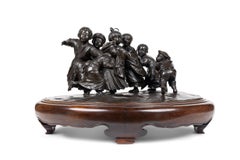
A Large and Exceptional Japanese Meiji Period Tokyo School Bronze Sculpture
Located in Queens, NY
Presenting an extraordinary Large and Exceptional Japanese Meiji Period Tokyo School Bronze Sculpture depicting a delightful ensemble of six energe...
Category
19th Century Figurative Sculptures
Materials
Bronze
Still Thinking About These?
All Recently ViewedMore Ways To Browse
Erotic Bronze
Sculptures Of Lovers
Erotic Art Sculpture
Monumental Nudes
Bronze Erotic Sculpture
Bronze And Plaster Nude Male Sculpture
Erotic Male Art
Charles Cooper Henderson
Charles Murphy
Christo Collage
Concours Poster
Dachshund Dog Paintings
Dan Smith
Dartmouth Ski
David Packard
Dead Game Painting
Deauville Poster
Deborah Remington