Art Nouveau
to
138
735
221
154
93
171
Overall Width
to
Overall Height
to
1
542
726
105
205
93
103
73
9
9
17
9
12
17
114,513
65,079
54,928
27,053
14,930
9,364
6,539
5,777
4,190
3,059
2,585
2,328
2,252
720
916
246
18
934
642
329
300
284
187
185
178
160
124
114
92
77
70
56
56
51
49
47
42
687
212
191
142
120
89
35
34
31
31
268
217
640
631
Style: Art Nouveau
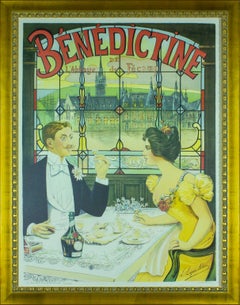
"Bénédictine" original 1898 advertising poster by Lucian Lopes Silva
Located in Boca Raton, FL
"Bénédictine" original 1898 advertising poster for Bénédictine de L'Abbaye de Fécamp liqueur by Lucian Lopes Silva.
Category
1890s Art Nouveau
Materials
Lithograph
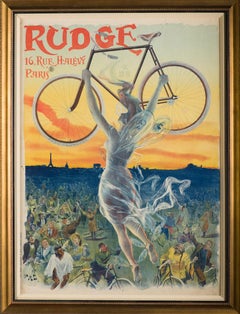
"Rudge Cycles" authentic antique posters with tax stamps
Located in Hinsdale, IL
PALEOLOGUE, JEAN DE(PAL)
(1860 -1942)
"Rudge Cycles"
Lithograph in color, linen-backed c. 1898
Sheet size: 56.75” x 41.75”
Imprimerie Paul Dupont, ParisStamp: Republique Francais, lower left
Colors fresh
Jean de Paleologue...
Category
1890s Art Nouveau
Materials
Lithograph
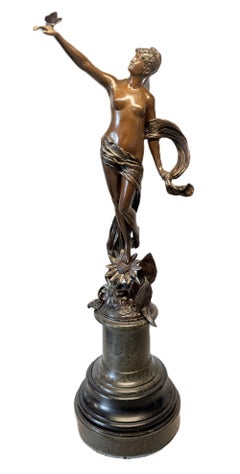
French Art Nouveau bronze by Franz Rosse 1893
Located in Berlin, DE
A late 19th-century French bronze sculpture titled "Fairy with Butterfly" by Franz Rosse (1858-1900), signed and dated "Frosse 93" on the base, depicting a semi-dressed woman floatin...
Category
1890s Art Nouveau
Materials
Bronze
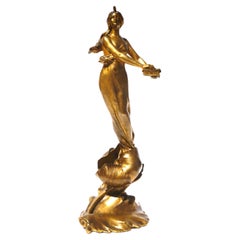
Maurice Bouval Art Nouveau Gilt Bronze Sculpture
Located in Dallas, TX
Maurice Bouval (Fr. 1863-1916) Art Nouveau sculpture.
French Art Nouveau Gilt-Bronze Figure of a Woman
Cast by E. Colin & Cie., Paris, circa 1900
Possibly Pandora, modeled rising ou...
Category
Early 1900s Art Nouveau
Materials
Bronze
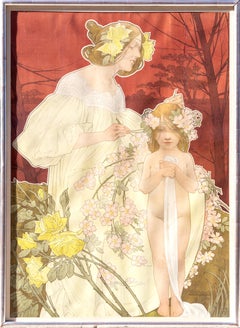
Palais de la Femme, Art Nouveau Lithograph by Georges Henri Privat-Livemont
Located in Long Island City, NY
Vintage poster by Henri Privat-Livemont created for the Exposition Universelle (the 1900 Paris Exposition) before the lettering was added on the upper portion of the image.
Palais d...
Category
Early 1900s Art Nouveau
Materials
Lithograph
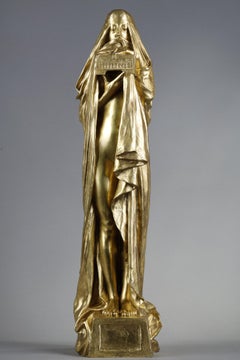
The Secret
Located in PARIS, FR
The Secret
by Pierre-Félix FIX-MASSEAU (1869-1937)
Sculpture in bronze with a gilded patina
Signed on the side " Fix-Masseau "
Cast by " Siot-Paris " (with the foundry mark)
France...
Category
Late 19th Century Art Nouveau
Materials
Bronze
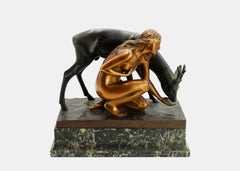
The Feeding / - Natural grace -
Located in Berlin, DE
Erich Schmidt-Kestner (1877 Berlin - 1941 Nordhausen), The Feeding, around 1915. Gold and black patinated bronze with cast brown patinated plinth mounted on a lightly veined black-gr...
Category
1910s Art Nouveau
Materials
Bronze
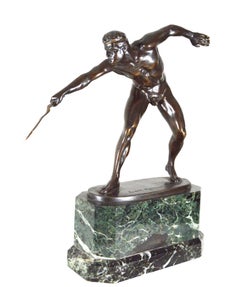
Antique bronze nude gladiator/ swordsman - Signed "Rudolf Marcuse" + "Gladenbeck
By Rudolf Marcuse
Located in Berlin, DE
Antique bronze nude gladiator/ swordsman - Signed "Rudolf Marcuse" + "Gladenbeck Berlin"
Dimensions:
Sculpture: 16.5 cm high
Base: 6.5 cm high
To...
Category
Early 20th Century Art Nouveau
Materials
Bronze
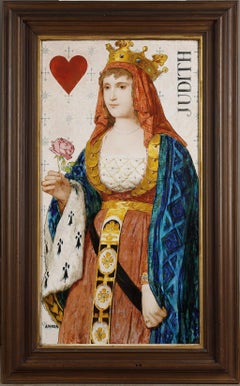
Plaque "Judith"
Located in PARIS, FR
"Judith"
by Théodore DECK (1823-1891)
and Albert ANKER (1831-1910)
Important and rare polychromatic enamelled earthenware pannel
Titled "Judith"
Signed in the decor "Anker".
Tripar...
Category
Late 19th Century Art Nouveau
Materials
Ceramic
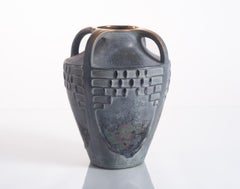
Secessionist Geometric Urn by Paul Dachsel c. 1900
By Paul Dachsel
Located in Chicago, IL
Whereas earlier Art Nouveau pottery focused on asymmetrical design to represent the wild and unpredictable aspects of nature, forward-thinking artists such as Paul Dachsel and those of the Vienna Secession also explored the geometric elements of nature. Four-handled blue and gray urn...
Category
Early 1900s Art Nouveau
Materials
Ceramic
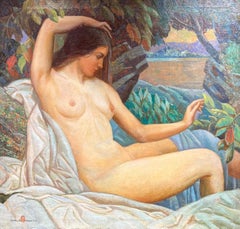
Bathing Beauty
Located in Missouri, MO
"Bathing Beauty" c. 1915
Carl Rudolph Krafft (American, 1884-1938)
Oil on Canvas
Signed Lower Left
38 x 40.25 inches
Born in Reading, Ohio, Carl Krafft...
Category
Early 20th Century Art Nouveau
Materials
Canvas, Oil
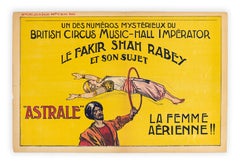
Levitation magic poster, The Fakir Shah Rabey and The Aerial Woman, c. 1915
Located in Chicago, IL
A magician billed as The Fakir Shah Rabey is pictured with his "astral" subject, The Aerial Woman, who levitates above in a hoop.
Original lithographic magic poster...
Category
1910s Art Nouveau
Materials
Lithograph
Cuban Artist - Caricature of Adolphe Menjou Debonair Devil
Located in Miami, FL
Framed Cuban Artist/Caricaturist Conrado Walter Massaguer presents Hollywood star Adolphe Menjou in a satirical dual portrait. In the foreground, the subject is seen in a dapper top hat, tux, fashionable cigarette and boutonnière, and is shown as being the epitome of being stylishly debonair. To make a larger point about this subject, Massaguer paints a cast shadow of Menjou as a burning red devil who studies his alter ego from above. Keeping with the artist's sarcasm, we see the good and bad in one image. Works by Massaguer are rare and this work is in keeping with his signature style. This work was most likely done on assignment for Life Magazine, Cosmopolitan, The New Yorker or Vanity Fair. Signed upper right. Inscribe lower right. Titled on verso. Unframed, Slight bend to board; toning to board; scattered faint foxing; pin point abrasions to margins, not affecting image. 19-1/2 x 15-1/8 inches board size.
Conrado Walter Massaguer y Diaz was a Cuban artist, political satirist, and magazine publisher. He is considered a student of the Art Nouveau. He was the first caricaturist in the world to broadcast his art on television.He was first caricaturist to exhibit on Fifth Avenue. He was the first caricaturist in the world to exhibit his caricatures on wood. He, and his brother Oscar, were the first magazine publishers in the world to use photolithographic printing.
Self portrait of Conrado Walter Massaguer, depicted on a carrousel ride, with the devil over his left shoulder and an angel over his right. (1945)
He created the magazine Social with his brother Oscar to showcase Cuban artistic talent. The duo later created the magazine Carteles, which became for a period the most popular magazine in Cuba, which was purchased by Miguel Ángel Quevedo in 1953.
In his life, he met and drew caricatures of Franklin D. Roosevelt, Walt Disney, Albert Einstein, the King of Spain, and many others.[ In sum total, he was the author of more than 28 thousand caricatures and drawings.Ernest Hemingway once had to refrain himself from punching Massaguer in the face after the artist drew an unflattering caricature of him. The dictator Gerardo Machado, however, did not punch Massaguer for his own unflattering caricature - he had the artist deported.
He was one of the most internationally renowned Cuban artists of his day, and his art is still regularly featured in galleries across the Western Hemisphere and Europe.
Early life
Massaguer was born on October 18, 1889, in Cárdenas, Cuba.[In 1892, his family moved to Havana.
When the Cuban War of Independence broke out, Massaguer's family escaped the country. From 1896 to 1908, he lived in Mérida, Mexico. However, during this time, his parents enrolled him in the New York Military Academy, where he stayed during school years.
In 1905, after graduating the military academy, he briefly attended the San Fernando school in Havana, where he was tutored by Ricardo de la Torriente and Leopoldo Romañach.
In 1906, less than a year later, he returned to the family home in Mexico.
Career as artist
Early career
While living in Yucatán, Mexico, Massaguer published his first caricatures in local newspapers and magazines. These included La Campana, La Arcadia, and the Diario Yucateco.
In 1908, he moved back to Havana. After returning to the island in 1908, Massaguer began mingling with Havana's aristocratic circles, forming close friendships with some of the city's most powerful and influential men, as well as winning the favor of many women who were quickly charmed by him. Massaguer, largely self-taught, honed his style using the avant-garde techniques he studied from the European and American magazines that were widely available in Cuba at the time.
Cover of the immensely popular Cuban magazine El Figaro, drawn by Massaguer in 1909. This cover depicts two bumbling, incompetent American tourists to the island.
He started drawing for El Fígaro, and was featured prominently on the cover in 1909.
After two years of refining his craft, Havana announced a poster contest aimed at attracting North American tourists to stay in the city during the winter months. Notable figures like Leopoldo Romañach, Armando Menocal, Rodríguez Morey, Jaime Valls, and others also entered the competition. The jury was particularly impressed by the modern execution and creative solution of one piece, signed by Massaguer, who was relatively unknown at the time.
The jury deliberations caused a great controversy.[5] The prize was ultimately awarded to the Galician painter Mariano Miguel, who had recently married the daughter of Nicolás Rivero, the wealthy owner of the conservative newspaper Diario de la Marina. Although Massaguer received only an honorable mention, the fraud scandal caused such an uproar that his name quickly entered the public spotlight, and he became an overnight sensation.
In 1910, he became co-owner of the advertising agency Mercurio, with Laureano Rodríguez Castells. At Mercurio, he led the Susini cigar campaign, and earned substantial wealth.
Massaguer has been described as a restless man, in both mind and body.After earning enough money from his art to begin traveling, he was almost always doing so. He constantly traveled between New York City and Havana, Mexico and France, Europe and the Americas.
In 1911, his reputation among the Havana socialites solidified when he organized his own first public caricature exhibit, and also the first Caricature Salon ever held in the Americas, hosted at Athenaeum of Havana (the Ateneo), and the Círculo de La Habana. Other exhibitors here included Maribona, Riverón, Portell Vilá, Valer, Botet, Barsó, García Cabrera, Carlos Fernández, Rafael Blanco, and Hamilton de Grau.
"Messaguer Visits Broadway." Caricatures of theatrical and literary figures. Elsie Janis, Raymond Hitchcock, S. Jay Kaufman (columnist), Ibanez, author of The Four Horsemen, and Frances White
In 1912, in the New York American Journal, he published his first Broadway drawings.
From 1913 to 1918, he was an editor for Gráfico.
Social
Main article: Social (magazine)
Cover of the magazine Social, July 7, 1923
In 1916, he created the magazine Social with his brother, Oscar H. Massaguer. Social's contributors included Guillén Carpentier, Chacón y Calvo, Enrique José Varona and others.Social has been described as Massaguer's great love in the magazine industry, and was the property that historians say he cared the most about. Social was an innovative magazine, being the first magazine in the world to use a modern printing process called photolithographic printing.
Social set cultural trends, not only in the fashion of Cuba, but in art, politics, and Cuban identity.[11] Social catered to a certain aesthetic in Cuba - that of the sophisticated elite socialite - but Massaguer would also use this magazine to ridicule and jibe against that same class of society when he found their personalities worthy of his contempt.
In Social, readers could find a variety of content, including short stories, avant-garde poetry, art reviews, philosophical essays, and serialized novels, as well as articles on interior design, haute couture, and fashion. Occasionally, the magazine also featured reports on sports such as motor racing, rowing, tennis, and horse riding.The cultural promotion efforts of both Massaguer and Emilio Roig de Leuchsenring are evident in the magazine. Notably, this period overlaps with their involvement in the Minorista Group, which was then at the forefront of the country's intellectual life.[5] Many contributors were devoted members of the group, leading some experts to consider Social as the cultural voice of the Minoristas.
One of the features of Social magazine was its section called "Massa Girls," which was a play on his own name, and pronounced with a glottal 'g' in a similar fashion to the letter in Massaguer.[12] Massaguer drew women as independent and free-thinking, and never drew the woman celebrity as a caricature of herself, but as a free agent surrounded by caricatures.[11] However, Massaguer himself has been described as a womanizer in his personal life, and hesitant to fully embrace every facet of women's liberation.
In 1916, he also established la Unión de Artes Gráficas and the advertising agency Kesevén Anuncios.[9]
The art critic Bernardo González Barroa wrote:
“Massaguer has solved the problem of working hard, living comfortably off what his art produces and not missing any artistic, sporting or social event. His broad, childish laugh, of a carefree individual who carries his luck hidden in a pocket, appears everywhere for the moment, disguising the pranks of pupils that lurk, mock and, finally, flash with satisfaction at finding the characteristic point after having analyzed a soul... Massaguer's personality is beginning to solidify now. He has been the best-known and most popular caricaturist for a long time, but his technique had not reached the security, the mastery of values that he presents in his latest works, which is very natural and explainable”[5]
Carteles
Main article: Carteles
Cover of the magazine Carteles, November 29, 1931
In 1919, Massaguer and his brother created the magazine Carteles.[9] Carteles gained the widest circulation of any magazine in Latin America, and the most popular magazine in Cuba for a time, until that title was claimed by Revista Bohemia. Carteles remained in print until July 1960.This magazine showcased Cuban commerce, art, sports, and social life before the revolution.
In 1924, Carteles took a more political turn, with articles criticizing Gerardo Machado's government. it became a prime example of the humor and graphic design employed by artists like Horacio Rodríguez Suria and Andrés García...
Category
1930s Art Nouveau
Materials
Ink, Watercolor, Illustration Board
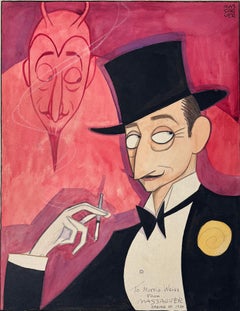
Felician Myrbach (1853-1940) The Musketeers, original drawing
Located in Paris, FR
Felician Myrbach (1853-1940)
The Musketeers
bears the monogram "M" on the lower left
Ink and pencil on paper
26,7 x 23,7 cm
in good condition,
In a mod...
Category
1890s Art Nouveau
Materials
Ink
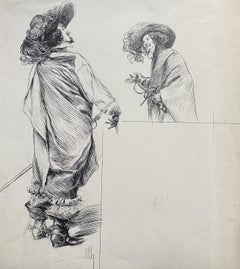
"Lorenzaccio" by Alphonse Mucha from Les Maitres de l
Affiche
Located in Hinsdale, IL
Alphonse Mucha
"Lorenzaccio, a play in five acts and an epilogue by Alfred de Museet"
Plate #114
Image Size: 15" x 11"
1896
Alphonse Mucha was born in Southern Moravia on July 24, 1860. At the age of seventeen the artist left his home, to work as a painter of stage decorations...
Category
1890s Art Nouveau
Materials
Lithograph
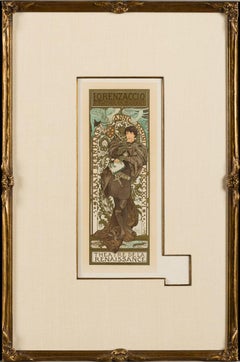
Musée Grévin, Pantomimes Lumineuses by Jules Cheret, Commedia lithograph, 1896
By Jules Chéret
Located in Chicago, IL
Jules Chéret’s poster advertising the Théâtre Optique (Optical Theatre) immortalized a momentous convergence of technology, culture, history, and art with the 1892 debut of Emile Reynaud’s praxinoscope at the Musée Grévin in Paris. Reynaud presented his Pantomimes Lumineuses, the world’s first animated films, using his innovative system which projected light through moving pictures to offer illuminated pantomimes. Among the three short films Reynaud screened through his praxinoscope was Pauvre Pierrot (Poor Pierrot), a story of Pierrot courting Columbine based on the timeless archetypal love triangle featured in many Commedia dell’arte pantomimes.
As a member of the Cercle Funambulesque (roughly “Friends of the Tightrope-walkers”), a French society which championed the contemporary creation of Commedia dell-arte-inspired pantomimes, Jules Chéret was often inspired by Pierrot and produced a large number of works depicting him, often with his beloved Columbine. Cheret’s involvement with the Cercle, combined with the immense popularity of these archetypes in the late 19th century, meant that they appeared frequently in his works.
This work comes from the extremely scarce edition of 25 strikes on Imperial Japon paper, a mulberry bark-based stock inspired by the smooth-surfaced papers used in Japanese printmaking. This world-class example of lithography captures superior resolution and color-richness to that of its large-format counterpart. The use of marbled Imperial Japon paper allows inks to rest upon its surface rather than being absorbed by a more porous paper stock. An extremely scarce fraction of the edition of 25 are estimated to have survived to date.
Stone lithograph of Jules Chéret’s Musée Grévin...
Category
1890s Art Nouveau
Materials
Lithograph
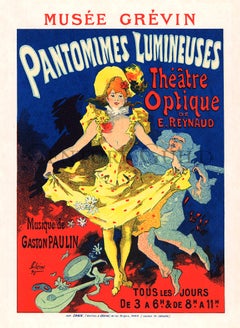
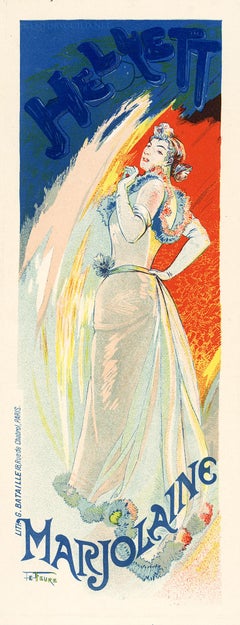
Hélyett Marjolaine by Georges de Feure, Art Nouveau theater lithograph, 1896
Located in Chicago, IL
Lithograph of George de Feure’s 1896 theatrical Art Nouveau poster promoting Mistinguett’s role as Hélyett in Marjolaine.
Hélyett is shown in a delicate pastel palette, enveloped b...
Category
1890s Art Nouveau
Materials
Lithograph
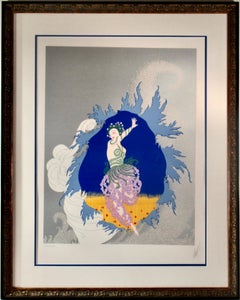
The Coming of the Spring
By Erté
Located in San Francisco, CA
This artwork titled "The Coming of Spring" 1982, is an original colors serigraph on Wove paper by renown Russian/French artist Erte, AKA Romain de Tirtoff, 1882-1990. It is hand sign...
Category
Late 20th Century Art Nouveau
Materials
Screen
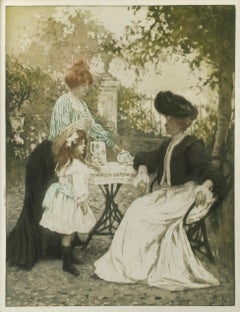
Le Tasse de The (The Cup of Tea)
By Manuel Robbe
Located in Fairlawn, OH
Le Tasse de The (The Cup of Tea)
Color aquatint and etching, c. 1906
Signed in pencil in the image (see photo)
Edition: c. 100
Reference: Merrill Chase, Volume 1, No. 85
Condition: F...
Category
Early 1900s Art Nouveau
Materials
Aquatint
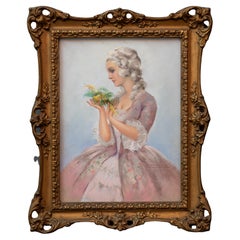
Period Framed Italian Portrait by Tito Corbella
By Tito Corbella
Located in Roma, IT
1930s painting by the important Italian artist Tito Corbella
Beautiful and rare work by the important Italian artist of the first half of the 20th century Tito Corbella. It depicts w...
Category
1930s Art Nouveau
Materials
Paper, Pastel
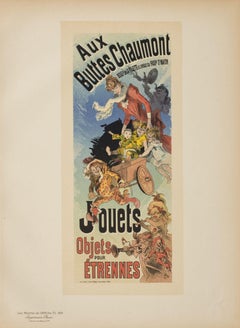
At the Buttes-Chaumont (Plate 169)
By Jules Chéret
Located in Greenwich, CT
At the Buttes-Chaumont (Plate 169) is an 1899 lithograph of Jules Chéret's poster, printed at Imprimerie Chaix by Jules Chéret and included in the famed collection of Belle Époque po...
Category
1890s Art Nouveau
Materials
Paper, Lithograph
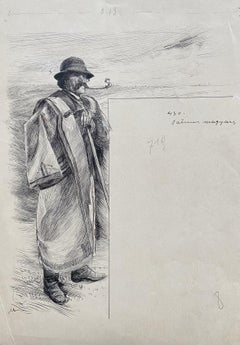
Felician Myrbach (1853-1940) Poèmes magyars original drawing
Located in Paris, FR
Felician Myrbach (1853-1940)
Poèmes magyars, Magyar poems
bears the monogram "M" on the lower left, titled in the upper right
Ink on paper
29,8 x 19,8 cm
in good condition, the sheet is slightly yellowed
In a modern frame : 33 x 23 cm
This is an illustration project by Felician Myrbach for François Coppée's work, "Poèmes magyars". He leaves the space to be occupied by the text blank on the sheet and arranges his composition accordingly. It is interesting to see the artist imagine his drawing with this constraint.
Felician Myrbach (also Felicien de Myrbach, Felician von Myrbach, from 1919 Freiherr von Rheinfeld) was born on 9 February 1853 in Zalishchyky, he died 14 January 1940 in Klagenfurt
He was an Austrian painter, graphic designer and illustrator. He was a founding member of the Vienna Secession and the director of the Applied Arts School in Vienna (now the University of Applied Arts Vienna), and was instrumental in the creation of the Wiener Werkstätte.
Myrbach's father was Franz Myrbach (1818–1882), the Administrator of Bukovina in 1865–70. His older brother Franz Xaver (1850–1919) was an economist and professor at the University of Innsbruck. He attended the Theresian Military Academy in 1868–71, graduating as a Leutnant, then at the Academy of Fine Arts, Vienna under August Eisenmenger. In 1875, he joined the 19th Feldjäger Battalion, and in 1877 became an Oberleutnant in the Military Geographic Institute, then, after campaigning in Bosnia in 1878, he taught drawing at the Infantry Cadet School in Vienna. He continued his artistic studies under C R Huber. In 1881, he went on military leave and moved to Paris, retiring totally from the military in 1884 as a Hauptmann, 2nd Class. He stayed in Paris until 1897, working as an illustrator, including illustrating the works of Alphonse Daudet, Victor Hugo and Jules Verne.
Myrbach was a founding member of the Vienna Secession in 1897. In the same year, he became the a professor of the Applied Arts School at the Museum of Art and Industry; Arthur von Scala, another reformer Modernist, was made head of the Museum. In 1889, Myrbach became the director of the school. He brought an enthusiastic Modernist attitude and encouraged an integration between art, design and production. He added Koloman Moser and Josef Hoffmann to the staff, amongst other Secession artists. This would lead to the foundation of the Wiener Werkstätte in 1903. Myrbach leant more towards an aesthetic approach than von Scala, but both worked together to bring about their combined vision of successful, popular Austrian applied art. Myrbach was a voice for reform towards Modernist ideals in the School, which was started 1899 with the support of Alfred Roller, and completed by 1901.The reform of the school has been described as his "lasting merit".
Ludwig Hevesi called Myrbach "probably the best [illustrator] in Vienna", partially for his work (with Moser) in the Secession magazine Ver Sacrum.
Myrbach visited America on a state-funded study trip in 1904, part of which was to represent the Applied Arts School at the 1904 World...
Category
Early 1900s Art Nouveau
Materials
Ink
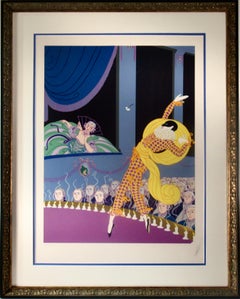
Harlequin
By Erté
Located in San Francisco, CA
This artwork titled "Harlequin" 1970, is an original colors serigraph on Wove paper by renown Russian/French artist Erte, AKA Romain de Tirtoff, 1882-1990. It is hand signed and numb...
Category
Late 20th Century Art Nouveau
Materials
Screen

$2,450
Beauty of Last Century - Original lithograph (1897/98)
Located in Paris, IDF
Lucien LEVY DHURMER (1865 - 1953)
Beauty of Last Century
Original litograph
Platesigned
1897/98
Printed on paper Vélin
Size 40 x 31 cm (c. 16 x 12")
I...
Category
1890s Art Nouveau
Materials
Lithograph
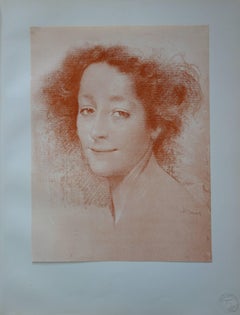
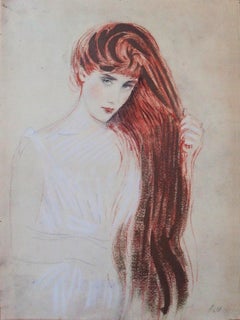
Shy Red Hair Woman - Lithograph
Located in Paris, IDF
Paul César Helleu
Shy Red Hair Woman, 1913
Lithograph and watercolor stencil
Printed signature
On vellum 26 x 20 cm (c. 10.5 x 8 inch)
Very good condition
Category
1890s Art Nouveau
Materials
Lithograph
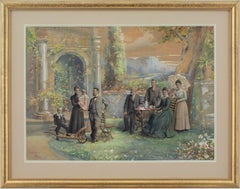
K
K Hof Atelier Pietzner, Family Portrait In A Garden Setting
Located in Cheltenham, GB
This early 20th-century mixed media by K & K Hof Atelier Pietzner of Vienna depicts a respectable family within a neoclassical garden setting.
With the advent of photography, afflue...
Category
Early 1900s Art Nouveau
Materials
Paper, Watercolor, Gouache, Photographic Paper
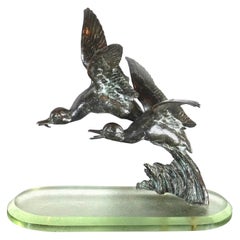
Maximilien-Louis Fiot Bronze Ducks In Flight Sculpture
Located in Dallas, TX
Maximilien-Louis Fiot (1886-1953) Art Nouveau-Art Deco sculpture of Ducks in Flight, patinated cast bronze sculpture mounted on thick Acid etched gl...
Category
1910s Art Nouveau
Materials
Bronze
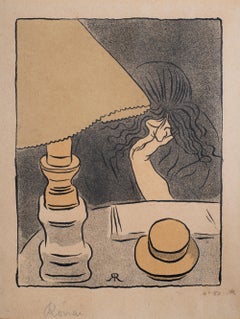
Femme Sous la Lampe (Woman Under the Lamp) signed lithograph; József Rippl-Rónai
Located in Palm Beach, FL
Framed lithograph, signed ("Rónai") and numbered ("no. 50") by the artist. Also includes a silver József Rippl-Rónai coin, made in 1977 for the 50th anniversary of his death.
The li...
Category
1890s Art Nouveau
Materials
Lithograph
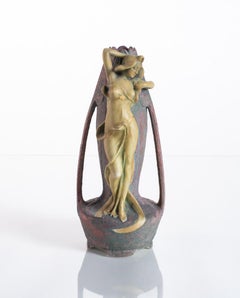
Iridescent Ernst Wahliss Art Nouveau Maiden on Tulip c. 1900
Located in Chicago, IL
Figural vase with a golden maiden on an iridescent form. This vase features a beautiful juxtaposition of the smooth and sinuous texture of the woman against a psychedelic stone-like ...
Category
Late 19th Century Art Nouveau
Materials
Ceramic
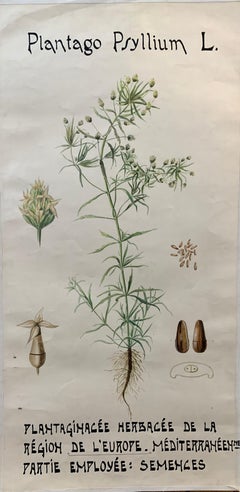
Early 20th C French Watercolor, botanical flowers from an University collection
Located in Woodbury, CT
Wonderful watercolor depicting a plant/flower. These were used at a Belgium University to teach the students about botany. Dating from the early 20th century. They are watercolor on ...
Category
Early 1900s Art Nouveau
Materials
Watercolor
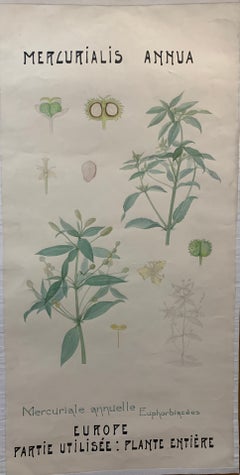
Early 20th C French Watercolor, botanical flowers from an University collection
Located in Woodbury, CT
Wonderful watercolor depicting a plant/flower. These were used at a Belgium University to teach the students about botany. Dating from the early 20th century...
Category
Early 1900s Art Nouveau
Materials
Watercolor
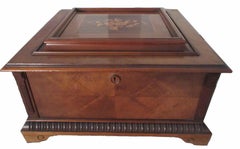
Polyphon Record Machine 1890-1900 Music
Located in Berlin, DE
Polyphon Record Automaton 1890-1900 Music
Large luxury model
Sounds beautiful in its original condition and has been retuned.
Records are approximately 40 cm in diameter.
Polyphon ...
Category
Late 19th Century Art Nouveau
Materials
Metal
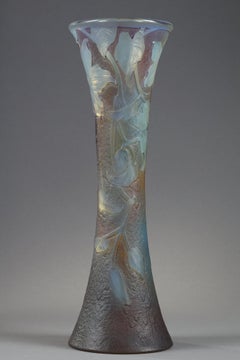
Vase with Clematis
By Daum
Located in PARIS, FR
Vase with Clematis
by DAUM
A diabolo-shaped vase
with opalescent Clematis decoration
Blown-molded multilayer glass
Acid-etched decor in reserve
Frosted background
Signed " Daum Na...
Category
Late 19th Century Art Nouveau
Materials
Blown Glass
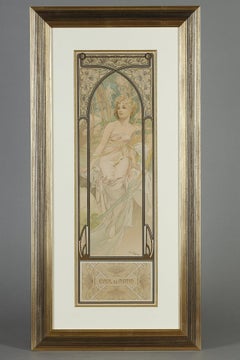
Morning Awakening
Located in PARIS, FR
Morning Awakening
by Alfons MUCHA (1860-1939)
"Morning Awakening"
from the series "The Times of the Day"
Variant 1
Original lithograph
Signed "Mucha" and dated "99" for 1899, at t...
Category
Late 19th Century Art Nouveau
Materials
Lithograph
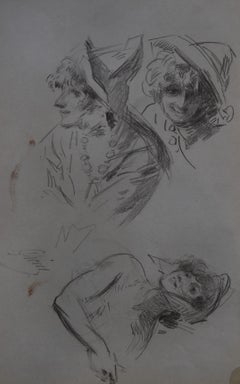
Jules Cheret (1836-1932) Three studies of women, original signed drawing
By Jules Chéret
Located in Paris, FR
Jules Cheret (1836-1932)
Three studies of women
charcoal on paper
signed on the bottom left
39 x 24.5 cm
This drawing of studies was part of the artist's workshop as so it bears the...
Category
1910s Art Nouveau
Materials
Charcoal
Sunrise
By Erté
Located in San Francisco, CA
Artist: (Romain De Tirtoff) Erte (Russian, 1892-1990)
Title: Sunrise
Year: 1984
Medium: Color serigraph, with stamped gold foil
Paper: Wove
Edition: Numbered 285/300 in pencil
...
Category
1980s Art Nouveau
Materials
Screen
$1,650
Eutrope Bouret (1833-1906) Psyché
Located in Berlin, DE
Eutrope Bouret Bronze
Spyche
Eutrope Bouret (French, 1833-1906)
Late 19th century.
Signed on the base
Bouret (French, 1833–1906) was an important 19...
Category
19th Century Art Nouveau
Materials
Bronze
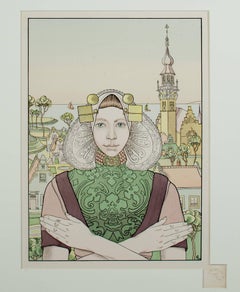
"La Phalène des Isles de la Mer, " figurative art nouveau ornate print
Located in Milwaukee, WI
"La Phalène des Isles de la Mer" or "The Moth of the Islands of the Sea" is an original color lithograph by Franz Melchers. This piece was published in L'Estampe Moderne I, an Art No...
Category
1890s Art Nouveau
Materials
Lithograph
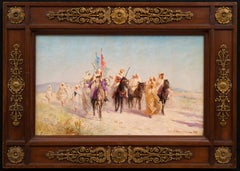
Orientalist: "Arabian Horseman" dated 1903 André Chaumière
Located in SANTA FE, NM
"Fantasia of Arabian Horseman" dated 1903
André Chaumière (French, XlX-XX)
Oil on canvas
Handcrafted original wood frame with bronze applique
20 3/4 x 12 3/4 (28 1/2 x 20 frame) inc...
Category
Early 1900s Art Nouveau
Materials
Canvas, Oil
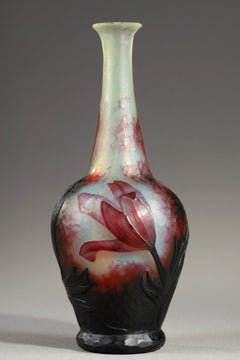
Vase with Colchicum
By Daum
Located in PARIS, FR
Vase with Colchicum
by DAUM
A bud vase decorated with Colchicum
Blown-molded multilayer glass
Acid-etched decoration in reserve and lightly wheel cut
Hammered background
Signed und...
Category
Late 19th Century Art Nouveau
Materials
Blown Glass
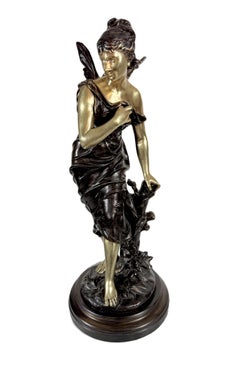
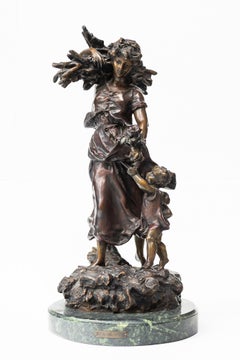
"Mother and Child" Art Nouveau Bronze Sculpture Woman Carrying Harvest Green
Located in Austin, TX
20 inches tall x 11 inches wide at base.
Signed.
Numbered 6/100
A cast bronze sculpture that depicts an adult female, rural worker, mid-stride, holding a large bundle of wood on her...
Category
Early 20th Century Art Nouveau
Materials
Marble, Bronze
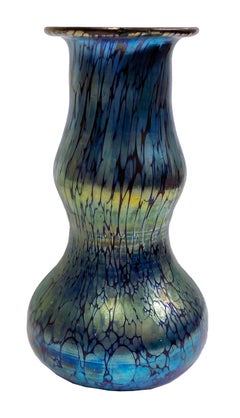
Diaspora Vase
By Loetz Glass
Located in Missouri, MO
Loetz
Diaspora Vase, c. 1900
Glass
Stamped on bottom
6 inches tall
3 inches diameter
This Loetz vase in the Papillon pattern has blue iridescent Papillon design covering the exterio...
Category
Early 20th Century Art Nouveau
Materials
Glass
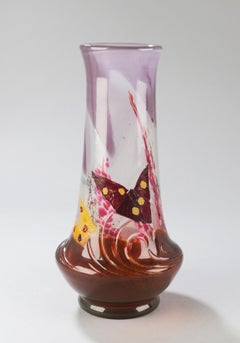
Exceptional vase "Marquetry with butterflies"
By Émile Gallé
Located in PARIS, FR
Exceptional vase "Marquetry with butterflies"
by Emile GALLE (1846-1904)
Baluster shaped vase raised on a rounded foot
Multi-layered blown-molded glass,
ornated with deep engraved ...
Category
Early 1900s Art Nouveau
Materials
Glass
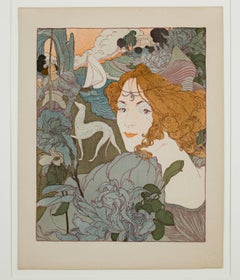
Art Nouveau Lithograph 1800s Landscape Romantic Figure Floral
Located in Milwaukee, WI
"Retour (L'Estampe Moderne I)" is a color lithograph by Georges de Feure. It features a woman with red hair in an environment of flora and fauna with muted colors and the Art Nouveau...
Category
1890s Art Nouveau
Materials
Lithograph
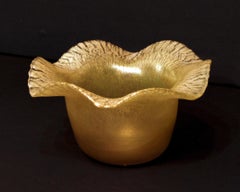
Gold Iridescent Favrile Art Glass Bowl
Located in Austin, TX
A delicate gold iridescent favrile art glass bowl by Tiffany and Co., featuring a flared and ruffled mouth.
Height: 3.25 in
Diameter: approx. 5.5 in.
Category
Early 20th Century Art Nouveau
Materials
Glass
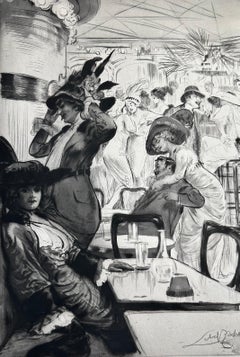
Les Bars, selected prints
Located in Wilton, CT
6 plates from the Lobel- Riche books, Les Bars depicting pre- war Paris fashions in the bars and nightclubs.
Category
1910s Art Nouveau
Materials
Etching
$480 Sale Price
20% Off
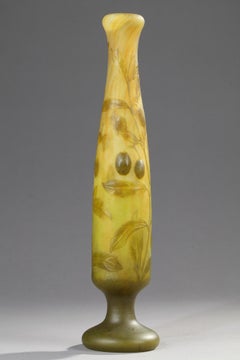
Vase with Olives
By Daum
Located in PARIS, FR
Vase with Olives
by DAUM
A bud vase with an Olive decor
Multilayer blown-molded glass
With an acid-etched decor in reserve
Decor of applied glass cabochons for olives.
Signed " Dau...
Category
Early 20th Century Art Nouveau
Materials
Blown Glass
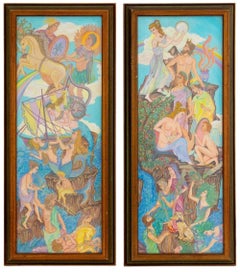
Art Nouveau Style Mythology Scene Gouache, Pr
Located in Astoria, NY
Pair of Signed Art Nouveau Style Greek Mythology Scenes, Gouache on Board, one of the Gods on Olympus, other depicting Gods and mythical creatures on a rock at sea, both signed "Isab...
Category
Late 20th Century Art Nouveau
Materials
Gouache, Board
Vase with Dandelions
By Daum
Located in PARIS, FR
Vase with Dandelions
by DAUM
Vase decorated with Dandelions
Blown-molded triple layer glass
Acid-etched decoration in reserve and wheel cut
Hammered background
Signed underneath "D...
Category
Late 19th Century Art Nouveau
Materials
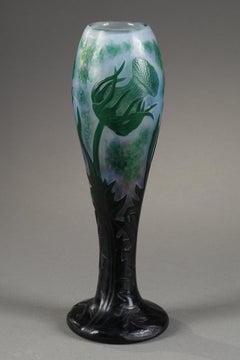
Blown Glass
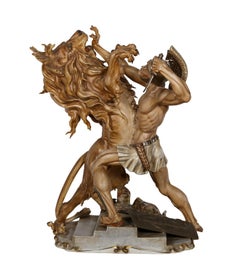
Spartico E Il Leone, Art Nouveau Porcelain Sculpture by Tiziano Galli
Located in Long Island City, NY
Tiziano Galli, Italian (1908 - 1986) - Spartico E Il Leone, Medium: Porcelain sculpture, signature and title inscribed, Size: 18 x 12 x 9 in. (45.72 x 30.48 x 22.86 cm)
Category
Mid-20th Century Art Nouveau
Materials
Porcelain
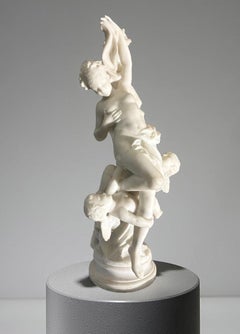
Grande Gruppo in Marmo "L
Innocenza tormentata dall
Amore" Scultura Francese
Located in Pistoia, IT
Imponente gruppo in marmo bianco raffigurante "Innocenza tormentata da Amore", firmato Luca Madrassi. Scuola francese, fine XIX secolo, periodo Art Nouveau.
Questo splendido grupp...
Category
Late 19th Century Art Nouveau
Materials
Marble
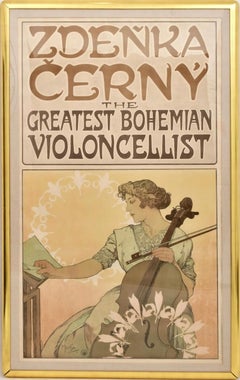
Alphonse Mucha Zdenka Cerny 1913 Lithograph (Rare and Large)
Located in Dallas, TX
Alphonse Mucha (Czech, 1860-1939) Original Lithograph 1913 - Very Large -
"Zdenka Cerny" The Greatest Bohemian Violincellist
Prague, Czechoslovak
Color lithograph
Signed and dated "...
Category
1910s Art Nouveau
Materials
Ink, Archival Paper
Raoul Fançois Larche Patinated bronze figure of a woman
Located in Berlin, DE
FRANCOIS-RAOUL LARCHE 1860 SAINT-ANDRÉ-DE-CUBZAC - 1912 PARIS
Signed on the base with "RAOUL LARCHE," foundry mark "SIOT DECAUVILLE PARIS FONDEUR," and number "R 276."
Total height...
Category
Early 1900s Art Nouveau
Materials
Bronze
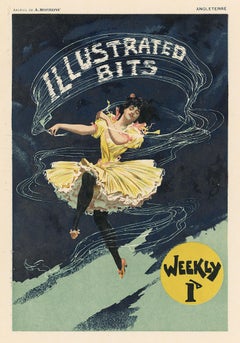
Albert Morrow
s Illustrated Bits, 1897 Art Nouveau lithograph on Japon paper
Located in Chicago, IL
Stone lithograph of Albert Morrow’s Illustrated Bits, printed by Imprimerie Chaix (Ateliers Chéret), Paris in 1897. This world-class example of lithography captures superior resoluti...
Category
1890s Art Nouveau
Materials
Lithograph
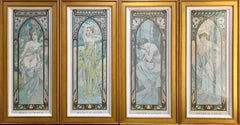
Four Alphonse Mucha Lithographs The Times Of The Day
Located in Dallas, TX
Alphonse Mucha (1860-1939)
Four lithographs on wove paper
For serious collectors and museum collections. A full set of Mucha’s iconic period lithographs representing The Times Of Th...
Category
1890s Art Nouveau
Materials
Lithograph
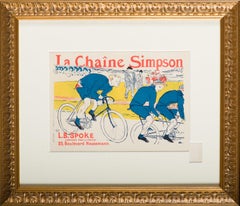
"LA CHAINE SIMPSON" by Toulouse-Lautrec from Les Maitres de l
Affiche
Located in Hinsdale, IL
TOULOUSE-LAUTREC, HENRI DE
(1864-1901)
"LA CHAINE SIMPSON"
Original lithograph from "Les Maitres de L'Affiche" series
Printed by Imprimerie Chaix, Paris
Bearing MDL stamp lower right, from issue #60, 1900. Plate #238
Unframed Size: 11 3/8 x 15 3/4”
The "Les Maitres de l'Affiche" series was offered as a subscription series to collectors every month for 60 months, from December 1895 through November 1900. The "Maitres de l'Affiche," were issued as separate numbered sheets, referred to as "plates". They were numbered, with the printers name "Imprimerie Chaix," in the margin at the bottom left hand corner, "PL.1" to "PL.240." In the margin at the bottom right hand corner of each, is a blind embossed stamp from a design of Cheret's. The smaller format and the fact the "Maitres" were a paid subscription series, allowed Imprimerie Chaix to use the latest state of the art printing techniques, not normally used in the large format posters due to cost. A very high quality of paper was used, where as the large format posters were printed on lesser quality newsprint, due to cost and a short expected life span. This explains why the quality of the printing, in the "Maitres de l'Affiche," usually far exceeds that of their larger counterparts. "In her recent excellent biography of Lautrec, Julia Frey indicates that 'Henry, the frustrated athlete, was compulsively familiar with the vocabulary and technical aspects of a variety of sports in which he could participate as a spectator: horse and bicycle racing, wrestling, yachting, bullfighting. He watched them all with the same intensity that he watched a line of dancers or a circus bareback rider, attracted by the beauty of movement, but also by the smells, sounds and excitement of the spectacle (Frey, p.353) His 'insider' knowledge of the cycling field shows up abundantly in this poster for the French agent of the Simpson bicycle chain company. In the foreground is the champion cyclist Constant Huret. In the background are Tristan Bernard, the sports impresario who was a close friend of Lautrec, with Louis Bougle, the French agent who adopted the name 'Spoke.' A touch of levity is added by what appears to be a 'bicycle-built-for-ten' in the upper-left corner, in fact it's two five-seaters, known at the time as 'quints.'"(Rennert, PAI-XXII, 35)Henri de Toulouse-Lautrec came from an aristocratic background, having been born the son of an earl.Even as a schoolboy he showed a talent for drawing. By 14 he had suffered two horse back riding accidents, combined with a serious bone disease which eventually left him crippled for life. His body continued to grow but not his legs, he would remain only five feet tall and suffer pain and embarrassment his entire life.At the age of 18, Lautrec moved to Montmartre in Paris to study art seriously. He worked with artists Louis Anquentin, Emile Bernard, Degas, Van Gogh and others. He became a frequenter of the the cafes, cabarets and brothels of the neighborhood, drawing from them inspirations for his artistic themes. As the artist's stature grew, several magazines wanted to publish his work, including Le Rire. His subjects, as well as street life, included some of the most famous music-hall performers, with whom he became friends, such as Yvette Guilbert, La Goulue Jane Avril, May Milton, May Belfort...
Category
1890s Art Nouveau
Materials
Lithograph
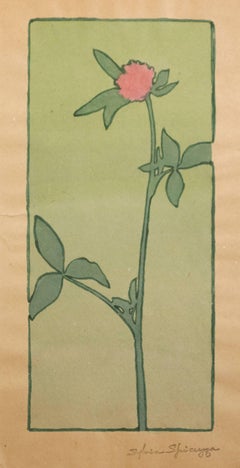
"Pink Flower, " Original Watercolor on Paper stamped by Sylvia Spicuzza
Located in Milwaukee, WI
"Pink Flower" is an original watercolor on paper by Sylvia Spicuzza. The artist stamped her signature lower right. This piece depicts a flower in graphic style.
11 3/4" x 6" art
13...
Category
1950s Art Nouveau
Materials
Paper, Watercolor
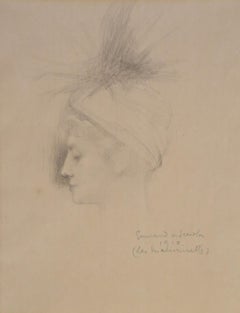
Lucien Victor Guirand de Scevola (1871-1950), Les Marionnettes 1910, drawing
Located in Paris, FR
Lucien Victor Guirand de Scevola (1871-1950)
Portrait of Marie-Thérèse Piérat in Les Marionnettes, 1910
Pencil on paper,
signed, dated and annotated lower ...
Category
1910s Art Nouveau
Materials
Carbon Pencil
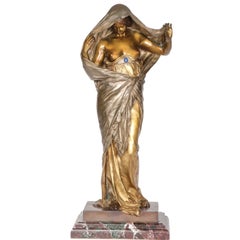
Louis Ernest Barrias Nature Revealing Herself
Located in Dallas, TX
Louis Ernest Barrias (French 1841-1905)
Nature Revealing Herself
La Nature se dévoilant devant la Science
Gilt, and silver patinated bronze with blue glass scarab
Signed on base “E...
Category
Early 1900s Art Nouveau
Materials
Bronze
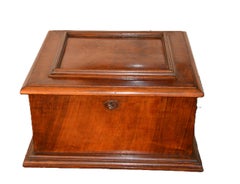
Kalliope record Machine slot Machine 10 Plates included
Located in Berlin, DE
The automaton has been completely overhauled and tuned.
The spring housing has been adjusted.
Comb has been completely tuned.
The case has been overhauled.
10 plates are included...
Category
Late 19th Century Art Nouveau
Materials
Metal
Art Nouveau art for sale on 1stDibs.
Find a wide variety of authentic art Nouveau available for sale on 1stDibs. Works in this style were very popular during the 21st Century and Contemporary, but contemporary artists have continued to produce works inspired by this movement. If you’re looking to add art created in this style to introduce contrast in an otherwise neutral space in your home, the works available on 1stDibs include elements of yellow, orange, blue, green and other colors. Many Pop art paintings were created by popular artists on 1stDibs, including Alphonse Mucha, Jules Chéret, Henri de Toulouse-Lautrec, and Adolphe Willette. Frequently made by artists working with Lithograph, and Paper and other materials, all of these pieces for sale are unique and have attracted attention over the years. Not every interior allows for large Art Nouveau, so small editions measuring 1.58 inches across are also available. Prices for art made by famous or emerging artists can differ depending on medium, time period and other attributes. On 1stDibs, the price for these items starts at $1 and tops out at $198,500, while the average work sells for $1,683.
Still Thinking About These?
All Recently ViewedMore Ways To Browse
Maggie Siner
Maplethorpe Calla
Marble Woman Head
Marcel Leprin
Mark Stock
Martin Hardie
Mauritz Lindstrom
Maximillien Luce
Michael Budden Central Park
Midcentury Matador Paintings
Mike Wright
Miracle On Ice
Mississippi River Painting
Monarch Of The Glen Painting
Moroccan Paintings Essaouira
Morpho Butterfly Art
Mount Tamalpais
Murray Dessner