18th Century Japanese Screens
Antique Late 18th Century Japanese Edo Antiquities
Wood, Paper
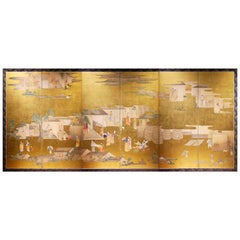

Antique 18th Century and Earlier Japanese Paintings
Gold Leaf
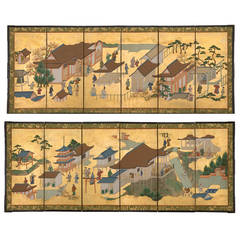
- 1
18th Century Japanese Screens For Sale on 1stDibs
How Much are 18th Century Japanese Screens?
Finding the Right Paintings-screens for You
Traditional Asian paintings were often created on scrolls and folding screens. Artisans made screens that could be folded up or spread out by connecting several panels using hinges. Today, antique Asian folding screens and paintings are sophisticated decorative accents that can serve as makeshift partitions to ensure privacy.
The original folding screens were created by Chinese artists. The earliest record of screens comes from the 2nd century B.C., and surviving examples date back to the Ming dynasty. Chinese painting utilizes many of the same tools as calligraphy — these screens were crafted from wood with painted panels featuring striking art or calligraphy that told cultural stories or represented nature and life in the area.
The practice was introduced to Japan, where paintings for screens were made on paper and silk, in the 8th century. These paintings frequently feature subjects such as landscapes, animals, flowers and Buddhist religious themes. Along with screens for tea ceremonies and dance backgrounds, there were screens for use in Shinto and Buddhist temples.
In the 17th century, screens began to be imported to Europe where their popularity grew. Coco Chanel famously collected Coromandel folding screens.
Traditional Asian paintings can make a tasteful addition to any wall, and screens can be used as decoration or, in the case of larger iterations, as an aesthetic way to divide a large room. Browse the selection of antique Asian paintings and screens from a variety of styles and eras on 1stDibs.
- 1stDibs ExpertApril 5, 2022Yes, wedding rings have a long history, stretching back to ancient Egypt. The first diamond engagement ring was created in 1477 by Archduke Maximillian of Austria. Browse a wide array of vintage and contemporary wedding rings on 1stDibs.
- 1stDibs ExpertApril 5, 2022In the 18th century, art changed in style from Baroque to Rococo and Neoclassicism. Art became more ornamented and idealized during the Rococo period and then shifted toward a style that emulated the artwork of ancient Greece and Rome near the end of the century. You’ll find a variety of fine art on 1stDibs.
- 1stDibs ExpertNovember 13, 2024To identify 18th-century furniture, you can research your piece in the context of the prevailing styles of the period or consult a certified appraiser or experienced antique dealer. To identify your item on your own, look over it for maker's marks, such as carvings, stamps, brands and labels. Researching the marking can help you determine the maker of your piece, and from there, you can search further to learn more about your particular item. Without a maker's mark, the best approach is to consider the characteristics of the dominant furniture styles during the 18th century. In England, these included William and Mary, Queen Anne, Georgian, Chippendale, Hepplewhite and Sheraton. Some French furniture styles of the 1700s include Louis XV, Louis XVI and Régence. Find a diverse assortment of 18th-century furniture on 1stDibs.
- 1stDibs ExpertApril 5, 2022One way to check if your brass candlesticks are from the 18th century is to look for the two seams running lengthwise on either side. This is from when the candlestick was molded in two halves and then soldered together. You’ll find a variety of candlesticks of all shapes and sizes from some of the top sellers on 1stDibs.
- 1stDibs ExpertJanuary 10, 2025The individuals considered the Big Three of 18th-century cartoons are William Hogarth, James Gillray and George Cruikshank. Although the 18th century saw a widespread increase in illustrations in newspapers, these three illustrators were particularly well-known for their work. Hogarth's work was extremely diverse, ranging from serious, realistic paintings and portraits to satirical and moralistic illustrations filled with symbolism. A British caricaturist, Gillray is remembered today for his artworks representing political and social satires, like his political cartoons against George III of England. Despite being a prolific caricaturist, Cruikshank is now most famous for illustrating the works of Charles Dickens. On 1stDibs, find a wide variety of illustrations.
- 1stDibs ExpertApril 5, 2022At the end of the 17th century, Europe went into a frenzy over porcelain. Asian porcelain was highly sought after, and spurred the foundation of the Meissen factory in France, where hard porcelain went on to be made. You’ll find a large collection of porcelain pieces from many of the world’s top sellers on 1stDibs.
Read More
Symbols of Happiness and Rebirth Adorn This Japanese Satsuma Bowl
Decorated with white cranes and the sought-after thousand-butterflies motif, the Meiji-period vessel offers both a celebration of traditional aesthetics and a clear reflection of the era’s appetite for exquisite export pieces.
Chicago’s Pagoda Red Has a Spirited Mix of Asian Antiques and Bold New Art
For 25 years, gallerist Betsy Nathan has leveraged her keen eye and key connections to bring a unique selection of rare finds to the market.
In L.A., Gallerist JF Chen Has Long Championed Eclectic Blue-Chip Design
Now working alongside his daughter Bianca, dealer Joel Chen has presented a most covetable array of antiques, art and contemporary creations for more than 40 years.
12 Calming Spaces Inspired by Japanese Design
From cherry-blossom-adorned walls paired with glamorous lighting to wood-paneled ceilings above checkerboard-patterned chairs, these 12 spaces seamlessly blend Eastern and Western aesthetics.
Rodrigo Rivero Lake’s Mexico City Showroom Is a Museum-Worthy Trove of Spanish Colonial and Asian Antiques
The dealer and curator has spent the past 50 years amassing a collection of exceptional art, furniture and architectural elements that trace the cultural influence of the Spanish empire from Europe to the Americas and beyond.
16 Refined Asian-Inspired Interiors
These spaces exemplify how Eastern elements elevate a home's decor.