1960s Moon Chair
Recent Sales
Mid-20th Century Danish Lounge Chairs
Teak, Wool
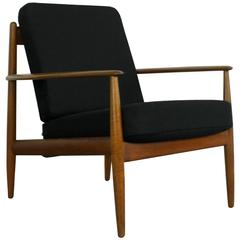

1960s Moon Chair For Sale on 1stDibs
How Much is a 1960s Moon Chair?
Grete Jalk for sale on 1stDibs
What would the reputation of mid-century Danish furniture be without legendary female designer Grete Jalk? A pioneer of Scandinavian modernism, Jalk sought to craft furniture that was both cost-efficient and high in quality, each piece made for the evolving interiors and design sensibilities of the day. She continues to be celebrated for her sleek and minimal armchairs, lounge chairs, coffee tables and more.
Jalk was born in 1920 in Copenhagen. She studied at the Drawing and Applied Art School for Women before enrolling at the Royal Danish Academy of Fine Arts, where famed designer Kaare Klint was among her instructors. Jalk completed her studies in 1946 and began a cabinetmaker apprenticeship. That same year, she won an award at the Copenhagen Cabinetmakers’ Guild competition. Jalk also participated in the 1951 Milan Triennial exhibition, where her designs earned more acclaim and attention.
In 1954, Jalk opened her own design studio and began working with major Danish furniture manufacturers like Fritz Hansen and Glostrup Møbelfabrik. She found inspiration in plywood experiments carried out by Alvar Aalto and Ray and Charles Eames, and she quickly became known for her pared-back, expressive designs, which touted fluid forms and were made of alluring woods such as teak and rosewood.
Jalk’s best-known work is the 1963 GJ chair, a collaboration with cabinetmaker Poul Jeppesen that won first place in the Daily Mail International Furniture Competition. Made of two pieces of molded teak plywood, the sculptural GJ lounge chair is part of the collections of the Museum of Modern Art and Metropolitan Museum of Art.
While creating her iconic furniture designs, Jalk wore many other hats. She taught at the Royal Danish Academy of Fine Arts and served as an editor of the Danish design magazine Mobilia from 1956–62 and 1968–74. In 1974, Jalk curated a traveling design exhibition for the Danish Foreign Ministry and was named a member of the Danish Design Council in 1981. She was also the editor of 40 Years of Danish Furniture Design: The Copenhagen Cabinet-makers' Guild Exhibitions 1927–1966, published in 1987.
Jalk passed away in 2006 at the age of 86. In 2008, Danish furniture manufacturer Lange Production was granted exclusive rights to reproduce the GJ chair, a design as fresh and original today as ever.
On 1stDibs, find vintage Grete Jalk seating, tables and storage pieces.
Finding the Right Lounge-chairs for You
While this specific seating is known to all for its comfort and familiar form, the history of how your favorite antique or vintage lounge chair came to be is slightly more ambiguous.
Although there are rare armchairs dating back as far as the 17th century, some believe that the origins of the first official “lounge chair” are tied to Hungarian modernist designer-architect Marcel Breuer. Sure, Breuer wasn’t exactly reinventing the wheel when he introduced the Wassily lounge chair in 1925, but his seat was indeed revolutionary for its integration of bent tubular steel.
Officially, a lounge chair is simply defined as a “comfortable armchair,” which allows for the shape and material of the furnishings to be extremely diverse. Whether or not chaise longues make the cut for this category is a matter of frequent debate.
The Eames lounge chair, on the other hand, has come to define somewhat of a universal perception of what a lounge chair can be. Introduced in 1956, the Eames lounger (and its partner in cozy, the ottoman) quickly became staples in television shows, prestigious office buildings and sumptuous living rooms. Venerable American mid-century modern designers Charles and Ray Eames intended for it to be the peak of luxury, which they knew meant taking furniture to the next level of style and comfort. Their chair inspired many modern interpretations of the lounge — as well as numerous copies.
On 1stDibs, find a broad range of unique lounge chairs that includes everything from antique Victorian-era seating to vintage mid-century modern lounge chairs by craftspersons such as Hans Wegner to contemporary choices from today’s innovative designers.