1960s Modernist Ring
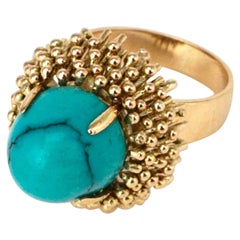
Vintage 1960s American Modernist Cocktail Rings
Turquoise, Yellow Gold

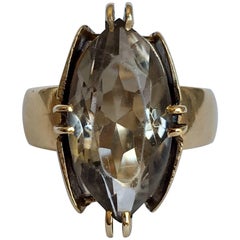
Vintage 1960s British Modernist Cocktail Rings
Quartz, 9k Gold
- 1
1960s Modernist Ring For Sale on 1stDibs
How Much is a 1960s Modernist Ring?
Finding the Right Rings for You
Antique and vintage rings have long held a special place in the hearts of fine jewelry lovers all over the world.
No matter their origin or specific characteristics, rings are timeless, versatile accessories. They’ve carried deep meaning since at least the Middle Ages, when diamond rings symbolized strength and other kinds of rings were worn to signify romantic feelings or to denote an affiliation with a religious order. Rings have also forever been emblematic of eternity.
Over time, rings have frequently taken the form of serpents, which have long been associated with eternal life, health and renewal. Italian luxury jewelry house Bulgari has become famous for its widely loved Serpenti motif, for example, and its Serpenti ring, like the other accessories in the collection, began as an homage to jewelry of the Roman and Hellenistic eras. The serpent is now a popular motif in fine jewelry. Jewelry devotees have long pined for rings adorned with reptiles, thanks to antique Victorian rings — well, specifically, Queen Victoria’s illustrious engagement ring, which took the form of a gold snake set with rubies, diamonds and an emerald (her birthstone). Designs for Victorian-era engagement rings often featured repoussé work and chasing, in which patterns are hammered into the metal.
Engagement rings, which are reliably intimidating to shop for, are still widely recognized as symbols of love and commitment. On 1stDibs, a range of buying guides can be found for those in the market for antique engagement rings, vintage engagement rings or Art Deco engagement rings.
The most collectible antique engagement rings and vintage engagement rings are those from the Victorian, Edwardian and Art Deco eras. Named for the monarchies of the four King Georges, who in succession ruled England starting in 1714 (plus King William’s reign), antique Georgian rings, be they engagement rings or otherwise, are also coveted by collectors. Pearls, along with colored gemstones like garnets, rubies and sapphires, were widely used in Georgian jewelry. The late-1700s paste jewelry was a predecessor to what we now call fashion or costume jewelry.
The Art Nouveau movement (1880–1910) brought with it rings inspired by the natural world. Antique Art Nouveau rings might feature depictions of winged insects and fauna as well as women, who were simultaneously eroticized and romanticized, frequently with long flowing hair. Art Deco jewelry, on the other hand, which originated during the 1920s and ’30s, is by and large “white jewelry.” White metals, primarily platinum, were favored over yellow gold in the design of antique Art Deco rings and other accessories as well as geometric motifs, with women drawn to the era’s dazzling cocktail rings in particular.
Whether you’re hunting down a chunky classic for a Prohibition-themed cocktail party or seeking a clean contemporary design to complement your casual ensemble, find an exquisite collection of antique, new and vintage rings on 1stDibs.
- Were there watches in the 1960s?1 Answer1stDibs ExpertFebruary 13, 2023Yes, there were watches in the 1960s. The first recorded wristwatch dates back to 1868, when Patek Philippe, a watchmaker founded in Geneva in 1839 by Polish expats Antoni Patek and Franciszek Czapek, designed a timepiece for Countess Koscowicz of Hungary. Shop a collection of vintage watches from some of the world’s top sellers on 1stDibs.
- What is a caftan from the 1960s?1 Answer1stDibs ExpertFebruary 13, 2023A caftan from the 1960s or any other era refers to a long ankle-length variation on a robe or a tunic. Caftans, which are sometimes referred to as kaftans, feature full sleeves and usually have a deep, open neck. While these garments can be made from any fabric, most caftans are made of wool, silk or cotton. Find a selection of caftans from top fashion boutiques around the world on 1stDibs.
- What was worn in the 1960s?1 Answer1stDibs ExpertFebruary 22, 2021Fashion in the 1960s progressed toward a more casual look for men and for women during the decade. For women, the skirt suits of the 1950s prevailed during the early ‘60s and eventually miniskirts came along. Late-1960s fashion included ponchos, peace signs, chain belts, puffed “bubble” sleeves, frayed bell-bottom jeans for men and women, tie-dyed shirts, work shirts, sandals, headbands and moccasins.
- 1stDibs ExpertFebruary 13, 2023Furniture from the 1960s is often called mid-century modern. This style emphasizes the importance of good design that looks attractive and performs its function well. Notable mid-century modern designers include Eero Saarinen, George Nelson, Florence Knoll and Charles and Ray Eames. On 1stDibs, shop a selection of mid-century modern furniture.
- 1stDibs ExpertFebruary 21, 2024The dresses they wore in the 1960s varied depending on the time of day and the occasion. For everyday wear, many women opted for simply tailored frocks called shift dresses. They often featured bold geometric prints in eye-catching colors. In the evening, women tended to opt for gowns with plunging necklines, fitted waists and flowing full skirts. On 1stDibs, shop a diverse assortment of vintage dresses from the 1960s.
- What did men wear in the 1960s?1 Answer1stDibs ExpertApril 26, 2024What men wore in the 1960s varied over the course of the decade. At the start of the ’60s, when the Mod style was all the rage, men often sported boxy Italian-style suits with tight-fitting trousers for work and dressier occasions and polo shirts and turtlenecks paired with fitted trousers for casual dress. As the decade progressed, the Peacock Revolution occurred, with menswear becoming flashier with bright colors and bold prints. Fedoras and trilby hats were common in the early ’60s, but by the start of the 1970s, hats for men were much less common, marking a major departure from the style conventions of the 1930s, ’40s and ’50s. Explore an assortment of 1960s men's apparel and accessories on 1stDibs.
- 1stDibs ExpertApril 5, 2022To tell if a dress is from the 1960s or 1970s, first look for a label. You may be able to determine the approximate date of the dress simply by researching the designer using reputable online sources. Also, check the zippers. Dresses from the 1960s will usually have metal or nylon zippers. Ones from the 1970s are more likely to be plastic. You'll find a large selection of vintage dresses on 1stDibs.
- 1stDibs ExpertApril 5, 2022Go-go boots were fashionable in the late 1960s through the 1970s. A calf-length to knee-length boot became synonymous with 1960s and 1970s fashion and is still highly coveted today by fashion enthusiasts. Shop a wide range of vintage go-go boots on 1stDibs.
- 1stDibs ExpertFebruary 21, 2024Who the most famous fashion designer of the 1960s was is open to debate. Many designers helped define the looks of the decade, each influencing style in their own way. Among these notable designers were Mary Quant, André Courrèges, Pierre Cardin, Yves Saint Laurent, Bonnie Cashin, Hubert de Givenchy, Emilio Pucci, Paco Rabanne and Ossie Clark. On 1stDibs, shop a variety of vintage apparel and accessories from the 1960s.
- 1stDibs ExpertFebruary 1, 2024Generally, 1960s-style furniture is called mid-century modern. The style, which emerged primarily in the years following World War II, is characterized by pieces that were conceived and made in an energetic, optimistic spirit by creators who believed that good design was an essential part of good living. Some of the most notable furniture designers of the time include Charles and Ray Eames, Arne Jacobsen, Eero Saarinen and Hans J. Wegner. On 1stDibs, shop a variety of mid-century modern furniture.
- 1stDibs ExpertSeptember 27, 2024What the dress style was called in the 1960s varied, as there were several types of dresses that were fashionable during the decade. At the start of the 1960s, many women wore swing dresses featuring fitted bodices and full skirts. Collared, button-up belted dresses called shirtwaist dresses were also popular, as were loose-fitting, flowy shift dresses. By the late 1960s, new styles emerged, such as flared, flowing tent dresses, sleeveless jumpers usually styled over sweaters and blouses and drop-waist dresses, which had their waist seams at the hips rather than the natural waist. Find a variety of 1960s dresses and other vintage dresses on 1stDibs.
- What is a 925s ring?1 Answer1stDibs ExpertApril 5, 2022A 925s ring is a piece of jewelry worn on a finger made of a specific type of precious metal. Specifically, 925s indicated 925 sterling silver. This metal is 92.5 percent pure silver, and the remaining 7.5 percent is another metal like copper. Shop a wide range of sterling silver rings on 1stDibs.
- 1stDibs ExpertDecember 4, 2023Yes, they did have wedding rings during the 1600s. However, exchanging rings during weddings was not common in all cultures. In Europe, many couples presented each other with rings to symbolize their marriage vows. The wedding ring tradition actually dates back thousands of years to ancient Egypt, Greece and Rome. Explore a wide variety of wedding rings on 1stDibs.
- Which artist became famous for his series of black paintings in the late 1950s and early 1960s?1 Answer1stDibs ExpertJanuary 27, 2025Frank Stella is the artist who became famous for his series of black paintings in the late 1950s and early 1960s. These works featured bands of black paint separated by thin, precise stripes of bare canvas. At a time when contemporary painting was all about wild gestures, thick paint and formal abandon, the “Black Paintings” created a sensation. Explore a range of Frank Stella art on 1stDibs.
- 1stDibs ExpertNovember 21, 2023In the 1920s, engagement rings still looked like rings but were representative of a diverse range of styles and influences. Art Deco diamond ring designs took inspiration from the contemporary Cubist movement as well as from ancient Egypt – a revival sparked by the opening of King Tut’s tomb in 1922. Native American, African and Asian motifs also inspired jewelry pieces. Diamonds in square and rectangular shapes incorporating angular steps – like emerald cuts, Asscher cuts and baguettes – were set against black onyx, rubies, sapphires and emeralds to create color-blocking effects. Platinum, 18-karat gold, 14-karat white gold and sterling silver were some of the favored metals of the decade. Find a wide range of Art Deco engagement rings on 1stDibs.
- 1stDibs ExpertDecember 4, 2023What wedding rings looked like in the 1800s was similar to other Victorian jewelry. The Victorian era spanned from 1837 to 1901, coinciding with the reign of Queen Victoria in the United Kingdom. At the beginning of this period, rings were made of gold and affordable only to the wealthy. Designs for Victorian-era rings often featured repoussé work and chasing, in which patterns are hammered into the metal. Some featured stones secured by collets, settings similar to bezels, with prongs and a closed back. On 1stDibs, find a selection of Victorian wedding rings.
- 1stDibs ExpertNovember 21, 2023In the early 1900s, engagement rings often looked like other jewelry from the Edwardian era, which coincided with the reign of King Edward VII in the United Kingdom from 1901 to 1910. Cutters used new diamond saws and jewelry lathes to refine the old European cut. The resulting stones, designed to sparkle in the light from candles and gas lamps, are beloved by connoisseurs for their inner fire and romantic glow. The invention of the oxyacetylene torch enabled jewelers to use platinum, which had previously been too challenging to work with. This technological advancement made it possible for Edwardian rings to show off lacy filigree and milgrain work. Nature also influenced jewelry in the early 1900s. Flowing and floral garland motifs were so popular that the Edwardian age is sometimes called the "garland era." Find a selection of Edwardian engagement rings on 1stDibs.