4 Foot Credenza
Recent Sales
Vintage 1960s American Credenzas
Slate
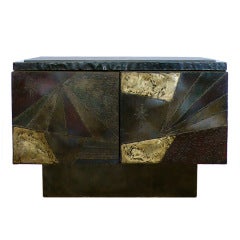

4 Foot Credenza For Sale on 1stDibs
How Much is a 4 Foot Credenza?
Paul Evans for sale on 1stDibs
A designer and sculptor, Paul Evans was a wild card of late 20th century modernism. A leading light of the American Studio Furniture movement, Evans’s sideboards, credenzas, coffee tables and other work manifests a singular aesthetic sense, as well as a seemingly contradictory appreciation for both folk art forms and for new materials and technologies.
Evans’s primary material was metal, not wood, which was favored by his fellow studio designers, and Bucks County, Pennsylvania, neighbors George Nakashima and Phillip Lloyd Powell. He trained in metallurgy and studied at the Cranbrook Academy of Art, the famed crucible of modern design and art in suburban Detroit. For a time early in his career, Evans also worked at Sturbridge Village, a historical “living museum” in Massachusetts, where he gave demonstrations as a costumed silversmith.
Evans’s earliest work unites these influences. The pieces that made his reputation are known as “sculpted-front” cabinets: wood cases faced with box-like high-relief patinated steel mounts laid out in a grid pattern. Each mount contains a metal emblem, or glyph, and the effect is that of a brawny quilt.
Evans’s later work falls into three distinct style groups. His sculpted-bronze pieces, begun in the mid-1960s, show Evans at his most expressive. He employed a technique in which resin is hand-shaped, and later sprayed with a metal coating, allowing for artistic nuance in the making of chairs, tables and case pieces. Later in the decade and into the 1970s, Evans produced his Argente series for celebrated manufacturer Directional (a brand known to vintage mid-century modern furniture collectors everywhere): consoles and other furniture forms that feature aluminum and pigment-infused metal surfaces welded into abstract organic forms and patterns.
Last, Evans's Cityscape design series — a milestone in the history of brutalist design — meshed perfectly with the sleek, “high tech” sensibility of the later ’70s. Evans constructed boxy forms and faced them with irregular mosaic patterns that mixed rectangular plaques of chromed steel, bronze or burlwood veneer. These, like all of Paul Evans’s designs, are both useful and eye-catching. But their appeal has another, more visceral quality: these pieces have clearly been touched by an artist’s hand.
Find a collection of authentic Paul Evans furniture today on 1stDibs.
Finding the Right Cabinets for You
Although traditionally used in the bedroom to store garments that would not be hung in a closet, an antique or vintage cabinet can easily find a purpose in rooms throughout your entire house.
The world's first storage cabinets, reportedly constructed in Renaissance-era Europe, were demonstrative of excellence in carpentry and the work of master carvers. These robust bureaus or sophisticated chests of drawers were typically built from common woods, such as oak or walnut. Although they were fairly uniform in structure and lacked the bright colors of modern-day furniture, case pieces and storage cabinets that date from the 18th century and earlier were often found in the homes of nobility.
Their intricate carvings and various embellishments — adornments made from ivory, ornate lacquer work and, later, glass shelvings — reflect the elegance with which these decorative furnishings were associated. Given its valuable purpose and the beauty of the early furnishings' designs, the storage cabinet is an investment that will never go out of style.
The practical design that defines the earliest storage cabinets has inspired the creation of household must-haves, like minimalist drink trolleys and marble wood bookcases. From hiding outdoor gear in the mudroom to decluttering your kitchen with a tall kitchen pantry cabinet, these versatile furnishings have now become available in enough sizes, styles and colors to accommodate any space. After all, these aren't your run-of-the-mill filing cabinets.
A sophisticated storage cabinet — wood storage cabinets with doors and shelves, for example — can serve as a room divider when necessary, while the right vintage wall unit or floor-to-ceiling cabinetry solutions can seamlessly become part of any space without disrupting the energy of the room. And although you may hide items away in its drawers, bookworms might prefer a storage cabinet with open shelving for displaying favorite books or other media.
One-of-a-kind solutions for the modern consumer abound, but enthusiasts of understated, classical beauty may turn to Baroque-style storage cabinets. Elsewhere, admirers of mid-century modernism looking to make a statement with their case pieces will warm to the dark woods and clean lines of vintage storage cabinets by Paul McCobb, Florence Knoll or Edward Wormley.
Sometimes the best renovation is a reorganization. If you're ready to organize and elevate your space, a luxury storage cabinet is the addition you need.
Find a variety of vintage and antique storage cabinets on 1stDibs, including unique Art Deco storage cabinets, chinoiserie cabinets and more.