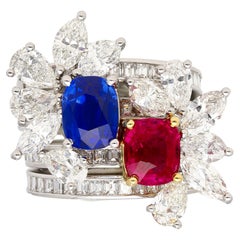
8 Carat Sapphire Kashmir
21st Century and Contemporary Indian Art Nouveau Cocktail Rings
Diamond, Ruby, Sapphire, 18k Gold, White Gold, Yellow Gold
People Also Browsed
2010s Italian Evening Gowns
2010s French Bomber Jackets
Early 2000s French Evening Dresses and Gowns

1990s French Evening Dresses and Gowns

Early 2000s Italian Evening Dresses
21st Century and Contemporary Top Handle Bags
1990s French Coats and Outerwear

1970s European Suitcases and Trunks
Early 2000s French Coats and Outerwear

Early 2000s American Bolero Jackets
1990s Italian Evening Dresses and Gowns
21st Century and Contemporary Evening Gowns
Early 2000s Jumpsuits

8 Carat Sapphire Kashmir For Sale on 1stDibs
How Much is a 8 Carat Sapphire Kashmir?
A Close Look at Art-nouveau Jewelry
Art Nouveau — generally considered to have begun in the late 1800s and ended with the start of World War I — was a movement in the decorative arts that drew inspiration from natural forms, such as trees, flowers and, of course, the human figure. The three main themes present in Art Nouveau jewelry and watches were flora, fauna and women.
Art Nouveau, which reached its pinnacle in the year 1900, spawned from artists who rejected the historicism of their predecessors to create an entirely new visual vocabulary. As compared to Art Deco jewelry’s geometric patterns and sharp lines, the extravagant style of antique Art Nouveau jewelry is characterized by curvilinear forms and whiplash lines, vibrant materials and dramatic imagery.
The first art and design movement of the 20th century, Art Nouveau was also a reaction against the Industrial Revolution, and took its inspiration from the theories of the Symbolists, the art of the Pre-Raphaelites, the ideas of John Ruskin and his follower William Morris and, most importantly Japanese crafts. (The country was a fertile ground for inspiration after it was opened to the West in 1854.) The Art Nouveau style touched all manners of the arts, including the most exultant jewelry.
Nature was a favorite muse for artists going back to the 18th and 19th centuries, but in the hands of 20th-century artists, it was depicted in new ways. For example, a withering flower was considered just as beautiful as one in full bloom. Winged creatures, such as insects and birds, were also a popular subject. Dragonflies and butterflies were particular favorites because they morphed so dramatically in different life stages.
This was also a reference to women, whose role in society was evolving. It was not uncommon to see a piece of jewelry that would at once reference a woman as a winged creature (think René Lalique’s famous Dragonfly brooch, circa 1897–98, at the Gulbenkian Collection in Lisbon). However, just as women’s roles were ambiguous, so was their image, as the femmes nouvelle were simultaneously eroticized and romanticized.
In addition to Lalique, vital figures in Art Nouveau jewelry included Louis Comfort Tiffany in the United States, Vladimir Soloviev, who designed jewelry for Peter Carl Fabergé in Russia, Fuset Grau of Spain, Karl Rothmuller of Germany and Philippe Wolfers of Belgium.
Art Nouveau jewelers used every “canvas” imaginable, looking beyond brooches and necklaces to belt buckles, fans, tiaras, dog collars (a type of choker necklace), pocket watches, corsages and hair combs. Multicolored gems and enamel could complete this vision better than diamonds. Jewelers also favored pearls, particularly baroque pearls, for their large size and irregular shape. However, opal was the most popular stone — its iridescence harmonized perfectly with the enamel, and it could be carved into any shape. Art Nouveau jewelry was primarily set in yellow gold.
Find a range of antique Art Nouveau jewelry today on 1stDibs.
The Legacy of Diamond in Jewelry Design
Antique diamond rings, diamond tiaras and dazzling vintage diamond earrings are on the wish lists of every lover of fine jewelry. And diamonds and diamond jewelry are primarily associated with storybook engagements and red-carpet grand entrances — indeed, this ultra-cherished gemstone has a dramatic history on its hands.
From “A Diamond Is Forever” to “Diamonds Are a Girl’s Best Friend,” pop culture has ingrained in our minds that diamonds are the most desired, the most lasting and the most valuable gemstone. But what makes the diamond so special? Each stone — whether it’s rubies, sapphires or another stone — is unique and important in its own right. April babies might claim diamonds for themselves, but just about everyone wants this kind of sparkle in their lives!
There are several factors that set diamonds apart from other stones, and these points are important to our gem education.
Diamonds are minerals. They are made up of almost entirely of carbon (carbon comprises 99.95 percent; the remainder consists of various trace elements). Diamonds are the hardest gemstones, ranking number 10 on the Mohs Hardness Scale. Even its name, diamond, is rooted in the Greek adamas, or unconquerable. The only object that can scratch a diamond is another diamond. Diamonds are formed deep within the earth at very high temperatures (1,652–2,372 degrees Fahrenheit at depths between 90 and 120 miles beneath the earth’s surface) and are carried up by volcanic activity. Diamonds are quite rare, according to the Gemological Institute of America, and only 30 percent of all the diamonds mined in the world are gem quality.
In the 1950s, the Gemological Institute of America developed the 4Cs grading system to classify diamonds: clarity, color, cut and carat weight. Not all diamonds are created equal (there are diamonds, and then there are diamonds). The value of the diamond depends on the clarity (flawless diamonds are very rare but a diamond's value decreases if there are many blemishes or inclusions), color (the less color the higher the grade), cut (how the diamond’s facets catch the light, certain cuts of diamonds show off the stone better than others) and carat weight (the bigger, the better).
When you start shopping for a diamond engagement ring, always prioritize the cut, which plays the largest role in the diamond's beauty (taking the time to clean your diamond ring at least every six months or so plays a role in maintaining said beauty). And on 1stDibs, a range of buying guides can be found for those in the market for antique engagement rings, vintage engagement rings or Art Deco engagement rings.
Shop antique and vintage diamond rings, diamond necklaces and other extraordinary diamond jewelry on 1stDibs.
Finding the Right Cocktail-rings for You
A flashy symbol of wealth during the early 20th century, antique and vintage cocktail rings have gained broader appeal in the decades since for the hefty dose of glamour they bring to any ensemble.
Cocktail rings earned their name for their frequent appearances during glitzy cocktail parties at the height of the Prohibition era. Back then, these accessories were seen not only as statement pieces but as statements in and of themselves. They openly represented a sense of freedom and independence as well as a demonstration of opulence. After all, the 1920s heralded the Harlem Renaissance and Art Deco design, and a slew of social and cultural shifts meant that women in particular were breaking from pre–World War I conventions and embracing newfound freedoms to express themselves as individuals.
Women expressly wore cocktail rings on the fingers of their right hand versus the left, which was “reserved” for an engagement ring or wedding band, accessories definitely paid for by a suitor. And for cocktail rings, the bigger the colored gem at the center — which is usually mounted in a high setting — and the more elaborate the design, the stronger the likelihood of being noticed.
Cocktail rings remained a popular piece of jewelry for women until the 1930s, when the Great Depression and the onset of war marked a change in behaviors nationwide. While the 1960s and ’70s saw a return in visibility for the accessory, it wasn’t until the 1980s that cocktail rings once again assumed their position as a beacon of luxury and glitz.
During the 20th century, the range of dazzling cocktail rings seems to have been limitless, from glimmering gold rings set with carved jade diamonds designed by David Webb to Pomellato’s pink quartz confections to striking Gucci butterfly rings with accent diamonds set in a pavé fashion.
So, how do you wear a cocktail ring? Cocktail rings “can be worn for almost anything — dinners, date nights, parties, special events, on the red carpet,” explains David Joseph of New York-based jewelry brand Bochic.
Can you wear cocktail rings with other rings? “In my opinion, cocktail rings should stand on their own since they showcase a large gem in the center,” says Joseph.
These glamorous jewels can be worn inside or outside crowded taverns, in either daytime or nighttime with casual or dressy attire. On 1stDibs, find a wide variety of antique and vintage cocktail rings, including those offered by Chanel, whose elegant cocktail rings often feature pearls and, of course, diamonds, and sometimes were styled after showy flowers like the camellia, and Van Cleef Arpels, whose detailed and intricate designs are viewed as miniature pieces of wearable art.