Antique Brass Overmantle Mirror
Recent Sales
1910s Art Nouveau Antique Brass Overmantle Mirror
Brass
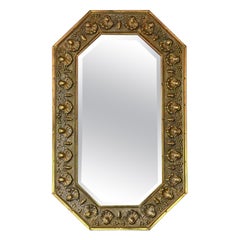

1910s Art Nouveau Antique Brass Overmantle Mirror
Brass
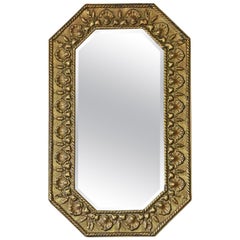
1910s Art Nouveau Antique Brass Overmantle Mirror
Brass, Copper
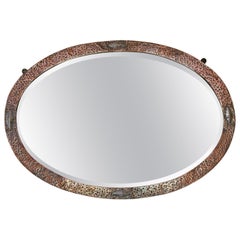
A Close Look at Art-nouveau Furniture
In its sinuous lines and flamboyant curves inspired by the natural world, antique Art Nouveau furniture reflects a desire for freedom from the stuffy social and artistic strictures of the Victorian era. The Art Nouveau movement developed in the decorative arts in France and Britain in the early 1880s and quickly became a dominant aesthetic style in Western Europe and the United States.
ORIGINS OF ART NOUVEAU FURNITURE DESIGN
- Emerged during the late 19th century
- Popularity of this modernizing style declined in the early 20th century
- Originated in France and Britain but variants materialized elsewhere
- Informed by Rococo, Pre-Raphaelite art, Japanese art (and Japonisme), Arts and Crafts; influenced modernism, Bauhaus
CHARACTERISTICS OF ART NOUVEAU FURNITURE DESIGN
- Sinuous, organic and flowing lines
- Forms that mimic flowers and plant life
- Decorative inlays and ornate carvings of natural-world motifs such as insects and animals
- Use of hardwoods such as oak, mahogany and rosewood
ART NOUVEAU FURNITURE DESIGNERS TO KNOW
ANTIQUE ART NOUVEAU FURNITURE ON 1STDIBS
Art Nouveau — which spanned furniture, architecture, jewelry and graphic design — can be easily identified by its lush, flowing forms suggested by flowers and plants, as well as the lissome tendrils of sea life. Although Art Deco and Art Nouveau were both in the forefront of turn-of-the-20th-century design, they are very different styles — Art Deco is marked by bold, geometric shapes while Art Nouveau incorporates dreamlike, floral motifs. The latter’s signature motif is the "whiplash" curve — a deep, narrow, dynamic parabola that appears as an element in everything from chair arms to cabinetry and mirror frames.
The visual vocabulary of Art Nouveau was particularly influenced by the soft colors and abstract images of nature seen in Japanese art prints, which arrived in large numbers in the West after open trade was forced upon Japan in the 1860s. Impressionist artists were moved by the artistic tradition of Japanese woodblock printmaking, and Japonisme — a term used to describe the appetite for Japanese art and culture in Europe at the time — greatly informed Art Nouveau.
The Art Nouveau style quickly reached a wide audience in Europe via advertising posters, book covers, illustrations and other work by such artists as Aubrey Beardsley, Henri de Toulouse-Lautrec and Alphonse Mucha. While all Art Nouveau designs share common formal elements, different countries and regions produced their own variants.
In Scotland, the architect Charles Rennie Mackintosh developed a singular, restrained look based on scale rather than ornament; a style best known from his narrow chairs with exceedingly tall backs, designed for Glasgow tea rooms. Meanwhile in France, Hector Guimard — whose iconic 1896 entry arches for the Paris Metro are still in use — and Louis Majorelle produced chairs, desks, bed frames and cabinets with sweeping lines and rich veneers.
The Art Nouveau movement was known as Jugendstil ("Youth Style") in Germany, and in Austria the designers of the Vienna Secession group — notably Koloman Moser, Josef Hoffmann and Joseph Maria Olbrich — produced a relatively austere iteration of the Art Nouveau style, which mixed curving and geometric elements.
Art Nouveau revitalized all of the applied arts. Ceramists such as Ernest Chaplet and Edmond Lachenal created new forms covered in novel and rediscovered glazes that produced thick, foam-like finishes. Bold vases, bowls and lighting designs in acid-etched and marquetry cameo glass by Émile Gallé and the Daum Freres appeared in France, while in New York the glass workshop-cum-laboratory of Louis Comfort Tiffany — the core of what eventually became a multimedia decorative-arts manufactory called Tiffany Studios — brought out buoyant pieces in opalescent favrile glass.
Jewelry design was revolutionized, as settings, for the first time, were emphasized as much as, or more than, gemstones. A favorite Art Nouveau jewelry motif was insects (think of Tiffany, in his famed Dragonflies glass lampshade).
Like a mayfly, Art Nouveau was short-lived. The sensuous, languorous style fell out of favor early in the 20th century, deemed perhaps too light and insubstantial for European tastes in the aftermath of World War I. But as the designs on 1stDibs demonstrate, Art Nouveau retains its power to fascinate and seduce.
There are ways to tastefully integrate a touch of Art Nouveau into even the most modern interior — browse an extraordinary collection of original antique Art Nouveau furniture on 1stDibs, which includes decorative objects, seating, tables, garden elements and more.
Materials: Brass Furniture
Whether burnished or lacquered, antique, new and vintage brass furniture can elevate a room.
From traditional spaces that use brass as an accent — by way of brass dining chairs or brass pendant lights — to contemporary rooms that embrace bold brass decor, there are many ways to incorporate the golden-hued metal.
“I find mixed metals to be a very updated approach, as opposed to the old days, when it was all shiny brass of dulled-out silver tones,” says interior designer Drew McGukin. “I especially love working with brass and blackened steel for added warmth and tonality. To me, aged brass is complementary across many design styles and can trend contemporary or traditional when pushed either way.”
He proves his point in a San Francisco entryway, where a Lindsey Adelman light fixture hangs above a limited-edition table and stools by Kelly Wearstler — also an enthusiast of juxtapositions — all providing bronze accents. The walls were hand-painted by artist Caroline Lizarraga and the ombré stair runner is by DMc.
West Coast designer Catherine Kwong chose a sleek brass and lacquered-parchment credenza by Scala Luxury to fit this San Francisco apartment. “The design of this sideboard is reminiscent of work by French modernist Jean Prouvé. The brass font imbues the space with warmth and the round ‘portholes’ provide an arresting geometric element.”
Find antique, new and vintage brass tables, case pieces and other furnishings now on 1stDibs.
Finding the Right Mantel-mirrors-fireplace-mirrors for You
Antique and vintage fireplace mirrors and mantel mirrors are sophisticated, classic pieces of decor, with the large size of fireplace mirrors making them centerpiece objects. They add character to any room and also create the appearance of space. Fireplace mirrors and mantel mirrors, like any well-placed antique or vintage mirror, can act as a source of light and make a room seem bigger than it is.
Fireplace mirrors were once a status symbol, as only the wealthiest could afford these big, beautiful pieces for their homes. In the 1500s and 1600s, the Venetian glass industry produced mirrors that were luxury items. Their painstaking creation was the result of a secretive process using melted tin, limiting their size and availability.
In the late 17th century, French glassmaker Bernard Perrot radically transformed mirrors. By casting glass into large, flat slabs, his work grew into an international market for mantel mirrors. These mirrors were often set in decorated frames.
French homes transitioned to lower fireplaces and mantels so tall mantel mirrors could fit above them. The design of fireplace mirrors reflected architectural trends. Some in the mid-18th century featured paintings, while others had delicate carvings.
By the 1800s, mantel mirrors had become more widely available. This reflected a dramatic change in glass mass-production technology, which made oversize mirrors more accessible, leading to their proliferation across the globe.
Today, mantel mirrors are still highly regarded statement pieces with an enduring reputation for elegance. Their versatility has allowed them to branch out beyond the fireplace. Their reflectiveness allows them to amplify a sumptuous painting in a bedroom or capture the tiling of a bathroom.
From mid-century modern designs to pieces created in Louis XVI style, there is a mirror for every room and every occasion on 1stDibs.