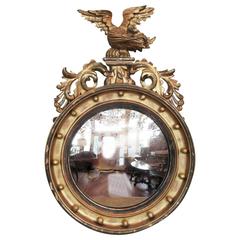
Antique Eagle Mirror
19th Century English Regency Antique Eagle Mirror
Mirror, Giltwood

- 1
Antique Eagle Mirror For Sale on 1stDibs
How Much is a Antique Eagle Mirror?
Finding the Right Mirrors for You
The road from early innovations in reflective glass to the alluring antique and vintage mirrors in trendy modern interiors has been a long one but we’re reminded of the journey everywhere we look.
In many respects, wall mirrors, floor mirrors and full-length mirrors are to interior design what jeans are to dressing. Exceedingly versatile. Universally flattering. Unobtrusively elegant. And while all mirrors are not created equal, even in their most elaborate incarnation, they're still the heavy lifters of interior design, visually enlarging and illuminating any space.
We’ve come a great distance from the polished stone that served as mirrors in Central America thousands of years ago or the copper mirrors of Mesopotamia before that. Today’s coveted glass Venetian mirrors, which should be cleaned with a solution of white vinegar and water, were likely produced in Italy beginning in the 1500s, while antique mirrors originating during the 19th century can add the rustic farmhouse feel to your mudroom that you didn’t know you needed.
By the early 20th century, experiments with various alloys allowed for mirrors to be made inexpensively. The geometric shapes and beveled edges that characterize mirrors crafted in the Art Deco style of the 1920s can bring pizzazz to your entryway, while an ornate LaBarge mirror made in the Hollywood Regency style makes a statement in any bedroom. Friedman Brothers is a particularly popular manufacturer known for decorative round and rectangular framed mirrors designed in the Rococo, Louis XVI and other styles, including dramatic wall mirrors framed in gold faux bamboo that bear the hallmarks of Asian design.
Perhaps unsurprisingly, mid-century modernism continues to influence the design of contemporary mirrors. Today’s simple yet chic mantel mirror frames, for example, often neutral in color, owe to the understated mirror designs introduced in the postwar era.
Sculptor and furniture maker Paul Evans had been making collage-style cabinets since at least the late 1950s when he designed his Patchwork mirror — part of a series that yielded expressive works of combined brass, copper and pewter — for Directional Furniture during the mid-1960s. Several books celebrating Evans’s work were published beginning in the early 2000s, as his unconventional furniture has been enjoying a moment not unlike the resurgence that the Ultrafragola mirror is seeing. Designed by the Memphis Group’s Ettore Sottsass in 1970, the Ultrafragola mirror, in all its sensuous acrylic splendor, has become somewhat of a star thanks to much-lauded appearances in shelter magazines and on social media.
On 1stDibs, we have a broad selection of vintage and antique mirrors and tips on how to style your contemporary mirror too.
- 1stDibs ExpertApril 5, 2022To tell if a mirror is antique, check the glass to see if it's wavy or has any imperfections. Modern glass tends to be perfect. While this can be a clue, it might just signify that the mirror is old, not antique. Another thing to check for is the reflective coating on the back of the glass to see if it has begun oxidizing and has any age scratches. Finally, check out the frame to see if it has the appearance of age. Shop a large collection of antique mirrors from some of the world’s top sellers on 1stDibs.
- 1stDibs ExpertApril 5, 2022An antique mirror is a mirror of considerable age that has historical significance or is in great demand due to its beauty or rarity. Oftentimes, you’ll hear an antique be defined as any item that is more than 100 years old, but this is not a specific measurement of an antique nor is it a requirement. Shop a collection of antique mirrors from some of the world’s top sellers on 1stDibs.
- 1stDibs ExpertFebruary 22, 2021You can tell if a mirror is antique through a number of indicators. For example, most antique mirrors are quite small in size, measuring no more than 2 feet. Additionally, antique mirrors will show signs of sports or discoloration. Many antique mirrors will have bubbling or waves in the glass.
- 1stDibs ExpertOctober 21, 2020
Repairs and replacements can go toward devaluing any piece of antique or vintage furniture, and any modifications or repairs done to a centuries-old mirror should be handled by experts and executed with care. Because antique Venetian mirrors were handcrafted by Italian artisans and can in some cases be hundreds of years old, it is strongly recommended that you consult with experts in the field of restoring antique or decorative mirrors in the event that your piece should require restorative work.
Read More
20 Artfully Crafted Mirrors to Frame Your Reflection
In "Object Permanence 4," on view at the 1stdibs Gallery, Emma Holland Denvir and Leah Ring have brought together pieces that range from polished to playful.
Unexpected Furniture Pieces Made from Clay
A new generation of creative minds is reinventing the use of clay through sculptural forms and bold ideas.
5 Standout Contemporary Mirrors (and How to Decorate with Them)
Leading talents tell us what goes into their mirrored creations and where to put them on a wall.
12 Rooms with Dramatic, Unexpected Mirrors
These are the fairest of them all.