Antique Kutani Porcelain Marks

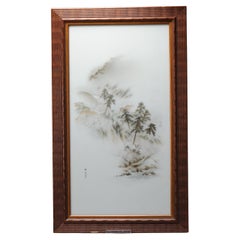
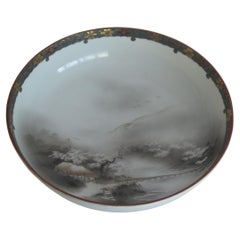
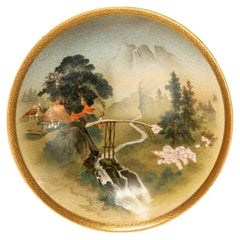
Antique Meiji Period Japanese Kutani Plaque with Landscape and Mark Japan 19th C
Located in Amsterdam, Noord Holland
Description Faboulous japanese porcelain plaque. Very high quality painting of a Mountain
Category

19th Century Japanese Meiji Antique Kutani Porcelain Marks

Materials

Porcelain

People Also Browsed

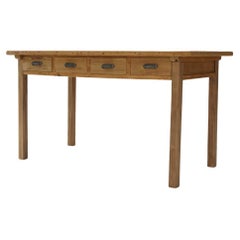
Japanese Antique Pine Cedar Dining Table, 1950s–1960s - Japandi Wabi-Sabi
Located in Chiba, Chiba
A Japanese antique dining table crafted from pine and cedar, dating from the 1950s–1960s. Its understated presence allows it to blend gently into a wide variety of interiors, offerin...
Category

Mid-20th Century Japanese Antique Kutani Porcelain Marks

Materials

Wood

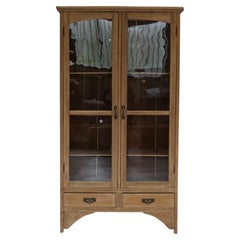
Japanese Antique Ash Wood Cabinet, 1912s–1926s - Japandi Wabi-Sabi
Located in Chiba, Chiba
A Japanese antique cabinet crafted from ash wood, dating from the 1912–1926 period. At 75 cm wide, it offers a compact footprint that fits easily into smaller rooms, entryways, or co...
Category

Early 20th Century Japanese Taisho Antique Kutani Porcelain Marks

Materials

Wood

Japanese 19th Century Keyaki Wood Isho Dansu Clothing Chest with Iron Hardware
Located in Yonkers, NY
A Japanese 19th century keyaki wood Sendai clothing tansu with four drawers and elaborate hand-cut iron hardware. Born during the 19th century in the Sendai prefecture, this exquisit...
Category

19th Century Japanese Antique Kutani Porcelain Marks

Materials

Iron

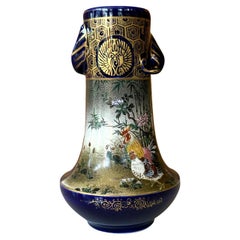
Fine Japanese Ceramic Satsuma Vase by Kinkozan
By Kinkozan
Located in Atlanta, GA
A miniature Japanese ceramic vase from the end of Meiji period circa 1880s- 1910s by Kinkozan (1645-1927). One of the largest studio manufacturers of the export ceramics at the time ...
Category

Early 20th Century Japanese Meiji Antique Kutani Porcelain Marks

Materials

Ceramic

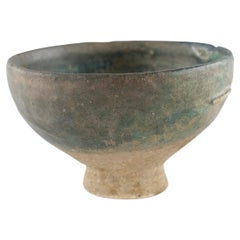
Japanese Chawan Teabowl Edo Period
Located in Stockholm, SE
A Japanese Chawan. Glazed pottery. 19th century or older. Provenance: Swedish early 20th century collection.
Category

19th Century Japanese Antique Kutani Porcelain Marks

Materials

Ceramic

Japanese Chawan 
Teabowl
 Edo Period
Japanese Chawan 
Teabowl
 Edo Period
$526 Sale Price
20% Off
H 2.56 in Dm 4.34 in
Large Japanese Kutani Satsuma Bowl Hand-Painted Marked to Base, Circa 1940
Located in Lincoln, Lincolnshire
This is a high quality Earthenware Japanese Satsuma - Kutani large Bowl, beautifully hand decorated and dating to Circa 1940. This is a well potted large diameter bowl, sitting on...
Category

Mid-20th Century Japanese Mid-Century Modern Antique Kutani Porcelain Marks

Materials

Earthenware

Exquisite Hand Painted Japanese Satsuma Lidded Bowl
Located in San Francisco, CA
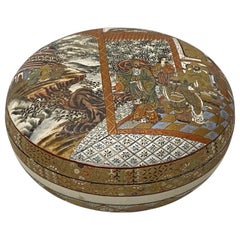
Exquisite Hand Painted Japanese Satsuma Lidded Bowl A stunning lidded Japanese Satsuma bowl, likely Meiji period, completely hand painted inside and out. This could be used on your ...
Category

Mid-20th Century Japanese Anglo-Japanese Antique Kutani Porcelain Marks

Materials

Porcelain

Japanese Antique Oak Armchair, 1920s–1930s - Japandi Wabi-Sabi
Located in Chiba, Chiba
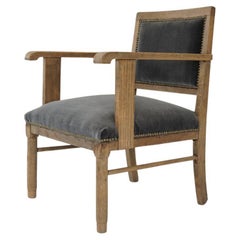
A Japanese antique armchair crafted from oak and dating from the 1920s–1930s. The blue-gray upholstery is beautifully complemented by decorative nailheads and subtle carved grooves a...
Category

Early 20th Century Japanese Antique Kutani Porcelain Marks

Materials

Wood

A Satsuma bowl decorated with a striking landscape
Located in Milano, IT
Satsuma bowl decorated with a striking landscape that evokes the beauty and serenity of the Japanese hills, with a gently flowing river surrounded by trees and mountains. The bowl i...
Category

19th Century Japanese Japonisme Antique Kutani Porcelain Marks

Materials

Ceramic

Fine and Rare Miniature Satsuma Vase by Taizan Yohei
Located in Atlanta, GA
A very fine miniature ceramic vase in satsuma ware by Taizan Yohei IX (1864-1922) circa 1880-1890s of late Meiji period. The vase with a broad flat shoulder was lavishly decorated wi...
Category

1880s Japanese Japonisme Antique Kutani Porcelain Marks

Materials

Ceramic

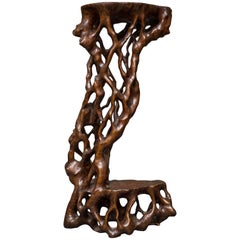
Japanese Two-Tier Root Stand
Located in Hudson, NY
Japanese two-tier root stand. Traditionally used for displaying flower arrangements.
Category

Early 20th Century Japanese Antique Kutani Porcelain Marks

Materials

Wood

Japanese Two-Tier Root Stand
$5,500
H 36 in W 18 in D 12 in
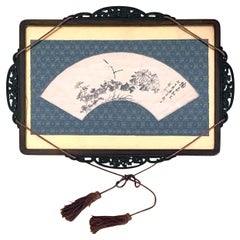
Framed Japanese Ink Painting Hidaka Tetsuo
By Hidaka Tetsuo
Located in Atlanta, GA
An ink painting on the fan surface by Japanese Zen artist Hidaka Tetsuo (1791-1871), now framed in a traditional Japanese carved wood frame with silk fabric mat and decorative hangin...
Category

1850s Japanese Japonisme Antique Kutani Porcelain Marks

Materials

Wood, Paper

Framed Japanese Ink Painting Hidaka Tetsuo
$2,500
H 19 in W 27 in D 1 in
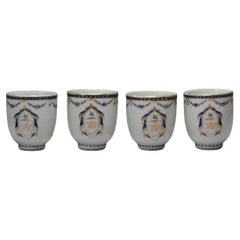
Antique Chinese Armorial WW Family Tea Set Porcelain Qianlong, 18th C, China
Located in Amsterdam, Noord Holland
Description A lovely set of 4 Armorial tea / coffee cups with the monogram WW. Condition 1 Cup with handle restored. 1 cup with frit to inside rim and minimal fleebites to bas...
Category

18th Century Chinese Qing Antique Kutani Porcelain Marks

Materials

Porcelain

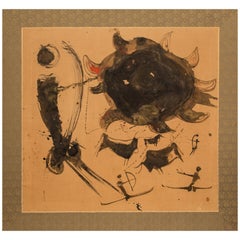
Japanese Modern Abstract Ink Painting
Located in Hudson, NY
On mulberry paper with silk brocade. From the estate of Andrea Bollt. Artist's seal reads: Mitsushito (died 1922).
Category

Early 1900s Japanese Antique Kutani Porcelain Marks

Materials

Brocade, Silk, Paper

Japanese Modern Abstract Ink Painting
$11,000
H 45.5 in W 48 in D 0.75 in
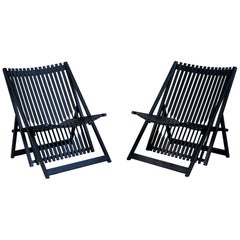
Jean-Claude Duboys, Pair of A1 Armchairs, France, 1980
By Jean-Claude Duboys
Located in Catonvielle, FR
Rare pair of A1 tinted gray lounge chairs by Jean-Claude Duboys, Attitude edition, France, 1980. Amazing comfort, these seats are made of solid maple blades, they fold and are part o...
Category

1980s French Mid-Century Modern Antique Kutani Porcelain Marks

Materials

Maple

Jean-Claude Duboys, Pair of A1 Armchairs, France, 1980
$2,753 / set
H 31.89 in W 25.4 in D 25.6 in
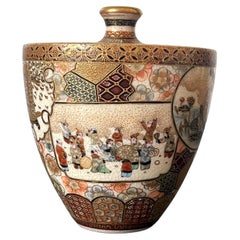
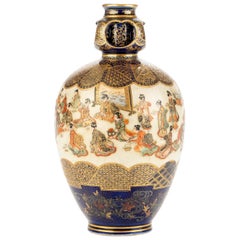
A Satsuma vase with numerous figures bringing gift
Located in Milano, IT
Satsuma bottle-shaped vase embellished with a detailed central scene in which numerous characters bring gifts to the emperor. The upper and lower sections of the vase are adorned wit...
Category

Late 19th Century Japanese Japonisme Antique Kutani Porcelain Marks

Materials

Ceramic

Get Updated with New Arrivals
Save "Antique Kutani Porcelain Marks", and we’ll notify you when there are new listings in this category.

Antique Kutani Porcelain Marks For Sale on 1stDibs

There is a range of antique kutani porcelain marks for sale on 1stDibs. Frequently made of ceramic, porcelain and gold, all antique kutani porcelain marks available were constructed with great care. There are all kinds of antique kutani porcelain marks available, from those produced as long ago as the 19th Century to those made as recently as the 20th Century.

How Much are Antique Kutani Porcelain Marks?

The average selling price for at 1stDibs is $1,869, while they’re typically $366 on the low end and $22,900 highest priced.

A Close Look at Meiji Furniture

From 1868 to 1912, Emperor Mutsuhito oversaw an era of transformation in Japan. Formerly a country of feudalism and isolation, Japan entered an age of modernization influenced by newly established trade and exchange with the West. The Meiji period, or period of “enlightened rule,” also saw the global impact of the East Asian country’s culture. Japanese Meiji furniture was exhibited at expositions from Paris to San Francisco and created for export.

Prior to the Meiji era, furniture was mostly made by commission for the ruling class; now there were new domestic and international markets. European styles like Japonisme appropriated Japanese design while craftsmen in places like Wales and England employed japanning, a varnishing technique that approximated the appearance of lacquer for the surfaces of furnishings.

Meiji furniture made for Japanese homes and buildings constructed in Western styles resulted in taller tables, chairs, cabinets with large drawers and other features. The government invested in areas such as transportation and communication, and because people could freely choose occupations after the restrictions of feudalism, industries of various types were energized by expressive new ideas during those years. Art schools were formed and, for the first time, design was an area of study in the country, leading to the evolution of professional design as a career by the 1890s.

The work of Japanese designers was transmitted widely through lavishly illustrated pattern books that included designs for screens and lacquerware for the home. While screens today may be of use as decorative accents or partitions to ensure privacy in one’s space, Japanese screens were adorned with paintings and were featured in performing arts such as concerts, tea ceremonies and more. The color illustrations that characterize Meiji woodblock prints, a genre of Japanese art that grew out of 17th-century developments in printing and book publishing, depicted the sweeping changes that the era brought to East Asia.

Although it was a time of societal and cultural shifts, a bolstered interest in art and design elevated Japanese craft traditions. From colorful porcelain table lamps with silk shades and hardwood tables decorated with dark lacquer to cabinets featuring iron hardware and inlaid with mother-of-pearl, Meiji furniture showcased Japan’s artistic heritage to the world.

Find a collection of antique Japanese Meiji period case pieces and storage cabinets, decorative objects, wall decorations and more furniture on 1stDibs.

Finding the Right Ceramics for You

With their rich and diverse history, antique, new and vintage Asian ceramics offer colorful and sophisticated ways to add flair to any space.

Japanese pottery dates back at least 13,000 years to the Jōmon period. Pieces from the Late Jōmon era display a rope-cord pattern encircling a pot or jug. During the Muromachi period, potters created simple bowls and utensils frequently used in tea ceremonies and were made as both functional and aesthetic objects.

Ceramics made during Japan’s Meiji period, from 1868 to 1912, reflected an explosion of artistic expression propelled by new access to international trade. Details became more intricate and refined, and colors were enhanced with new glazing practices.

Chinese porcelain, meanwhile, is often identified by its shape. Each reign and dynasty had specific shapes and styles that were encouraged by the imperial ruler. During the Song dynasty, for instance, there were four dominant types of ceramic vase shapes: plum-shaped, pear-shaped, cong-shaped (tall and square) and double-gourd.

Chinese ceramics that were made during the Qing dynasty were demonstrative of an expanded artistic expression, with more delicate shapes and a focus on intricate detailing. The shapes of ceramics from this era are thinner, taller and have subtle features like a gentle flare, such as on the mallet-shaped vase.

Later, the 17th- and 18th-century interior design trend of chinoiserie brought Asian paintings and screens, textiles and other art and furniture from the continent into many European homes.

Explore an extensive range of antique, new and vintage Asian ceramics on 1stDibs to find the perfect piece for your home.