Antique Pewter Flatware
Early 20th Century British Arts and Crafts Antique Pewter Flatware
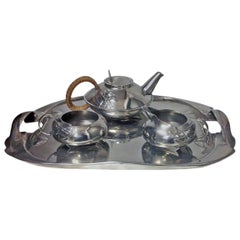

Liberty Co. for sale on 1stDibs
Long before Liberty became one of London’s most iconic luxury department stores, shoppers of the late 19th century knew it as Liberty Co. — purveyors of fine silverware designed in the Art Nouveau style, Arts and Crafts-style furniture and an eclectic assortment of ornaments, fabrics, fashion and other goods from around the world.
British merchant Arthur Lasenby Liberty founded Liberty Co. in 1875. Liberty dreamed of selling an assortment of fine wares he obtained in the Far East from a ship docked in the middle of one of London’s busiest shopping thoroughfares. However, he could only manage to borrow £2,000 from his father-in-law, so he settled for a small shop on Regent Street.
What began as a modest business grew exponentially over the next few years, and, by 1890, Liberty Co. occupied most of Regent Street. Meanwhile, Liberty forged relationships with many British Art Nouveau artists and designers who were keen to work with one of the most prestigious retailers in London.
In 1899, Liberty Co. hosted an exhibition showcasing a collection of silver pieces designed by notable silversmiths like Oliver Barker, Albert Edward Jones and Bernard Cuzner. A line of silverware called Cymric also debuted and was produced in partnership with silversmith W. H. Haseler of Birmingham and Liberty Co.’s chief designer, Manx artist Archibald Knox. The innovative Cymric collection featured a blend of Art Nouveau with traditional Celtic style, including such pieces as candlesticks, spoons, bowls, tableware and jewelry.
Liberty Co. also had a furniture workshop in Archway, London, run by Lawrence Turner and which employed carpenters to produce handcrafted, Arts and Crafts-style armchairs, stools, bookcases, cabinets, side tables and other furniture. Most of these high-quality and durable pieces were made of solid wood such as oak, mahogany and walnut. In addition to their own in-house creations, Liberty Co. also sold furniture by other designers, including chairs by German architect Richard Riemerschmid.
Liberty died in 1917, and Liberty Co. became Liberty of London after relocating to their iconic location on Great Marlborough Street in 1924. Ironically, the imposing Tudor Revival building is constructed from the timbers of two decommissioned British Navy ships — realizing Liberty’s original “ship-store” dream.
On 1stDibs, discover a range of antique and vintage Liberty Co. serveware, seating and decorative objects.
A Close Look at Arts-and-crafts Jewelry
The Arts and Crafts movement that emerged in England in the late 19th century saw a dehumanization of design in the rise of industrialization and mass production of objects. Its practitioners prized craftsmanship and a close connection between the artisan and the entire process of what they were making. This included the design of Arts and Crafts jewelry and watches, which evolved as the movement spread to the United States in the early 20th century.
While much of the Arts and Crafts furniture realm was dominated by male designers like William Morris and Gustav Stickley, several women came to prominence in Arts and Crafts jewelry design, including British metalworker Charlotte Newman and American enamelist and metalsmith Elizabeth Copeland. Many creators were part of guilds, encouraging an exchange of ideas, with some focused on jewelry, like England’s Guild and School of Handicraft — founded by Charles Robert Ashbee — and Birmingham Guild of Handicraft.
In contrast to the Victorian era, with its decadent gemstones and heavy mourning jewelry, designers of Arts and Crafts jewelry looked to the past and abroad for inspiration, from simple medieval shapes to East Asian styles. The movement’s emphasis on natural forms overlapped with Art Nouveau. Flourishes like leaves and flowers formed from silver, aluminum and copper can be found in bracelets and necklaces designed in this style, while rings and earrings are adorned with affordable gems such as turquoise and freshwater pearls.
Arts and Crafts jewelry designers used materials that were often simple, such as semiprecious stones and enamel, which is one of the oldest forms of surface decoration. Artisans prioritized the use of artistic techniques to elevate the jewelry rather than expensive components, and every piece was intended to be one of a kind — a work of wearable art.
Find antique Arts and Crafts jewelry boxes and a collection of Arts and Crafts jewelry on 1stDibs.
Finding the Right Coffee-tea-sets for You
As a part of your efforts to introduce a calm and tranquil aesthetic to your living room, dining room or other common area, consider how vintage and antique coffee sets and tea sets might play a role in welcoming guests as well as a relaxing atmosphere to your home.
Coffee and tea both have a ritualistic place in history that spans centuries and continents. Some of the oldest tea sets date to the Han dynasty in China. The early tea sets were simple and featured serving bowls rather than teapots. Over time, tea sets and coffee sets evolved to include the variety of pieces that modern sets have today.
Europe became enthralled with tea in the early 1600s when Portuguese and Dutch traders brought it back from China. Around this time, the Ottoman Empire — today’s Turkey — introduced coffee to Europe. In England, tea drinking has been a royal preoccupation for hundreds of years.
It all began in 1662, when Portugal’s Catherine of Braganza brought a canister of tea with her as part of her dowry when she arrived in England to wed King Charles II. During Queen Victoria’s reign, teakettles and coffeepots were added to tea services that were quite large. Indeed, small baked goods were served with your drink back then, and a tea set could include many teacups and saucers, a milk pot and other accessories. Early coffee tables surfaced in Victorian-era England, likely influenced by the use of tea tables in Japanese tea gardens. Since then, tea sets and coffee sets have been created in a range of styles and materials over the years.
Browse 1stDibs for a selection of authentic antique and vintage coffee sets and tea sets, reflecting a time when serving tea and coffee to guests represented the height of class and sophistication. Modern and contemporary designs offer a new take on these enduring objects.
- Is Liberty of London worth it?1 Answer1stDibs ExpertSeptember 27, 2024Yes, many furniture lovers believe that Liberty of London is worth it. The Liberty of London department store, located in the fashionable West End of London in the United Kingdom, has been selling luxury items since 1875. From leather footstools in the shape of a hippo to elegantly hand-carved Moroccan coffee tables, there’s something to please every discerning collector. The original Liberty Co. was a pivotal force in the development of the Aesthetic, Art Nouveau and Arts and Crafts movements. As an enduring champion of eclectic design, Liberty continues to collaborate with designers to produce covetable interior pieces and accessories. However, whether or not it’s worth investing in Liberty of London furniture is totally subjective! At 1stDibs, we believe in buying what you love. Our shopping experience enables discovery and learning, whether you are a seasoned connoisseur or just beginning your collection. Find a range of Liberty of London furniture on 1stDibs.