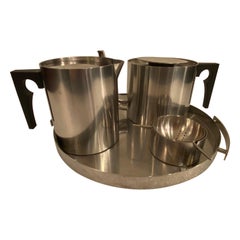
Arne Jacobsen Teapot
Vintage 1980s Danish Mid-Century Modern Tea Sets
Stainless Steel

People Also Browsed
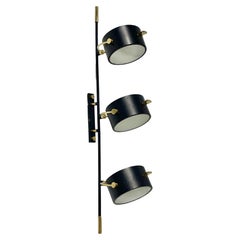
Vintage 1950s French Mid-Century Modern Wall Lights and Sconces
Aluminum, Brass
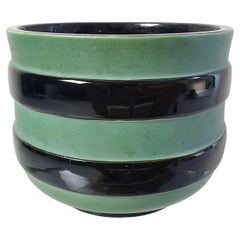
Vintage 1930s Italian Art Deco Planters, Cachepots and Jardinières
Ceramic
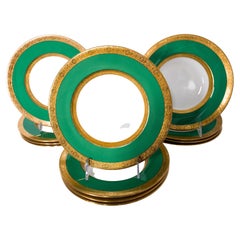
Vintage 1910s English Belle Époque Tableware
Gold, Enamel
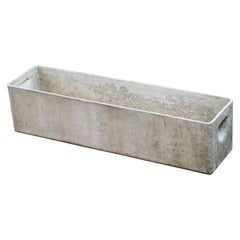
Vintage 1960s Swiss Mid-Century Modern Planters and Jardinieres
Concrete
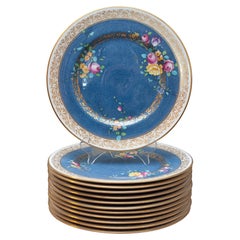
Vintage 1910s English Dinner Plates
Porcelain
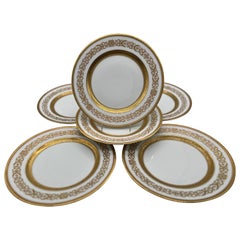
Early 20th Century French Dinner Plates
Porcelain
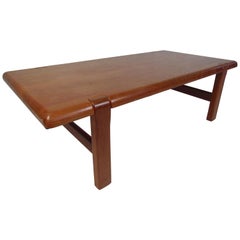
Vintage 1960s Danish Mid-Century Modern Coffee and Cocktail Tables
Teak
Vintage 1950s American Mid-Century Modern Bookcases
Aluminum
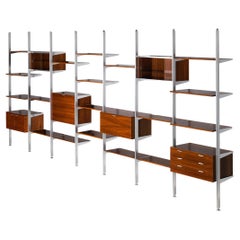
Vintage 1960s Danish Scandinavian Modern Benches
Teak
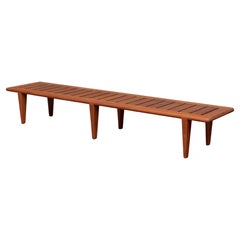
Vintage 1960s Italian Mid-Century Modern Sofas
Leather, Plastic
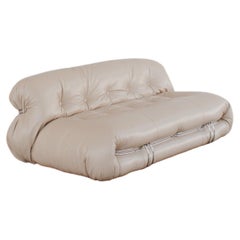
Antique 19th Century German Belle Époque Dinner Plates
Gold Leaf
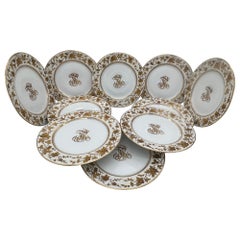
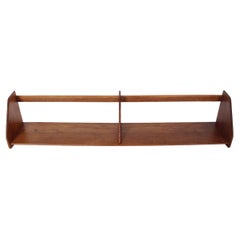
Vintage 1950s American Scandinavian Modern Shelves
Oak
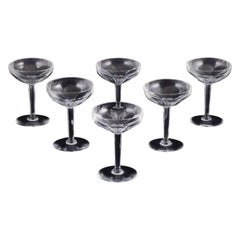
Vintage 1930s Belgian Art Deco Glass
Crystal
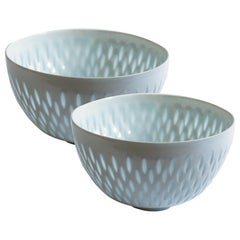
Vintage 1950s Swedish Scandinavian Modern Porcelain
Porcelain
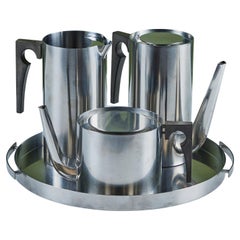
Vintage 1960s Danish Mid-Century Modern Tea Sets
Stainless Steel
Vintage 1970s Italian Arts and Crafts Centerpieces
Glass, Murano Glass
Arne Jacobsen for sale on 1stDibs
The eye-catching work of the Danish architect and designer Arne Jacobsen often introduces new collectors to mid-20th century furniture. With their fluid lines and sculptural presence, Jacobsen’s signature pieces — the elegant Swan chair and the cozy-yet-cutting edge Egg chair, both first presented in 1958 — are iconic representations of both the striking aesthetic of the designers of the era and their concomitant attention to practicality and comfort. Jacobsen designed furniture that had both gravitas and groove.
Though Jacobsen is a paragon of Danish modernism, his approach to design was the least “Danish” of those who are counted as his peers. The designs of Hans Wegner, Finn Juhl, Børge Mogensen and others grew out of their studies as cabinetmakers. They prized skilled craftsmanship and their primary material was carved, turned and joined wood. Jacobsen was first and foremost an architect, and while he shared his colleagues’ devotion to quality of construction, he was far more open to other materials such as metal and fiberglass.
Many of Jacobsen’s best-known pieces had their origin in architectural commissions. His molded-plywood, three-legged Ant chair (1952) was first designed for the cafeteria of a pharmaceutical company headquarters. The tall-backed Oxford chair was made for the use of dons at St. Catherine’s College, Oxford, whose Jacobsen-designed campus opened in 1962 (while still under construction). The Swan, Egg and Drop chairs and the AJ desk lamp were all created as part of Jacobsen’s plan for the SAS Royal Copenhagen Hotel, which opened in 1960. (The hotel has since been redecorated, but one guest room has been preserved with all-Jacobsen accoutrements.)
To Jacobsen’s mind, the chief merit of any design was practicality. He designed the first stainless-steel cutlery set made by the Danish silver company Georg Jensen; Jacobsen’s best-selling chair — the plywood Series 7 — was created to provide lightweight, stackable seating for modern eat-in kitchens. But as you will see from the objects on 1stDibs, style never took a backseat to function in Arne Jacobsen’s work. His work merits a place in any modern design collection.
Find authentic Arne Jacobsen chairs, tables, sofas and other furniture on 1stDibs.
A Close Look at Mid-century-modern Furniture
Organically shaped, clean-lined and elegantly simple are three terms that well describe vintage mid-century modern furniture. The style, which emerged primarily in the years following World War II, is characterized by pieces that were conceived and made in an energetic, optimistic spirit by creators who believed that good design was an essential part of good living.
ORIGINS OF MID-CENTURY MODERN FURNITURE DESIGN
- Emerged during the mid-20th century
- Informed by European modernism, Bauhaus, International style, Scandinavian modernism and Frank Lloyd Wright’s architecture
- A heyday of innovation in postwar America
- Experimentation with new ideas, new materials and new forms flourished in Scandinavia, Italy, the former Czechoslovakia and elsewhere in Europe
CHARACTERISTICS OF MID-CENTURY MODERN FURNITURE DESIGN
- Simplicity, organic forms, clean lines
- A blend of neutral and bold Pop art colors
- Use of natural and man-made materials — alluring woods such as teak, rosewood and oak; steel, fiberglass and molded plywood
- Light-filled spaces with colorful upholstery
- Glass walls and an emphasis on the outdoors
- Promotion of functionality
MID-CENTURY MODERN FURNITURE DESIGNERS TO KNOW
- Charles and Ray Eames
- Eero Saarinen
- Milo Baughman
- Florence Knoll
- Harry Bertoia
- Isamu Noguchi
- George Nelson
- Danish modernists Hans Wegner and Arne Jacobsen, whose emphasis on natural materials and craftsmanship influenced American designers and vice versa
ICONIC MID-CENTURY MODERN FURNITURE DESIGNS
- Eames lounge chair
- Nelson daybed
- Florence Knoll sofa
- Egg chair
- Womb chair
- Noguchi coffee table
- Barcelona chair
VINTAGE MID-CENTURY MODERN FURNITURE ON 1STDIBS
The mid-century modern era saw leagues of postwar American architects and designers animated by new ideas and new technology. The lean, functionalist International-style architecture of Le Corbusier and Bauhaus eminences Ludwig Mies van der Rohe and Walter Gropius had been promoted in the United States during the 1930s by Philip Johnson and others. New building techniques, such as “post-and-beam” construction, allowed the International-style schemes to be realized on a small scale in open-plan houses with long walls of glass.
Materials developed for wartime use became available for domestic goods and were incorporated into mid-century modern furniture designs. Charles and Ray Eames and Eero Saarinen, who had experimented extensively with molded plywood, eagerly embraced fiberglass for pieces such as the La Chaise and the Womb chair, respectively.
Architect, writer and designer George Nelson created with his team shades for the Bubble lamp using a new translucent polymer skin and, as design director at Herman Miller, recruited the Eameses, Alexander Girard and others for projects at the legendary Michigan furniture manufacturer.
Harry Bertoia and Isamu Noguchi devised chairs and tables built of wire mesh and wire struts. Materials were repurposed too: The Danish-born designer Jens Risom created a line of chairs using surplus parachute straps for webbed seats and backrests.
The Risom lounge chair was among the first pieces of furniture commissioned and produced by celebrated manufacturer Knoll, a chief influencer in the rise of modern design in the United States, thanks to the work of Florence Knoll, the pioneering architect and designer who made the firm a leader in its field. The seating that Knoll created for office spaces — as well as pieces designed by Florence initially for commercial clients — soon became desirable for the home.
As the demand for casual, uncluttered furnishings grew, more mid-century furniture designers caught the spirit.
Classically oriented creators such as Edward Wormley, house designer for Dunbar Inc., offered such pieces as the sinuous Listen to Me chaise; the British expatriate T.H. Robsjohn-Gibbings switched gears, creating items such as the tiered, biomorphic Mesa table. There were Young Turks such as Paul McCobb, who designed holistic groups of sleek, blond wood furniture, and Milo Baughman, who espoused a West Coast aesthetic in minimalist teak dining tables and lushly upholstered chairs and sofas with angular steel frames.
Generations turn over, and mid-century modern remains arguably the most popular style going. As the collection of vintage mid-century modern chairs, dressers, coffee tables and other furniture for the living room, dining room, bedroom and elsewhere on 1stDibs demonstrates, this period saw one of the most delightful and dramatic flowerings of creativity in design history.
Finding the Right Tea-sets for You
Ready to serve high tea and brunch for your family and friends? Start with the right antique, new or vintage tea set.
Tea is a multicultural, multinational beverage and isn’t confined to any particular lifestyle or age group. It has humble beginnings, and one of its best-known origin stories places the first cups of tea in 2700 B.C. in China, where it was recognized for its medicinal properties. Jump ahead to 17th-century England, when Chinese tea began to arrive at ports in London. During the early 1800s, tea became widely affordable, and the concept of teatime took shape all over England. Today, more than 150 million people reportedly drink tea daily in the United States.
Early tea drinkers enjoyed their beverage in a bowl, and English potters eventually added a handle to the porcelain bowls so that burning your fingers became less of a teatime hazard. With the rise in the popularity of teatime, tea sets, also referred to as tea service, became a hot commodity.
During Queen Victoria’s reign, teakettles and coffeepots were added to tea services that were quite large — indeed, small baked goods were served with your drink back then, and a tea set could include many teacups and saucers, a milk pot and other accessories.
During the early 1920s, a sterling-silver full tea service and tray designed by Tiffany Co. might include a hot-water kettle on a stand, a coffeepot, teapot, a creamer with a small lip spout, a waste bowl and a bowl for sugar, which the British were stirring into tea as early as the 18th century.
But you don’t have to limit your tea set to Victorian or Art Deco styles — shake up teatime with an artful contemporary service. If the bold porcelain cups and saucers by Italian brand Seletti are too unconventional for your otherwise subdued tea circle, find antique services on 1stDibs from Japan, France and other locales as well as vintage mid-century modern tea sets and neoclassical designs.