Art Nouveau Opal Ring
2010s British Art Nouveau Cocktail Rings
Amethyst, Aquamarine, Diamond, Morganite, Opal, Pink Sapphire, Gold, 18k...
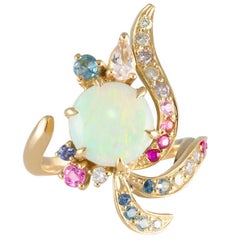

2010s Australian Art Nouveau Cocktail Rings
Diamond, Opal, 18k Gold
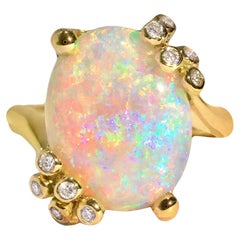
20th Century British Art Nouveau Cluster Rings
Opal, 9k Gold
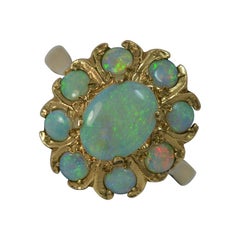
2010s French Art Nouveau Engagement Rings
Diamond, Opal, 18k Gold, White Gold, Yellow Gold
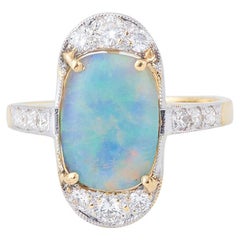
21st Century and Contemporary American Art Nouveau Cocktail Rings
Diamond, Opal, Gold, Yellow Gold, Enamel
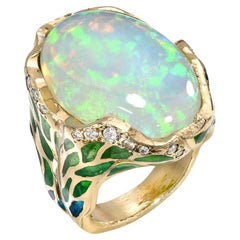
21st Century and Contemporary American Art Nouveau Cocktail Rings
Diamond, Opal, Gold, Yellow Gold, Enamel
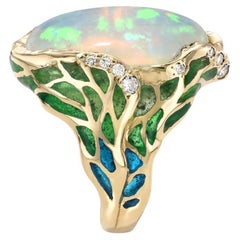
21st Century and Contemporary Thai Art Nouveau Cocktail Rings
Opal, Blue Sapphire, Pink Sapphire, 18k Gold, Gold Plate, Silver, Sterli...
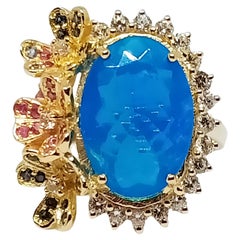
Antique Late 19th Century Unknown Art Nouveau Engagement Rings
Diamond, Opal, 14k Gold
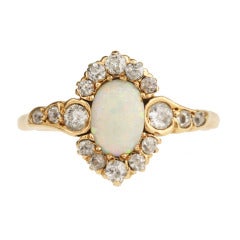
2010s American Art Nouveau Cocktail Rings
Opal, Tourmaline, 18k Gold, Yellow Gold
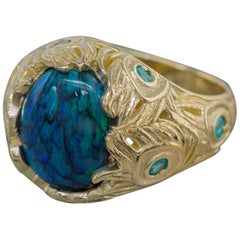
21st Century and Contemporary Thai Art Nouveau Three-Stone Rings
Opal, Ruby, Zircon, Black Opal, 18k Gold, Gold Plate, Silver, Sterling S...
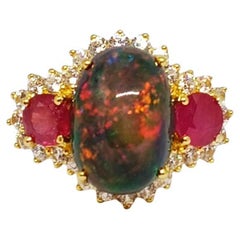
21st Century and Contemporary Thai Art Nouveau Three-Stone Rings
Emerald, Opal, Black Opal, 18k Gold, Gold Plate, Silver, Sterling Silver
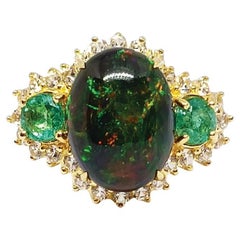
- 1
Art Nouveau Opal Ring For Sale on 1stDibs
How Much is a Art Nouveau Opal Ring?
A Close Look at Art Nouveau Jewelry
Art Nouveau — generally considered to have begun in the late 1800s and ended with the start of World War I — was a movement in the decorative arts that drew inspiration from natural forms, such as trees, flowers and, of course, the human figure. The three main themes present in Art Nouveau jewelry and watches were flora, fauna and women.
Art Nouveau, which reached its pinnacle in the year 1900, spawned from artists who rejected the historicism of their predecessors to create an entirely new visual vocabulary. As compared to Art Deco jewelry’s geometric patterns and sharp lines, the extravagant style of antique Art Nouveau jewelry is characterized by curvilinear forms and whiplash lines, vibrant materials and dramatic imagery.
The first art and design movement of the 20th century, Art Nouveau was also a reaction against the Industrial Revolution, and took its inspiration from the theories of the Symbolists, the art of the Pre-Raphaelites, the ideas of John Ruskin and his follower William Morris and, most importantly Japanese crafts. (The country was a fertile ground for inspiration after it was opened to the West in 1854.) The Art Nouveau style touched all manners of the arts, including the most exultant jewelry.
Nature was a favorite muse for artists going back to the 18th and 19th centuries, but in the hands of 20th-century artists, it was depicted in new ways. For example, a withering flower was considered just as beautiful as one in full bloom. Winged creatures, such as insects and birds, were also a popular subject. Dragonflies and butterflies were particular favorites because they morphed so dramatically in different life stages.
This was also a reference to women, whose role in society was evolving. It was not uncommon to see a piece of jewelry that would at once reference a woman as a winged creature (think René Lalique’s famous Dragonfly brooch, circa 1897–98, at the Gulbenkian Collection in Lisbon). However, just as women’s roles were ambiguous, so was their image, as the femmes nouvelle were simultaneously eroticized and romanticized.
In addition to Lalique, vital figures in Art Nouveau jewelry included Louis Comfort Tiffany in the United States, Vladimir Soloviev, who designed jewelry for Peter Carl Fabergé in Russia, Fuset Grau of Spain, Karl Rothmuller of Germany and Philippe Wolfers of Belgium.
Art Nouveau jewelers used every “canvas” imaginable, looking beyond brooches and necklaces to belt buckles, fans, tiaras, dog collars (a type of choker necklace), pocket watches, corsages and hair combs. Multicolored gems and enamel could complete this vision better than diamonds. Jewelers also favored pearls, particularly baroque pearls, for their large size and irregular shape. However, opal was the most popular stone — its iridescence harmonized perfectly with the enamel, and it could be carved into any shape. Art Nouveau jewelry was primarily set in yellow gold.
Find a range of antique Art Nouveau jewelry today on 1stDibs.
Why Gold Shines in Jewelry Craftsmanship
Gold is the feel-good metal, the serotonin of jewelry. Wear vintage and antique gold necklaces, watches, gold bracelets or gold rings and you feel happy, you feel dressed, you feel, well, yourself.
Gold, especially yellow gold, with its rich patina and ancient pedigree going back thousands of years, is the steady standby, the well-mannered metal of choice. Any discussion of this lustrous metal comes down to a basic truth: Gold is elementary, my dear. Gold jewelry that couples the mystique of the metal with superb design and craftsmanship achieves the status of an enduring classic. Many luxury houses have given us some of our most treasured and lasting examples of gold jewelry over the years.
Since its founding, in 1837, Tiffany Co. has built its reputation on its company jewelry as well as its coterie of boutique designers, which has included Jean Schlumberger, Donald Claflin, Angela Cummings and Elsa Peretti. There are numerous gold Tiffany classics worth citing. Some are accented with gemstones, but all stand out for their design and the workmanship displayed.
For the woman who prefers a minimalist look, the Tiffany Co. twist bangle (thin, slightly ovoid) is stylishly simple. For Cummings devotees, signature pieces feature hard stone inlay, such as her pairs of gold ear clips inlaid with black jade (a play on the classic Chanel black and tan), or bangles whose design recalls ocean waves, with undulating lines of lapis lazuli and mother-of-pearl. And just about any design by the great Jean Schlumberger is by definition a classic.
Even had he eschewed stones and diamonds, Southern-born David Webb would be hailed for the vast arsenal of heavy gold jewelry he designed. Gold, usually hammered or textured in some manner, defines great David Webb jewelry. The self-taught jeweler made very au courant pieces while drawing inspiration from ancient and out-of-the-way sources — East meets West in the commanding gold necklaces made by Webb in the early 1970s. The same could be said for his endlessly varied gold cuffs.
In Europe, many houses have given us gold jewelry that sets the highest standard for excellence, pieces that were highly sought after when they were made and continue to be so.
Numerous designs from Cartier are homages to gold. There are the classic Trinity rings, necklaces and bracelets — trifectas of yellow, white and rose gold. As a testament to the power of love, consider the endurance of the Cartier Love bracelet.
Aldo Cipullo, Cartier’s top in-house designer from the late 1960s into the early ’70s, made history in 1969 with the Love bracelet. Cipullo frequently said that the Love bracelet was born of a sleepless night contemplating a love affair gone wrong and his realization that “the only remnants he possessed of the romance were memories.” He distilled the urge to keep a loved one close into a slim 18-karat gold bangle.
BVLGARI and its coin jewelry, gemme nummarie, hit the jackpot when the line launched in the 1960s. The line has been perennially popular. BVLGARI coin jewelry features ancient Greek and Roman coins embedded in striking gold mounts, usually hung on thick link necklaces of varying lengths. In the 1970s, BVLGARI introduced the Tubogas line, most often made in yellow gold. The Tubogas watches are classics, and then there is the Serpenti, the house's outstanding snake-themed watches and bracelets.
A collection called Monete that incorporated the gold coins is one of several iconic BVLGARI lines that debuted in the 1970s and ’80s, catering to a new generation of empowered women. Just as designers like Halston and Yves Saint Laurent were popularizing fuss-free ready-to-wear fashion for women on the go, BVLGARI offered jewels to be lived in.
Since Van Cleef Arpels opened its Place Vendôme doors in 1906, collection after collection of jewelry classics have enchanted the public. As predominantly expressed in a honeycomb of gold, there is the Ludo watch and accessories, circa the 1920s, and the golden Zip necklace, 1951, whose ingenious transformation of the traditional zipper was originally proposed by the Duchess of Windsor. Van Cleef's Alhambra, with its Moroccan motif, was introduced in 1968 and from the start its popularity pivoted on royalty and celebrity status. It remains one of VCA’s most popular and collected styles.
Mention must be made of Buccellati, whose name is synonymous with gold so finely spun that it suggests tapestry. The house’s many gold bracelets, typically embellished with a few or many diamonds, signified taste and distinction and are always in favor on the secondary market. Other important mid-20th-century houses known for their gold-themed jewelry include Hermès and Ilias Lalaounis.
Find a stunning collection of vintage and antique gold jewelry on 1stDibs.
The Legacy of Opal in Jewelry Design
Opals were discovered in 400 BC, and since then five types have been found throughout the world. Before you start shopping for mysteriously beautiful vintage opal rings and other opal jewelry, learn about the different varieties of the gem — and find out which historical figure was reportedly willing to trade his kingdom for a single stone.
Here is a little riddle for you: the month of October has two birthstones, but only one of them encompasses the colors of other birthstones. If you guessed opal, you’re right! (The other gemstone associated with the month of October is tourmaline.)
Opals are such unusual gemstones that there are too many old-wives tales associated with them, like if you’re a blond, wearing an opal necklace will protect your locks from losing color. Opals were also very fashionable in the early 19th century, up until the publication of Sir Walter Scott’s novel Anne of Geierstein in 1829. The title heroine wears an opal and succumbs to an untimely death. However, the British monarchy, and in particular Queen Victoria, did not let this story get in their way, and they frequently gifted opals to friends and family members. October babies should disregard the noise and proudly wear their opals!
There are five types of precious opals: boulder opal, fire opal, crystal/water opal, black opal, and white/light opal. Each variety is distinguished by its color.
So, where does the name come from? The word opal is thought to originate from the Roman opalus or from the Sanskrit úpala (“precious stone”) or from the Greek opallios (“to see a color change”). So while there have been many names for the stones, opals were first discovered in 400 BC in Ethiopia. But the early reference that comes up most often in history books is from the Roman philosopher Pliny the Elder, who wrote about it in 75 AD. In his text he refers to it as opali. The Romans were big fans of opal, Mark Antony was so enamored by it that, as the story goes, he was willing to trade a portion of his kingdom for a single opal.
There's a wide variety of antique and vintage opal jewelry on 1stDibs (and you won't have to trade your kingdom for it).
Finding the Right Rings for You
Antique and vintage rings have long held a special place in the hearts of fine jewelry lovers all over the world.
No matter their origin or specific characteristics, rings are timeless, versatile accessories. They’ve carried deep meaning since at least the Middle Ages, when diamond rings symbolized strength and other kinds of rings were worn to signify romantic feelings or to denote an affiliation with a religious order. Rings have also forever been emblematic of eternity.
Over time, rings have frequently taken the form of serpents, which have long been associated with eternal life, health and renewal. Italian luxury jewelry house Bulgari has become famous for its widely loved Serpenti motif, for example, and its Serpenti ring, like the other accessories in the collection, began as an homage to jewelry of the Roman and Hellenistic eras. The serpent is now a popular motif in fine jewelry. Jewelry devotees have long pined for rings adorned with reptiles, thanks to antique Victorian rings — well, specifically, Queen Victoria’s illustrious engagement ring, which took the form of a gold snake set with rubies, diamonds and an emerald (her birthstone). Designs for Victorian-era engagement rings often featured repoussé work and chasing, in which patterns are hammered into the metal.
Engagement rings, which are reliably intimidating to shop for, are still widely recognized as symbols of love and commitment. On 1stDibs, a range of buying guides can be found for those in the market for antique engagement rings, vintage engagement rings or Art Deco engagement rings.
The most collectible antique engagement rings and vintage engagement rings are those from the Victorian, Edwardian and Art Deco eras. Named for the monarchies of the four King Georges, who in succession ruled England starting in 1714 (plus King William’s reign), antique Georgian rings, be they engagement rings or otherwise, are also coveted by collectors. Pearls, along with colored gemstones like garnets, rubies and sapphires, were widely used in Georgian jewelry. The late-1700s paste jewelry was a predecessor to what we now call fashion or costume jewelry.
The Art Nouveau movement (1880–1910) brought with it rings inspired by the natural world. Antique Art Nouveau rings might feature depictions of winged insects and fauna as well as women, who were simultaneously eroticized and romanticized, frequently with long flowing hair. Art Deco jewelry, on the other hand, which originated during the 1920s and ’30s, is by and large “white jewelry.” White metals, primarily platinum, were favored over yellow gold in the design of antique Art Deco rings and other accessories as well as geometric motifs, with women drawn to the era’s dazzling cocktail rings in particular.
Whether you’re hunting down a chunky classic for a Prohibition-themed cocktail party or seeking a clean contemporary design to complement your casual ensemble, find an exquisite collection of antique, new and vintage rings on 1stDibs.