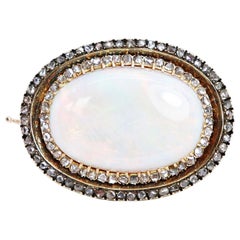
Australian Opal Rose Brooch
Recent Sales
Antique Early 1900s Unknown Late Victorian Brooches
Diamond, Opal, 18k Gold, Rose Gold, Yellow Gold

A Close Look at Late-victorian Jewelry
Also called Aesthetic period jewelry, historians have determined that antique late Victorian jewelry and watches are representative of an era that lasted from about 1880 until 1901 and ushered in the Belle Époque.
Queen Victoria wore her heart on her sleeve, and her emotions were reflected in her fashion and in what we now call Victorian jewelry. By about 1880, Queen Victoria and her constituents were ready to look to the future. The dark skies were parting and fashion was changing. There was also a major shift in industry.
While in the beginning of Queen Victoria’s reign the focus was on manufacturing, toward the later years there was a renewed interest and appreciation of the handmade. The late Victorian period (1880–1901) was referred to as the Aesthetic period and coincided with these changing tastes.
The Aesthetic Movement, concerned with “art for art’s sake,” began in Britain around the 1870s and became recognized by designers and artists worldwide, eventually resulting in the Arts and Crafts movement (1880s–1920s).
Stylistically, jewelry of this time period did not resemble its earlier Victorian counterparts, in fact it was in complete opposition to what preceded it. Gone were the mourning jewelry, heavy brooches and large necklaces. Late Victorian-era jewelry was smaller, lighter and more dainty. Women still layered pieces, though, and favored smaller scatter pins. Jewelry also became an evening accessory and not so visible during the day.
Women were starting to actively participate in sporting events (socially, of course, not professionally), so athletic motifs showed up on their accessories. Lockets and heart pendants remained popular, but the REGARD or DEAREST rings of the early Victorian period were replaced by Mizpah pieces, which means “the Lord watches over me” in Hebrew. These items were exchanged between two people to symbolize a close bond.
Diamonds came into fashion, and semiprecious gems such as amethysts and opals became prevalent, too. Using gemstones for their natural beauty and not their worth was something that jewelers of the Aesthetics movement felt passionate about, and this ideology would really become relevant in Art Nouveau jewelry.
The Brits still looked to their monarchs to dictate the latest trends. Queen Victoria’s daughter-in-law Alexandra famously wore a dog-collar necklace, also known as a collier de chien, made up of multiple strands of pearls, to hide a scar. This style of necklace quickly rose to prominence. Toward the end of the 19th century, solitaire rings were also becoming fashionable thanks to Tiffany Co.’s advent of the six-prong diamond setting in 1886. Platinum was starting to be used in jewelry production as well. Edwardian and, afterward, Art Deco engagement rings that followed in the wake of Queen Victoria’s death in 1901 would be characterized by complex geometric designs and platinum settings.
Women were the biggest influences on jewelry. They joined the workforce, fought for their independence and overall began to lead a much more active lifestyle. Jewelry had to become comfortable and serve multiple purposes. While in the United States, the Gibson Girls lifestyle was emulated by young women, and starlets became trendsetters.
Finally, the international expositions made the world seem like a much smaller place and jewelry from North Africa and India captured people’s attention, appealing to those who already favored Revival jewelry from the Etruscans to the Romans.
Find antique late Victorian jewelry and watches on 1stDibs.
The Legacy of Diamond in Jewelry Design
Antique diamond rings, diamond tiaras and dazzling vintage diamond earrings are on the wish lists of every lover of fine jewelry. And diamonds and diamond jewelry are primarily associated with storybook engagements and red-carpet grand entrances — indeed, this ultra-cherished gemstone has a dramatic history on its hands.
From “A Diamond Is Forever” to “Diamonds Are a Girl’s Best Friend,” pop culture has ingrained in our minds that diamonds are the most desired, the most lasting and the most valuable gemstone. But what makes the diamond so special? Each stone — whether it’s rubies, sapphires or another stone — is unique and important in its own right. April babies might claim diamonds for themselves, but just about everyone wants this kind of sparkle in their lives!
There are several factors that set diamonds apart from other stones, and these points are important to our gem education.
Diamonds are minerals. They are made up of almost entirely of carbon (carbon comprises 99.95 percent; the remainder consists of various trace elements). Diamonds are the hardest gemstones, ranking number 10 on the Mohs Hardness Scale. Even its name, diamond, is rooted in the Greek adamas, or unconquerable. The only object that can scratch a diamond is another diamond. Diamonds are formed deep within the earth at very high temperatures (1,652–2,372 degrees Fahrenheit at depths between 90 and 120 miles beneath the earth’s surface) and are carried up by volcanic activity. Diamonds are quite rare, according to the Gemological Institute of America, and only 30 percent of all the diamonds mined in the world are gem quality.
In the 1950s, the Gemological Institute of America developed the 4Cs grading system to classify diamonds: clarity, color, cut and carat weight. Not all diamonds are created equal (there are diamonds, and then there are diamonds). The value of the diamond depends on the clarity (flawless diamonds are very rare but a diamond's value decreases if there are many blemishes or inclusions), color (the less color the higher the grade), cut (how the diamond’s facets catch the light, certain cuts of diamonds show off the stone better than others) and carat weight (the bigger, the better).
When you start shopping for a diamond engagement ring, always prioritize the cut, which plays the largest role in the diamond's beauty (taking the time to clean your diamond ring at least every six months or so plays a role in maintaining said beauty). And on 1stDibs, a range of buying guides can be found for those in the market for antique engagement rings, vintage engagement rings or Art Deco engagement rings.
Shop antique and vintage diamond rings, diamond necklaces and other extraordinary diamond jewelry on 1stDibs.
Finding the Right Brooches for You
Vintage brooches, which refer to decorative jewelry traditionally pinned to garments and used to fasten pieces of clothing together where needed, have seen increasing popularity in recent years.
While jewelry trends come and go, brooches are indeed back on the radar thanks to fashion houses like Gucci, Versace, Dior and Saint Laurent, all of which feature fun pinnable designs in their current collections. Whether a dazzlingly naturalistic Art Nouveau dragonfly, a whimsical David Webb animal, a gem-studded bloom or a streamlined abstract design, these jewels add color and sparkle to your look and a spring to your step.
Given their long history, brooches have expectedly taken on a variety of different shapes and forms over time, with jewelers turning to assorted methods of ornamentation for these accessories, including enameling and the integration of pearls and gemstones. Cameo brooches that originated during the Victorian age are characterized by a shell carved in raised relief that feature portraits of a woman’s profile, while 19th-century micromosaic brooches, comprising innumerable individually placed glass fragments, sometimes feature miniature depictions of a pastoral scene in daily Roman life.
At one time, brooches were symbols of wealth, made primarily from the finest metals and showcasing exquisite precious gemstones. Today, these jewels are inclusive and universal, and you don’t have to travel very far to find an admirer of brooches. They can be richly geometric in form, such as the ornate diamond pins dating from the Art Deco era, or designer-specific, such as the celebrated naturalistic works created by Tiffany Co., the milk glass and gold confections crafted by Trifari or handmade vintage Chanel brooches of silk or laminated sheer fabric. Chanel, of course, has never abandoned this style, producing gorgeously baroque CC examples since the 1980s.
Brooches are versatile and adaptable. These decorative accessories can be worn in your hair, on hats, scarves and on the lower point of V-neck clothing. Pin a dazzling brooch to the lapel of your blazer-and-tee combo or add a cluster of smaller pins to your overcoat. And while brooches have their place in “mourning jewelry,” in that a mourning brooch is representative of your connection to a lost loved one, they’re widely seen as romantic and symbolic of love, so much so that a hardcore brooch enthusiast might advocate for brooches to be worn over the heart.
Today, find a wide variety of antique and vintage brooches for sale on 1stDibs, including gold brooches, sapphire brooches and more.