Axminster Used
Recent Sales
1960s Swedish Axminster Used
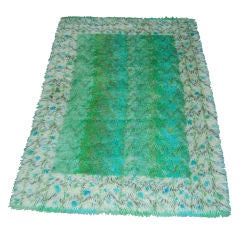

Axminster Used For Sale on 1stDibs
How Much is a Axminster Used?
Marianne Richter for sale on 1stDibs
Swedish textile artist Marianne Richter is internationally revered for her range of extraordinary rugs, carpets and large tapestries. Her textiles featured a variety of provocative geometric shapes in warm earth tones and dazzling graphic patterns.
A master in her field, Richter created works that adorn Swedish embassies all over the world. One of her most notable pieces was a 200-square-meter wall hanging that she created for the United Nations building in New York City.
Born in 1916, in Helsingborg, Sweden, Richter was the second of seven children in her family. Her father was a merchant and her mother was a homemaker.
She trained at the Technical School in Stockholm with a focus on textiles (and also eventually worked in ceramics, too). When she completed her studies, Richter apprenticed for Märta Måås-Fjetterström at MMF AB — the widely celebrated designer’s atelier — where the budding textile artist worked during the summers. After her apprenticeship, Richter went on to work for Svensk Hemslöjd — a handicraft association in Växjö, Sweden.
In the early 1940s, Barbro Nilsson — a Swedish textile designer known for popularizing Scandinavian modernism within the decorative arts — invited Richter to return to MMF AB in Båstad — this time as a designer — where she would become pivotal to the growth of the company.
In a time when machine-made textiles were gaining popularity, Richter became a leader at the facility and her innovative mid-century modern works — as well as those produced by Nilsson and designer Ann-Mari Forsberg — brought considerable attention to MMF AB, which is still Sweden’s foremost atelier for hand-woven art textiles.
The wall hanging that Richter designed for the United Nations building in Manhattan was commissioned by the Swedish government (it was intended for the Economic and Social Affairs Council Chamber, which was designed by Sven Markelius). For more than a year, ten artisans at MMF AB worked with wool and linen to produce Richter’s design. In 1968, the piece had to be restored as it began to disintegrate, partly owing to an effect that chemicals had on the textile as part of a fireproofing process that took place when it arrived in Manhattan.
Richter continued to work at MMF AB until the 1970s, creating pile rugs, flatwoven rugs and tapestries, while also teaching at the Konstfack University of Arts, Crafts and Design in Stockholm. She died in 2010.
Find vintage Marianne Richter rugs and carpets on 1stDibs.
Finding the Right Area-rugs-carpets for You
Antique, new and vintage area rugs and carpets are a simple way to add warmth and style to any space. Area rugs can be seasonal or changed with other decorative objects to refresh an interior. Carpet piles materials can vary from wool and cotton to silk and synthetic fibers, and the purpose of a floor covering can range from reducing noise to offering a place to sit.
Vintage rugs can ground a space, and arranging furniture around them creates a measured focal point. Key furniture pieces can be placed on the rug or just the legs, such as with furniture like coffee tables in your living room.
So, how can you tell if a rug is high quality or vintage?
The three main components that determine the quality of a piece are the dyes, the wool and the number of knots per square inch. Ultimately, however, if you want to be sure the rug you’re buying is truly an antique, it is best to consult an expert.
If you want a creative design that stands out, area rugs or carpets can provide layers of color. Rugs and carpets reflect a global heritage of textiles and weaving, such as ornately patterned Persian and Indian designs. Visually striking Chinese rugs can add a delicate touch of color, while modern rugs make a statement with their geometric patterns.
Turkish rugs, with their ruby reds and misted blues, their entwined botanical designs and rhythmic geometries, are as beloved today as they were in the 13th century. The West’s current infatuation with Moroccan and North African tribal rugs stretches to the mid-20th century, when modern furniture designers embraced bold geometric patterns and even bolder palettes as counterpoints to form-follows-function interiors. Alvar Aalto, Frank Lloyd Wright and Le Corbusier were among the designers who used these rustic, natural rugs to offset austere interiors.
If you properly maintain your antique and vintage rugs, they will last for many years. When you’re thinking about how to clean a rug, it is important to keep in mind that your vacuum is not too harsh for your favorite floor covering. Frequent vacuuming is in fact necessary to remove everyday dirt that otherwise wears down the pile. Omri Schwartz of Nazmiyal does, however, stipulate that “it’s best to use an ordinary suction vacuum without bristles, as the bristles can damage the rug’s pile.” Rotating the carpet every couple of years is also recommended — it ensures that the rug gets even foot traffic.
On 1stDibs, find a vintage rug or carpet to add a layer of beauty and function to your room.