Biedermeier Secretary
Antique 1830s German Biedermeier Secretaires
Birch, Mahogany
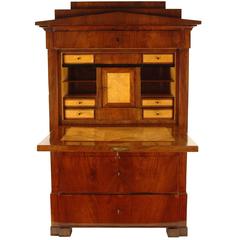

Antique 1820s Biedermeier Secretaires
Ash
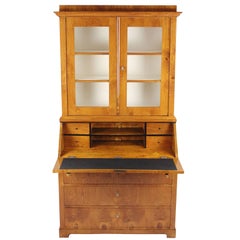
- 1
Biedermeier Secretary For Sale on 1stDibs
How Much is a Biedermeier Secretary?
A Close Look at Biedermeier Furniture
The authentic Biedermeier furniture on 1stDibs is representative of the first modern European decorative style not dictated by the tastes of the aristocracy. Following the Napoleonic wars, a growing, wealthy urban middle class in the German-speaking states of Central Europe began to demand rights and privileges once granted only to nobles. To avoid trouble, the upwardly striving confined their political discussions to one another’s homes. And so the salon was born.
Cabinetmakers in cities such as Vienna, Berlin and Mainz began to offer goods that reflected the tastes and needs of the new class. The makers of Biedermeier chairs, tables and other furniture used little or no gilding, silver hardware or other lavish ornament. Ebonized trims are common on Biedermeier cabinetry, and neoclassical elements — lyre-shaped chair splats, carved scrollwork, table supports shaped like Greek columns. But the strongest aesthetic statement came from the wood — richly-grained, honey-colored, often book-matched veneers of walnut and fruitwood.
There are two iconic Biedermeier furniture forms, both made to outfit rooms designed for conversation. One is the sofa, deeply upholstered with a strong, architectural wooden frame. The second is the circular pedestal table, which stood at the center of the room, offering a surface on which to place coffee and cake services; or to roll out a map, or sketch out ideas on paper.
“Biedermeier” was originally a derogatory term — it derives from the pen names of two German magazine writers who mocked bourgeois manners. Looking at the elegant and refined antique, new and vintage Biedermeier furniture offered on 1stDibs, that is now an amusing irony.
Finding the Right Secretaires for You
Your antique, new or vintage secretary desk has become the (chic) saving grace of the "new normal" at home.
Simply put, a secretary desk is a multifunctional piece of furniture with a hinged writing surface that folds open or drops down. When the leaf is folded out, small inner storage compartments — pigeonholes, cubbies, recesses or drawers — are revealed.
Traditionally, a secretary is composed of two parts — a chest of drawers on the bottom and a cabinet with shelves on the top. Taking its name from the French word for the piece, secrétaire, the secretary desk dates back to the 18th century, when Paris-based cabinetmaker Jean-François Oeben, known for his exquisite marquetry and clever mechanical desks, is thought to have invented the secrétaire à abbattant, or drop-leaf desk.
While the defining drop-down feature of the secretary desk has remained constant, the materials used, as well as its configuration, size and style have evolved over time.
At first, secretaries were typically made from exotic woods, like rosewood, tulipwood and kingwood; later, hardwoods like cherry, maple, oak and mahogany were more common. The desks also became lighter, with space carved out of the lower half for the writer’s feet or with drawers replaced by legs — making them more table-like.
When open, the secretary is a dynamic, versatile Wunderkammer. When closed, it’s a sophisticated, space-saving piece of furniture.
“A fine secretary with a good provenance adds stature and credence to its owner — it is a cornerstone piece,” says antiques dealer Stanley Weiss, who specializes in 18th- and 19th-century English and American furniture. “In this disposable world, fine furniture is always passed on and speaks to who its owner is.”
No matter what style or period you choose, and no matter how you decide to use it, the timeless, flexible secretary desk is bound to become an indispensable part of your daily routine.
Browse a range of antique and vintage secretary desks on 1stDibs, including mid-century modern secretaires, Georgian secretaires and others.