Big Sea Pearls Necklace
Recent Sales
2010s Australian Art Nouveau Beaded Necklaces
Pearl, South Sea Pearl, 14k Gold
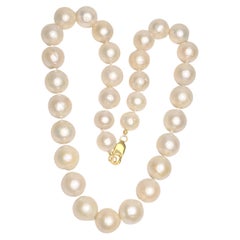

Big Sea Pearls Necklace For Sale on 1stDibs
How Much is a Big Sea Pearls Necklace?
A Close Look at Art-nouveau Jewelry
Art Nouveau — generally considered to have begun in the late 1800s and ended with the start of World War I — was a movement in the decorative arts that drew inspiration from natural forms, such as trees, flowers and, of course, the human figure. The three main themes present in Art Nouveau jewelry and watches were flora, fauna and women.
Art Nouveau, which reached its pinnacle in the year 1900, spawned from artists who rejected the historicism of their predecessors to create an entirely new visual vocabulary. As compared to Art Deco jewelry’s geometric patterns and sharp lines, the extravagant style of antique Art Nouveau jewelry is characterized by curvilinear forms and whiplash lines, vibrant materials and dramatic imagery.
The first art and design movement of the 20th century, Art Nouveau was also a reaction against the Industrial Revolution, and took its inspiration from the theories of the Symbolists, the art of the Pre-Raphaelites, the ideas of John Ruskin and his follower William Morris and, most importantly Japanese crafts. (The country was a fertile ground for inspiration after it was opened to the West in 1854.) The Art Nouveau style touched all manners of the arts, including the most exultant jewelry.
Nature was a favorite muse for artists going back to the 18th and 19th centuries, but in the hands of 20th-century artists, it was depicted in new ways. For example, a withering flower was considered just as beautiful as one in full bloom. Winged creatures, such as insects and birds, were also a popular subject. Dragonflies and butterflies were particular favorites because they morphed so dramatically in different life stages.
This was also a reference to women, whose role in society was evolving. It was not uncommon to see a piece of jewelry that would at once reference a woman as a winged creature (think René Lalique’s famous Dragonfly brooch, circa 1897–98, at the Gulbenkian Collection in Lisbon). However, just as women’s roles were ambiguous, so was their image, as the femmes nouvelle were simultaneously eroticized and romanticized.
In addition to Lalique, vital figures in Art Nouveau jewelry included Louis Comfort Tiffany in the United States, Vladimir Soloviev, who designed jewelry for Peter Carl Fabergé in Russia, Fuset Grau of Spain, Karl Rothmuller of Germany and Philippe Wolfers of Belgium.
Art Nouveau jewelers used every “canvas” imaginable, looking beyond brooches and necklaces to belt buckles, fans, tiaras, dog collars (a type of choker necklace), pocket watches, corsages and hair combs. Multicolored gems and enamel could complete this vision better than diamonds. Jewelers also favored pearls, particularly baroque pearls, for their large size and irregular shape. However, opal was the most popular stone — its iridescence harmonized perfectly with the enamel, and it could be carved into any shape. Art Nouveau jewelry was primarily set in yellow gold.
Find a range of antique Art Nouveau jewelry today on 1stDibs.
The Legacy of Pearl in Jewelry Design
The pearl has been synonymous with ladylike elegance since the Tudor period — learn what to look for when shopping for vintage and antique pearl jewelry as well as how to tell the origin of a pearl with our handy primer.
Every woman at some point in her life desires a simple strand of pearls. They are elegant, timeless, versatile — just ask Coco Chanel or Jacqueline Kennedy — and valuable. In 1917, Pierre Cartier famously traded a double-strand of natural pearls for a Fifth Avenue mansion, the Cartier brand’s flagship store ever since. And if you were born in the beginning of summer, pearl is the June birthstone.
It is possible to tell where a pearl originated from its appearance. Akoyas are usually round and white — the classic pearl, if you will. South Sea pearls are normally larger and vary in color; orangey yellow ones are not uncommon. Tahitian pearls are mostly black but can also be gray or brown, and between the Akoya and the South Sea varieties in size. Freshwater pearls, or Orientals, run the gamut in terms of color and size, but in shape, they tend to resemble Rice Krispies. Another important distinction is a round pearl versus a baroque pearl. A round pearl is self-explanatory, but there are two types of baroque pearls: symmetrical and asymmetrical. In general, the symmetrical variation commands a higher valuation. Within a strand of pearls, uniformity is prized — the more the individual pearls resemble one another, the more valuable the strand.
According to the Gemological Institute of America (GIA), the earliest recorded mention of a pearl was in 2206 BC by a Chinese historian. Centuries later, Christopher Columbus made it a point to visit pearl fisheries during his 15th-century exploration of the Caribbean. Since the late-19th century, the Japanese have been at the forefront of cultivating pearls, when jeweler Kokichi Mikimoto successfully cultured the world’s first pearl in 1893.
On 1stDibs, find vintage and antique pearl necklaces, pearl earrings and other accessories.
Finding the Right Beaded-necklaces for You
Whether they’re chunky, statement-making accessories or a single strand of the understated sort, antique and vintage beaded necklaces are versatile pieces of jewelry. Indeed, the unique beaded necklaces in your jewelry box likely go with everything, from casual summer tops and shorts to dazzling evening gowns.
From the fish-bone and seashell jewelry of the prehistoric era to the breathtaking amulets and pendants of ancient Egypt to modern sapphire beads, people have been accessorizing with beaded necklaces for eternity.
Beaded necklaces — as well as other kinds of necklaces — were common in prehistoric times. Personal adornment was important, and jewelry was made for every part of the body. Beadwork is among the best known art forms attributed to Native Americans, and just as they had for saddlery and clothing, early populations would fashion beads for necklaces with stone tools or instruments made of wood. The making of colorful glass beads for beaded necklaces likely originated in Venice, Italy, during the 14th century, particularly given the growth of the decorative glass industry on the series of Venetian islands called Murano. During the Neolithic period, humans were buried with coral beaded necklaces from the Mediterranean, even as far north as the Alps.
Whether you’re seeking the pop of color you’ll get in a double-row jade beaded necklace from the Art Deco era — which encompasses the 1920s and ’30s and ushered in a very distinct look in jewelry design — or perhaps a simple strand of pearls for a blouse that leaves your neck bare, remember that different necklines call for different pieces of jewelry.
When accessorizing with a beaded necklace, a long piece with a pendant will likely pair best with your favorite vintage V-neck dress or V-neck tee, while beaded chokers and collar necklaces are a stylish fit for strapless tops. Bigger beads will hit your neckline in a different way than a more minimalist necklace might, so you’ll want to keep that in mind. Choose colors you like and pick items that will go with what is in your closet. When the occasion calls for it, don’t be afraid to stack. “More is more” for some, so pairing a delicate strand with a bolder piece might be the move for you.
On 1stDibs, find a collection of pearl beaded necklaces, antique emerald beaded necklaces, diamond beaded necklaces and more.