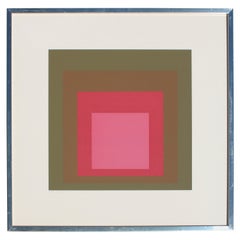
Birthday Squares Josef Albers
Recent Sales
Vintage 1970s American Mid-Century Modern Paintings
Paper

Josef Albers for sale on 1stDibs
The German-born American painter, writer, and educator Josef Albers was a pioneer of 20th century modernism, and an innovative practitioner of color theory. With his wife, the textile artist and printmaker Anni Albers (1899–1994), he shaped the development of a generation of American artists and designers through his teaching at the experimental Black Mountain College in North Carolina, and later at Yale University School of Art, where he was the chairman of the department of design from 1950–1958. Albers is widely known for his series of prints and paintings "Homages to the Square," which he created between 1950 and 1975. His influential volume on color theory The Interaction of Color was published in 1963.
Albers was born in Bottrop, Germany, and as a young man he studied art education, earning certification from the Königliche Kunstschule in Berlin in 1915. He entered the legendary Bauhaus school in Weimar in 1920. The Bauhaus had been established by Walter Gropius in 1919, in the immediate aftermath of World War I, with the hope that its innovative curriculum would foster connections between architecture, art, and traditional crafts. In 1923 Albers began teaching the Vorkurs, the introductory class in which new students learned to work with each of the key artists’ materials, along with color theory, composition, construction and design.
Albers was a polymath, and the multidisciplinary environment of the Bauhaus was fertile ground for his artistic ambitions. When the school moved from Weimar to Dessau in 1925, he became a full professor, and in addition to glass and metal, he designed typefaces and furniture. While at the Bauhaus, Albers drew inspiration from the work of his colleagues, the color theorist Johannes Itten, and the painter, photographer, and designer László Moholy-Nagy, with whom he co-taught the Vorkurs.
In 1933, the Bauhaus was shut down due to pressure from the Nazi Party, which perceived the school as being sympathetic to communist intellectuals. As Albers’ wife Anni was Jewish, the couple resolved to leave Germany, and settled in rural North Carolina. The architect Philip Johnson helped make arrangements for Albers to join the faculty of Black Mountain College as the head of the painting program, where he remained until 1949. While at Black Mountain, both Josef and Anni Albers became influential mentors to American artists including Ruth Asawa, Cy Twombly, and Robert Rauschenberg, while working alongside fellow professors Buckminster Fuller, John Cage, Merce Cunningham and William de Kooning.
In 1950, Albers joined the faculty of the Yale University School of Art where he would head the newly established Department of Design until his retirement in 1958. In the 1950s, the Alberses began taking trips to Mexico, where the colors and forms of the local art and architecture inspired both artists.
In 1971, Albers became the first living artist whose work was the subject of a solo retrospective at the Metropolitan Museum of Art. Though they worked in different mediums, Josef and Anni Albers’ work shares a fascination with color and geometry. Josef Albers’ compositions from the "Homages to the Square" series, such as Formulation: Articulation Portfolio II Folder 28 (B), from 1972, give deceptively simple shapes a novel vibrance as colors play off of one another. The hues in Articulation Portfolio II Folder 28 (B) work in concert to give the flat surface the distinct appearance of a tunnel or other three-dimensional space; while the form on the left appears to move towards the viewer, the form on the right seems to lead directly into the canvas. Similarly, Anni Albers’ designs for textiles use graphic design to lend a sense of dynamism to flat works. Her Study for Unexecuted Wall Hanging (Bauhaus), from 1984 is a Mondrian-like pattern for a weaving in which different colors alternately recede and advance into the foreground, giving the image a sense of complexity and uncanny depth.
Josef Albers also created works of public art, including a delicate, geometric gold leaf mural called Two Structural Constellations for the lobby of the Corning Glass building in New York City in 1959. He designed a work called Two Portals for the lobby of the Time Life Building in 1961, in which which and brown bands move towards two square panels made of bronze. Walter Gropius invited Albers to create a piece for the Pan Am Building, which he was designing with the architectural firm of Emery Roth Sons. Albers reworked an existing glass piece from his Bauhaus days called City, and, fittingly, renamed it Manhattan.
Find a collection of authentic Josef Albers art on 1stDibs.
A Close Look at Mid-century-modern Furniture
Organically shaped, clean-lined and elegantly simple are three terms that well describe vintage mid-century modern furniture. The style, which emerged primarily in the years following World War II, is characterized by pieces that were conceived and made in an energetic, optimistic spirit by creators who believed that good design was an essential part of good living.
ORIGINS OF MID-CENTURY MODERN FURNITURE DESIGN
- Emerged during the mid-20th century
- Informed by European modernism, Bauhaus, International style, Scandinavian modernism and Frank Lloyd Wright’s architecture
- A heyday of innovation in postwar America
- Experimentation with new ideas, new materials and new forms flourished in Scandinavia, Italy, the former Czechoslovakia and elsewhere in Europe
CHARACTERISTICS OF MID-CENTURY MODERN FURNITURE DESIGN
- Simplicity, organic forms, clean lines
- A blend of neutral and bold Pop art colors
- Use of natural and man-made materials — alluring woods such as teak, rosewood and oak; steel, fiberglass and molded plywood
- Light-filled spaces with colorful upholstery
- Glass walls and an emphasis on the outdoors
- Promotion of functionality
MID-CENTURY MODERN FURNITURE DESIGNERS TO KNOW
- Charles and Ray Eames
- Eero Saarinen
- Milo Baughman
- Florence Knoll
- Harry Bertoia
- Isamu Noguchi
- George Nelson
- Danish modernists Hans Wegner and Arne Jacobsen, whose emphasis on natural materials and craftsmanship influenced American designers and vice versa
ICONIC MID-CENTURY MODERN FURNITURE DESIGNS
- Eames lounge chair
- Nelson daybed
- Florence Knoll sofa
- Egg chair
- Womb chair
- Noguchi coffee table
- Barcelona chair
VINTAGE MID-CENTURY MODERN FURNITURE ON 1STDIBS
The mid-century modern era saw leagues of postwar American architects and designers animated by new ideas and new technology. The lean, functionalist International-style architecture of Le Corbusier and Bauhaus eminences Ludwig Mies van der Rohe and Walter Gropius had been promoted in the United States during the 1930s by Philip Johnson and others. New building techniques, such as “post-and-beam” construction, allowed the International-style schemes to be realized on a small scale in open-plan houses with long walls of glass.
Materials developed for wartime use became available for domestic goods and were incorporated into mid-century modern furniture designs. Charles and Ray Eames and Eero Saarinen, who had experimented extensively with molded plywood, eagerly embraced fiberglass for pieces such as the La Chaise and the Womb chair, respectively.
Architect, writer and designer George Nelson created with his team shades for the Bubble lamp using a new translucent polymer skin and, as design director at Herman Miller, recruited the Eameses, Alexander Girard and others for projects at the legendary Michigan furniture manufacturer.
Harry Bertoia and Isamu Noguchi devised chairs and tables built of wire mesh and wire struts. Materials were repurposed too: The Danish-born designer Jens Risom created a line of chairs using surplus parachute straps for webbed seats and backrests.
The Risom lounge chair was among the first pieces of furniture commissioned and produced by celebrated manufacturer Knoll, a chief influencer in the rise of modern design in the United States, thanks to the work of Florence Knoll, the pioneering architect and designer who made the firm a leader in its field. The seating that Knoll created for office spaces — as well as pieces designed by Florence initially for commercial clients — soon became desirable for the home.
As the demand for casual, uncluttered furnishings grew, more mid-century furniture designers caught the spirit.
Classically oriented creators such as Edward Wormley, house designer for Dunbar Inc., offered such pieces as the sinuous Listen to Me chaise; the British expatriate T.H. Robsjohn-Gibbings switched gears, creating items such as the tiered, biomorphic Mesa table. There were Young Turks such as Paul McCobb, who designed holistic groups of sleek, blond wood furniture, and Milo Baughman, who espoused a West Coast aesthetic in minimalist teak dining tables and lushly upholstered chairs and sofas with angular steel frames.
Generations turn over, and mid-century modern remains arguably the most popular style going. As the collection of vintage mid-century modern chairs, dressers, coffee tables and other furniture for the living room, dining room, bedroom and elsewhere on 1stDibs demonstrates, this period saw one of the most delightful and dramatic flowerings of creativity in design history.
Finding the Right Paintings for You
When paired with the perfect frame, the right antique and vintage paintings and other wall decorations can either subtly showcase your personality or steal the show altogether.
The earliest paintings were created on the walls of caves, proving even our ancient ancestors knew that striking artwork is meant to be on display. Cave paintings on an Indonesian island are reportedly older than the earliest cave art in Spain and France, and the figurative paintings back then were produced with inorganic pigments like iron oxide.
Later, the people of Ancient Greece — who learned about art from the Egyptians before them — conceived panel paintings of wax and tempera that were collected and publicly displayed. In the centuries that followed, artists would be commissioned to create large-scale wall murals and frescoed ceilings in sprawling European palaces and in the homes of the aristocracy.
Today, 1stDibs makes it easy for you to celebrate this rich history in your own home. Our collection of paintings includes Art Deco paintings, baroque art and a broad range of other categories. Search by material, period or other attributes to find the right fit — browse an array of 19th century landscape paintings in giltwood frames or abstract oil paintings and portraits made during the 1950s and ‘60s.
An understated contemporary work can complement your space’s color palette without drawing the focus away from the other pivotal design choices you’ve made over the years. Roy Lichtenstein’s Pop art, on the other hand, demands attention with its array of vibrant hues and subjects inspired by popular culture.
Whether you aim to create a gallery in your home or build a single, stunning focal point, you can find what you’re looking for in an extensive inventory of paintings on 1stDibs.