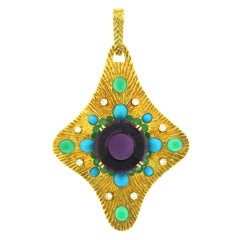
Boucheron Amethyst Pendant
Recent Sales
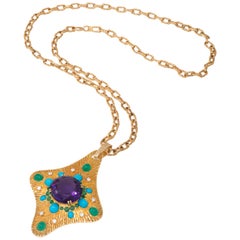
Vintage 1970s French Pendant Necklaces
Amethyst, Chrysophrase, Diamond, Turquoise, 18k Gold, Yellow Gold

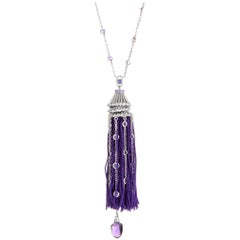
21st Century and Contemporary Pendant Necklaces
Amethyst, Diamond, Sapphire, 18k Gold, White Gold
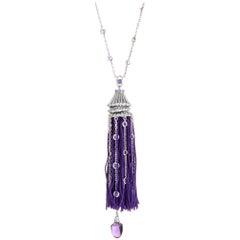
21st Century and Contemporary Pendant Necklaces
Amethyst, Diamond, Sapphire, 18k Gold, White Gold
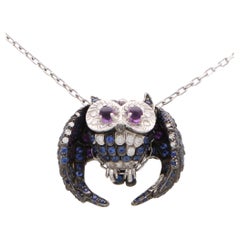
Early 2000s Unknown Modern Pendant Necklaces
Amethyst, Diamond, Sapphire, Gold, 18k Gold, White Gold
French Drop Necklaces
Amethyst, Turquoise, Chrysophrase, Diamond
Boucheron for sale on 1stDibs
As the oldest high-end jewelry boutique on the legendary Place Vendôme in Paris, dating to 1893, Boucheron stands for history, sensuality and avant-garde style. The French fine jewelry house has created iconic rings, necklaces and other adornments over its more than 160-year history for royalty like the Russian imperial family, the Maharaja of Patiala and Elizabeth, the Queen Mother. It has also received popular acclaim for its modern designs and playful motifs such as serpents and cats.
Since its founding in 1858 by Frédéric Boucheron with a boutique at the Palais Royal arcades, the maison has sought to create unforgettably unique pieces, push the boundaries of innovations in jewelry design and celebrate the opulence of gold. Many of its pieces are sculpted in gold by expert goldsmiths so that the material becomes a design element in its own right.
At its best, Edwardian jewelry was all about the exquisite diamond, platinum and pearl creations made by such famous names as Cartier and Boucheron. Later, Frédéric’s son Louis became especially interested in the Art Deco style as well as accessories like cigarette holders, bags and belts.
Boucheron is most famously known for its sources of inspiration: nature, animals and the earth. Its iconic Serpent Bohème collection, introduced in 1968, references the curves and scales of the animal with pear-shaped motifs and coiled accents adorned with diamonds and other precious stones like turquoise, lapis lazuli and malachite. (A 1960s-era Boucheron brooch featuring a lavish mound of artfully assembled round and baguette diamonds set in platinum is a dinner-party conversation starter from any angle.)
Frédéric Boucheron gave a serpent necklace to his wife as a symbol of love and protection. Leopards, hummingbirds, deer and hedgehogs are referenced in the Animaux de Collection, while high-end 3D technology in the Nature Triomphante meticulously re-creates flower petals, ivy branches and other organic forms.
Boucheron also pays homage to Paris, the city where it was founded. The octagonal shape of the Place Vendôme is translated into the geometric Liseré pieces, and the Clou de Paris motif — which is integral to the house's Quatre series — is inspired by the cobblestones on its streets. Since 1859, when Boucheron introduced a collection of pocket watches, the maison has also regularly created timepieces with the same elegance and refinement as its jewelry.
Despite having such a long legacy, Boucheron has always been ahead of its time. Its creative collections and bold jewelry remain coveted and cherished. In 2018, its flagship in the Place Vendôme reopened after a restoration under its current owner Kering.
Find antique and vintage Boucheron jewelry on 1stDibs.
The Legacy of Amethyst in Jewelry Design
There are few gemstones in the world that are both affordable and worthy of a duchess’s attention. But then not many stones are as beautiful as amethyst. Indeed, vintage and antique amethyst jewelry has innumerable fans, and February’s birthstone has many unique attributes. For the romantics, there are several tales in Greek mythology that tell the story of Bacchus and Amethyste, a maiden that he pursues yet is rescued by Diane by turning her into a white stone. Bacchus, mourning his love, pours a glass of wine over the sculpture, dyeing her purple.
Amethyst has adorned many royal jewels. One of the most enviable jewelry collections of all time belonged to Wallis Simpson, the Duchess of Windsor. In 1947, the Duke gifted her with a Cartier amethyst and turquoise bib necklace. This special order piece was made with twisted 18-carat and 20-carat gold, platinum, brilliant- and baguette-cut diamonds, one heart-shaped faceted amethyst, 27 emerald-cut amethysts, one oval faceted amethyst, and turquoise cabochons. The Duchess was not the only Royal with a penchant for the purple gemstone. The tiara now owned by Queen Silvia of Sweden is set with amethysts that once belonged to the French Empress Josephine. A stunning 56-carat cushion-cut, square-shaped amethyst set in an 18-karat yellow gold necklace designed by Tiffany Co. is now in the collection of the Smithsonian National Museum of Natural History.
The Smithsonian also has in its possession an even more rare example of fine amethyst: the 96-carat Morris Amethyst Brooch. The brooch features a deep, rich purple heart-shaped amethyst. The museum states that the piece was likely made during the Edwardian period (1901–15) “when platinum and diamonds were often used, and amethyst, a favorite stone of King Edward VII’s wife, Alexandra, was often included in jewelry of the era.”
Another amethyst necklace, with an even richer story, can be found in the Natural History Museum of London. Known as the Delhi Purple Sapphire (even though the stone is an amethyst), this stone was stolen from the Temple of Indra during the Indian Mutiny of 1857. Anyone in possession of this stone is bound to have terrible luck, including its owner Edward Heron-Allen, who gifted the gemstone to the museum thinking that this would save him but ended up transferring the bad luck to the museum curators overseeing the stone.
Find a wide range of vintage and antique amethyst necklaces, bracelets and other fine jewelry on 1stDibs.
Finding the Right Pendant-necklaces for You
Whether you’re layering multiple jewelry pieces or opting for a single strand, vintage pendant necklaces are versatile accessories that can elevate your casual wear as easily as they can add a creative flourish to your formal attire.
The earliest jewelry was less about accessorizing than it was about wearers arming themselves with amulets. In Ancient Egypt, some amulets featured a loop so that they could be strung around one’s neck. While rubies have long been one of the few gemstones that can give diamonds a run for their money, members of some ancient civilizations valued the stones from the get-go, donning ruby pendants as well as other stones with the belief that these adornments would bring protection, healing powers or strength. Today, we still wear our charm bracelets and charm pendants around our necks for good luck.
Later, pendant necklaces, like most fine jewelry, were worn strictly by royalty or the upper class and conferred wealth and prestige. This changed over time, thankfully, as wearing jewelry became more widespread, a democratized means of personal expression.
During the 18th and 19th centuries, pendant necklaces evolved from their status as spiritual amulets, but the jewels still carried deep personal significance. Victorian pendants, in particular, were part of the “mourning jewelry” tradition. Wearers would embed their pendants with locks of hair from a deceased loved one as a way of grieving in the wake of a loss. In the case of cameo jewelry, some pendants were even decorated with miniature hand-carved portraits in a detailed raised relief. Today, portraiture is still a characteristic of many of the hand-carved pendant necklaces offered by Italian jewelry house Scala Gioielli.
Luxury fine jewelry brands such as Cartier, BVLGARI and David Yurman offer their own unique interpretations of the cherished accessory, embellishing platinum or gold pendant necklaces with diamonds, sapphires and other stones.
On 1stDibs, find an extraordinary range of vintage pendant necklaces and other necklaces today.