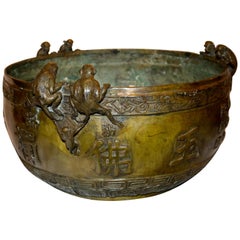
Bronze Prayer Bowl
Recent Sales
Antique 19th Century Chinese Chinese Chippendale Planters, Cachepots and...
Bronze

A Close Look at Chinese-chippendale Furniture
Like chinoiserie, which had emerged in Europe in the 17th century, antique Chinese Chippendale furniture was an appropriation of Asian design that often distilled it to stereotypes.
Thomas Chippendale published The Gentleman and Cabinet-Maker’s Director in 1754, and the widespread popularity of the book of furniture designs influenced a new style of furniture named for the English cabinetmaker. Artisans in England, the United States and Europe adapted the work illustrated in its pages. The publication of the pattern book included designs reflecting “Gothic, Chinese and Modern Taste,” with illustrations of “Chinese” chairs and cabinets featuring elaborate hand-carved latticework.
Pagoda-shaped flourishes and wood painted in the “japanned” finish that mimicked lacquer were common on these pieces, as were fretwork patterns on chair backs. The back of a chair is the easiest way to distinguish between Gothic, Rococo and Chinese Chippendale chairs, all of which typically feature broad seats and luxurious upholstery. Chippendale’s designs for “Chinese” chairs tend to favor more clean lines and less ornamentation than the other styles, with cutouts in the rails and the fretwork on the back evoking a European ideal of East Asian design.
Dark woods such as walnut and solid mahogany were commonly used, as were bamboo turnings. Cabinets for imported Chinese ceramics frequently were adorned with glazing bars, while small tea tables were detailed with angular fretwork. The style remained popular through the 18th century and into the decades that followed, even inspiring an entire room at Buckingham Palace.
Find antique Chinese Chippendale dining room chairs, side tables, case pieces and other furniture and decor on 1stDibs.
Finding the Right Asian-art-furniture for You
From Japanese handmade earthenware pottery, originating circa 14,500 B.C. and adorned with elaborate corded patterns known as jōmon, to natural elm case pieces and storage cabinets built in Qing dynasty–era China to mid-century Thai rice-paper charcoal rubbings, antique and vintage Asian art and furniture make for wonderful additions to all kinds of contemporary interiors.
Eastern elements elevate any home’s decor. Introduce zen sensibility to your living room, dining room and bedroom with the neutral color palettes and the natural materials such as rattan, bamboo and elm that we typically associate with traditional Asian furniture. Decorative handwoven embroideries and textiles originating from India and elsewhere on the continent, which can be draped over a bed or sofa or used as a wall hanging, can be as practical as they are functional, just as you wouldn’t seek out Japanese room-divider screens — often decorated with paintings but constructed to be lightweight and mobile — merely for privacy.
With everything from blanket chests to lighting fixtures to sculptures and carvings, it’s easy to tastefully bring serenity to your living space by looking to the treasures for which the East has long been known.
For British-born furniture designer Andrianna Shamaris, the Japanese concept of beauty in imperfection isn’t limited to her Wabi Sabi collection. She embraces it in her New York City apartment as well. In the living area, for instance, she retained the fireplace’s original black marble while swathing its frame and the rest of the room in bright white.
“We left the fireplace very clean and wabi-sabi, so that it blended into the wall,” says Shamaris, who further appointed the space with a hand-carved antique daybed whose plush pillows are upholstered in antique textiles from the Indonesian island of Sumba.
In the growing antique and vintage Asian art and furniture collection on 1stDibs, find ceramics from China, antiquities from Cambodia and a vast range of tables, seating, dining chairs and other items from Japan, India and other countries.