Capodimonte Flower Lamps
Recent Sales
Vintage 1950s Italian Porcelain
Porcelain
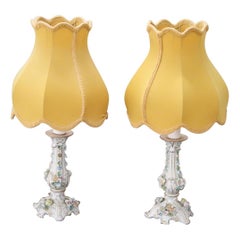

Capodimonte Flower Lamps For Sale on 1stDibs
How Much are Capodimonte Flower Lamps?
Capodimonte for sale on 1stDibs
If success is measured by lasting name recognition, Capodimonte porcelain would seem to be in the same league as such makers as Meissen, Sèvres and Wedgwood. Early examples of Capodimonte lamps — as well as the Italian manufacturer’s celebrated porcelain vases, figurines and sculptures — can be hard to come by, but the best later pieces possess the same over-the-top charm.
The Real Fabbrica (“royal factory”) di Capodimonte hasn’t actually produced porcelain since the early 19th century, when Charles’s son Ferdinand sold it. Although secondary manufacturers have built upon the aesthetic and kept the name alive, some connoisseurs of the royal product feel these pieces should be labeled “in the style of” Capodimonte.
The timeline of royal Capodimonte porcelain is decidedly brief. From beginning to end, its manufacture lasted approximately 75 years. King Charles VII of Naples, who founded the manufactory in 1743, began experimenting with porcelain around 1738, the year he married Maria Amalia of Saxony. No coincidence there. His new bride was the granddaughter of Augustus the Strong, Elector of Saxony and founder of Meissen, the first European hard-paste porcelain manufactory. Her dowry included 17 Meissen table services.
Struck by porcelain fever, Charles built a dedicated facility on top of a hill (capo di monte) overlooking Naples. He financed expeditions to search for the right clay. He hired chemists and artisans to experiment. His earliest successes were small white snuffboxes and vases, although efforts soon progressed to full sets of tableware, decorative objects and stylized figurines of peasants and theatrical personalities.
In 1759, Charles succeeded to the throne of Spain. He moved the manufactory with him — including 40 workers and 4 tons of clay — and continued operations in Madrid. Twelve years later, his son Ferdinand IV, who inherited the throne of Naples, built a new factory there that became known for distinctly rococo designs.
The Napoleonic wars interrupted production, and around 1807, oversight of the royal factories was transferred to a franchisee named Giovanni Poulard-Prad.
Beginning in the mid-18th century, porcelain made by Charles’s factory was stamped with a fleur-de-lis, usually in underglaze blue. Pieces from Ferdinand’s were stamped with a Neapolitan N topped by a crown. When secondary manufacturers began production, they retained this mark, in multiple variations. The value of these later 19th- and 20th-century pieces is determined by the quality, not the Capodimonte porcelain marks.
Find antique and vintage Capodimonte porcelain for sale on 1stDibs.
Finding the Right Table-lamps for You
Well-crafted antique and vintage table lamps do more than provide light; the right fixture-and-table combination can add a focal point or creative element to any interior.
Proper table lamps have long been used for lighting our most intimate spaces. Perfect for lighting your nightstand or reading nook, table lamps play an integral role in styling an inviting room. In the years before electricity, lamps used oil. Today, a rewired 19th-century vintage lamp can still provide a touch of elegance for a study.
After industrial milestones such as mass production took hold in the Victorian era, various design movements sought to bring craftsmanship and innovation back to this indispensable household item. Lighting designers affiliated with Art Deco, which originated in the glamorous roaring ’20s, sought to celebrate modern life by fusing modern metals with dark woods and dazzling colors in the fixtures of the era. The geometric shapes and gilded details of vintage Art Deco table lamps provide an air of luxury and sophistication that never goes out of style.
After launching in 1934, Anglepoise lamps soon became a favorite among modernist architects and designers, who interpreted the fixture as “a machine for lighting,” just as Le Corbusier had reimagined the house as “a machine for living in.” The popular task light owed to a collaboration between a vehicle-suspension engineer by the name of George Carwardine and a West Midlands springs manufacturer, Herbert Terry Sons.
Some mid-century modern table lamps, particularly those created by the likes of Joe Colombo and the legendary lighting artisans at Fontana Arte, bear all the provocative hallmarks associated with Space Age design. Sculptural and versatile, the Louis Poulsen table lamps of that period were revolutionary for their time and still seem innovative today.
If you are looking for something more contemporary, industrial table lamps are demonstrative of a newly chic style that isn’t afraid to pay homage to the past. They look particularly at home in any rustic loft space amid exposed brick and steel beams.
Before you buy a desk lamp or table lamp for your living room, consider your lighting needs. The Snoopy lamp, designed in 1967, or any other “banker’s lamp” (shorthand for the Emeralite desk lamps patented by H.G. McFaddin and Company), provides light at a downward angle that is perfect for writing, while the Fontana table lamp and the beloved Grasshopper lamp by Greta Magnusson-Grossman each yield a soft and even glow. Some table lamps require lampshades to be bought separately.
Whether it’s a classic antique Tiffany table lamp, a Murano glass table lamp or even a bold avant-garde fixture custom-made by a contemporary design firm, the right table lamp can completely transform a room. Find the right one for you on 1stDibs.
- What is Capodimonte s style?1 Answer1stDibs ExpertFebruary 27, 2024Capodimonte's style is regal and opulent, though it has varied over the years. Early pieces from the celebrated Italian porcelain manufacturer often reflect Rococo design sensibilities, with organic motifs rendered in soft colors. As trends changed, so did the look of Capodimonte porcelain, which skewed Victorian, Edwardian and Art Deco over the years that followed. Capodiomonte has also looked beyond its native Italy for inspiration, producing porcelain ware that reflects Japanese and ancient Roman decorative techniques. Shop a wide range of Capdodimonte porcelain on 1stDibs.