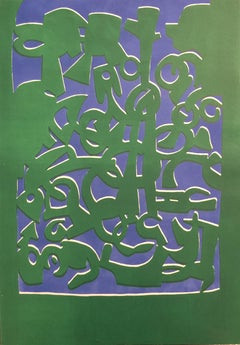
Carla Accardi On Sale

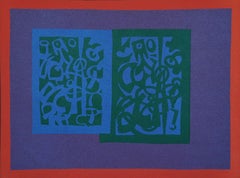
Abstract - Lithograph by Carla Accardi - 1970 ca.
By Carla Accardi
Located in Roma, IT
Limited edition of 150 pieces, hand signed and numbered in pencil. Very good condition.
Category

1970s Abstract Abstract Prints

Materials

Lithograph

Abstract - Lithograph by Carla Accardi - 1970 ca.
$382 Sale Price
30% Off
H 18.9 in W 25.2 in D 0.04 in

Recent Sales

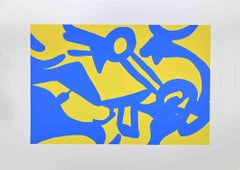
Abstract Composition - Screen Print by Carla Accardi - 1970s
By Carla Accardi
Located in Roma, IT
Abstract Composition is an original Screen Print realized by Carla Accardi in the 1970s. Good condition. Not signed. Carla Accardi (9 October 1924 – 23 February 2014) was an Italia...
Category

1970s Contemporary Abstract Prints

Materials

Screen

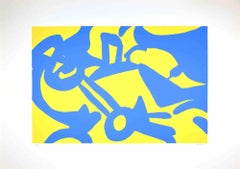
Untitled - Original Screen Print by Carla Accardi - 1980
By Carla Accardi
Located in Roma, IT
Untitled is an original Serigraph realized by Carla Accardi in 1980s. Hand-signed and numbered with pencil by the artist on the lower right margin. Excellent condition. Carla Acca...
Category

1980s Abstract Abstract Prints

Materials

Screen

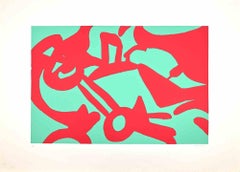
Untitled - Original Screen Print by Carla Accardi - 1980
By Carla Accardi
Located in Roma, IT
Untitled is an original screen print realized by Carla Accardi in 1980s. Hand-signed and numbered with pencil by the artist on the lower right margin. Excellent condition. Carla A...
Category

1980s Abstract Abstract Prints

Materials

Screen

Untitled - Lithograph 1960
By Carla Accardi
Located in Roma, IT
Hand signed. Edition of 70 pieces. Very good conditions.Original Prints. Carla Accardi is an Italian artist who, from 1947, contributed to developing abstract art in Italy. In this ...
Category

1960s Abstract Abstract Prints

Materials

Lithograph

Untitled - Lithograph 1960
H 19.69 in W 13.78 in D 0.04 in
Get Updated with New Arrivals
Save "Carla Accardi 1924 Italian On Sale", and we’ll notify you when there are new listings in this category.

Carla Accardi for sale on 1stDibs

Already an artist, and among the most representative of the Italian Postwar period, she leaves Florence and arrives in Rome as the only woman of the group Forma 1. She defines herself as a white fly who has managed to follow her vocation “because someone believed in me and that was my father”. In Rome she meets Pietro Dorazio, Mino Guerrini, Achille Perilli and the younger Giulio Turcato. Occasionally, Severini went to Pietro Consagra’s studio (at that time he is a guest of Renato Guttuso in via Margutta 58) who appreciated the group’s works and defined Accardi’s works as full of verve. In 1947 the artist creates her first abstract painting, Scomposizioni (Decompositions) - a general theme for all the artists part of the group - in the Accardi’s artwork there are intersections of triangles. In the fifties there is her exhibition in Paris and Italy, where she meets the Turin gallery owner Luciano Pistoi, and in the seventies we see her political adhesion to feminism with her friend Carla Lonzi. Her art was born from the idea that figuration is a transmission of spirituality, to which she arrives with a personal journey marked by meetings with friends such as Consagra, Burri, Fontana. Among the biggest artists, at various times, she has loved Kandinskij or Klee, Mondrian or Matisse. In the artistic panorama of dualities, between figuration and abstraction, Carla Accardi chooses the Sign. Her work is based on the interaction between sign, surface, light, colour and transparency. The importance of her sign begins around 1952, when she isolates herself believing that she can no longer do anything in painting, and she starts to draw directly on the ground. She makes some signs. First, she uses white on black, then she starts to draw shapes one on the top of the other - this produces strong differentiated signs. On Accardi’s opinion, the sign is a vent of subconscious and artistic expression, and language too. A sign exists in relation to others, since it forms a structure with them. Its purpose is to represent the vital impulse that is in the world. In 1965 it takes place a real revolution in Carla Accardi’s artistic activity, when she starts using different materials. She gives up the physical setting of the painting by realizing her signs on sicofoil supports (transparent and shiny material used in the industrial field) with transparent paints. The idea of using sicofoil borns out of an interest in transparency - she wants to make her surroundings transparent and, therefore, she researches some colours that can adhere to, without detaching. She searches how to paint with them too. The process she uses is: to prepare sheets of paper where to draw and to pay attention to the combination and emanation of the light, that derives from the colours. The return to the rough canvas, as an inspiration of anti-painting, a desire for contradiction, this marks her last phase of artistic production.

A Close Look at Abstract Art

Beginning in the early 20th century, abstract art became a leading style of modernism. Rather than portray the world in a way that represented reality, as had been the dominating style of Western art in the previous centuries, abstract paintings, prints and sculptures are marked by a shift to geometric forms, gestural shapes and experimentation with color to express ideas, subject matter and scenes.

Although abstract art flourished in the early 1900s, propelled by movements like Fauvism and Cubism, it was rooted in the 19th century. In the 1840s, J.M.W. Turner emphasized light and motion for atmospheric paintings in which concrete details were blurred, and Paul Cézanne challenged traditional expectations of perspective in the 1890s.

Some of the earliest abstract artists — Wassily Kandinsky and Hilma af Klint — expanded on these breakthroughs while using vivid colors and forms to channel spiritual concepts. Painter Piet Mondrian, a Dutch pioneer of the art movement, explored geometric abstraction partly owing to his belief in Theosophy, which is grounded in a search for higher spiritual truths and embraces philosophers of the Renaissance period and medieval mystics. Black Square, a daringly simple 1913 work by Russian artist Kazimir Malevich, was a watershed statement on creating art that was free “from the dead weight of the real world,” as he later wrote.

Surrealism in the 1920s, led by artists such as Salvador Dalí, Meret Oppenheim and others, saw painters creating abstract pieces in order to connect to the subconscious. When Abstract Expressionism emerged in New York during the mid-20th century, it similarly centered on the process of creation, in which Helen Frankenthaler’s expressive “soak-stain” technique, Jackson Pollock’s drips of paint, and Mark Rothko’s planes of color were a radical new type of abstraction.

Conceptual art, Pop art, Hard-Edge painting and many other movements offered fresh approaches to abstraction that continued into the 21st century, with major contemporary artists now exploring it, including Anish Kapoor, Mark Bradford, El Anatsui and Julie Mehretu.

Find original abstract paintings, sculptures, prints and other art on 1stDibs.

Finding the Right Abstract-prints-works-on-paper for You

Explore a vast range of abstract prints on 1stDibs to find a piece to enhance your existing collection or transform a space.

Unlike figurative paintings and other figurative art, which focuses on realism and representational perspectives, abstract art concentrates on visual interpretation. An artist may use a single color or simple geometric forms to create a world of depth. Printmaking has a rich history of abstraction. Through materials like stone, metal, wood and wax, an image can be transferred from one surface to another.

During the 19th century, iconic artists, including Edvard Munch, Paul Cézanne, Georgiana Houghton and others, began exploring works based on shapes and colors. This was a departure from the academic conventions of European painting and would influence the rise of 20th-century abstraction and its pioneers, like Pablo Picasso and Piet Mondrian.

Some leaders of European abstraction, including Franz Kline, were influenced by the gestural shapes of East Asian calligraphy. Calligraphy interprets poetry, songs, symbols or other means of storytelling into art, from works on paper in Japan to elements of Islamic architecture.

Bold, daring and expressive, abstract art is constantly evolving and dazzling viewers. And entire genres have blossomed from it, such as Color Field painting and Minimalism.

The collection of abstract art prints on 1stDibs includes etchings, lithographs, screen-prints and other works, and you can find prints by artists such as Joan Miró, Alexander Calder and more.