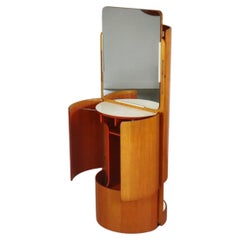
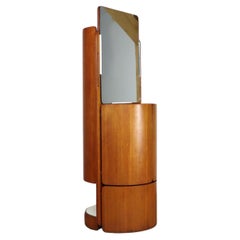
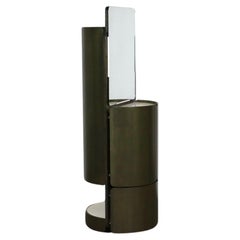
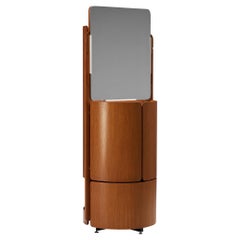
Carlo De Carli Vanity
Recent Sales
Vintage 1950s Wardrobes and Armoires
Mirror, Plywood

Vintage 1960s Wardrobes and Armoires
Brass
Vintage 1960s Wardrobes and Armoires
Brass
Vintage 1960s Wardrobes and Armoires
Brass
Vintage 1960s Italian Mid-Century Modern Coat Racks and Stands
Metal
Carlo di Carli for sale on 1stDibs
A modern Renaissance man, Italian designer Carlo di Carli wove his personal philosophy into his furniture creations. He believed that furniture should suit human movement and the surrounding environment, and each piece was made not only with an eye to form but also for everyday practicality. In today’s interiors, vintage di Carli furniture captures the extraordinary essence of Italian mid-century modernism.
Carlo di Carli was born in Milan in 1910. He studied at the Polytechnic University of Milan and developed an interest in design, architecture, writing and philosophy. After graduating in 1934, he worked under revered Italian architect and designer Gio Ponti. Shortly afterward, di Carli opened a studio with furniture maker Renato Angeli. In 1940, he began a relationship with the Milan Triennial design and art museum, where he eventually joined the board of directors.
Most of di Carli's furniture and architectural works came to fruition between the 1940s and 1970s. His architectural projects included the Church of Saint Ildefonso and the Via dei Giardini 7 building in Milan. However, di Carli is best known for his chair and table designs.
What sets di Carli’s chairs and other seating apart from those of other designers is that they are made to be lived in. As a result, his comfortable, functional and inviting designs earned the attention of leading Italian furniture companies like Cassina, Singer Sons, Tecno and GUBI, and he played a significant role in 20th-century Italian furniture design.
In 1954, di Carli was awarded the Compasso d’Oro for his Cassina Model 683 chair. In 1957, he also won a Grand Prix at the Milan Triennial exhibition for a chair he designed for Tecno. Still committed to his academic pursuits, di Carli served as dean of the architecture faculty at the Polytechnic University of Milan from 1963 to 1968. He continued teaching until 1986 and continued writing until his death in 1999. His most important writings were published in a book titled Architettura, Spazio Primario.
Find vintage Carlo di Carli armchairs, dining chairs and coffee tables on 1stDibs.
Finding the Right Wardrobes-armoires for You
When shopping for antique and vintage wardrobes and armoires for your home, there are several things to keep in mind, not least of which is question number 1:
What is the difference between an armoire and a wardrobe?
The difference between an armoire and a wardrobe is actually simple: An armoire is merely an ornate wardrobe. A wardrobe is a tall, streamlined storage cabinet that usually has some combination of drawers, shelves and hanging rods.
Antique and vintage armoires, on the other hand, are freestanding, heavy wooden structures that typically feature decorative metal hinges and pictorial carvings. Armoires are large cabinets that aren’t outfitted with the varied storage features that wardrobes now commonly have. Armoires often have one or two doors and a hanging bar and allow for quick access. Whether a minimalist mid-century modern wardrobe or grandiose Victorian-era armoire is the right fit for you, both are highly functional furnishings and can be a smart storage solution.
Armoires have been around since medieval times, and initially they may have housed weapons and armor. In their early days, armoires were often adorned with elaborate carvings and lavish paintings, particularly in Renaissance-era France. During the 18th century and later, armoires were widely known as “presses” for hanging clothes, and they were so large that they swallowed up the room where they stood.
In today’s modern homes, an antique armoire can be a striking, architectural work of art amid comparably unadorned furnishings. Whether you’re using your piece in the kitchen for cookware or as a food pantry, in the bedroom for clothes or in the living room as a media console, it will likely become a lovable focal point.
The evolution of the armoire can be seen in today’s corner wardrobes, which may rest on an asymmetrical base to account for corner placement, and even mirrored wardrobes, which feature a mirror affixed to the inside panel of one of the doors for convenience. Contemporary wardrobes commonly feature additional sliding trays and drawers and hanging space for clothing or linens, and the cabinet doors make them ideal for concealing televisions and computer monitors when such devices aren’t in use.
When choosing the right wardrobe or vintage armoire for your home, it’s good to have the following in mind: What are you planning to store in it? How much of what you’re storing will need to be housed in it? It should be big enough to accommodate your needs. What is the size of the room where your wardrobe or armoire will live? A large new piece of furniture in a modest space can easily become a hindrance if you have to navigate your way around it during your daily routine, so be mindful of the area you'll need in order to move freely.
Whether you are looking for an antique walnut armoire or a simple contemporary wardrobe, find the right piece for your home today on 1stDibs.