Elsa Peretti Claw
Recent Sales
21st Century and Contemporary American Modern Choker Necklaces
Yellow Gold
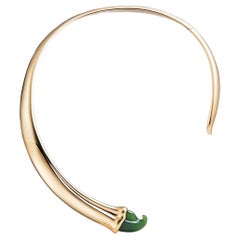

Elsa Peretti for Tiffany Co. for sale on 1stDibs
In an era of social upheaval, venerable Tiffany Co. designer Elsa Peretti reimagined diamonds as jewelry that working women bought for themselves rather than receiving it from a suitor.
By the time the Italian-born Peretti (1940–2021) arrived in New York City, she’d already studied design in Rome, worked for a Milanese architect and taught Italian, French and skiing in Switzerland. She settled on interior design as her potential career path but then chose an altogether different route: modeling. Peretti modeled in Barcelona, Spain, and on the advice of Wilhelmina Cooper — a former model who’d by then founded Wilhelmina Modeling Agency — moved to Manhattan in 1968. When she relocated, Peretti was inspired to pick up jewelry design.
After modeling for designer Halston, the undisputed fashion king of Studio 54, Peretti became his close friend and collaborator, eventually creating jewelry and teardrop-shaped perfume bottles for him. By way of her association with Halston, Peretti took to the disco scene, flourishing in a social circle that included artist Andy Warhol and fashion designer Giorgio di Sant’Angelo.
It wasn’t long before models on di Sant’Angelo’s runway were donning two-inch sterling-silver vases, complete with a rose stem, suspended on leather thongs around their necks. The accessory was Peretti’s inaugural piece of jewelry — she designed it in 1969 after finding a flower vase at a flea market. It was hardly the only time that Peretti found motifs in nature and in organic forms. In the years that followed, her Bean pendant necklace, Starfish earrings and other sensuous accessories would draw on human emotion as well as the natural world around her. Each evocative and wholly versatile design is universally adored decades later, and each was made for a storied American jewelry house with which Peretti would be associated for nearly 50 years.
It was Halston who introduced Peretti to Tiffany Co. She had her own boutique at Bloomingdale’s by 1972, and her partnership with the firm, which signed the venturesome and unorthodox designer to an exclusive contract in 1974, would cement her place in the lofty annals of jewelry legend. Peretti’s simple but sophisticated designs — the Teardrop collection, her minimalist Diamonds by the Yard necklace and Open Heart ring, to name a few — elevated sterling silver, previously considered unsuitable for fine jewelry, and created an enthusiastic young audience for Tiffany’s offerings. In 1977, Peretti’s designs earned the jewelry house more than $6 million. (In some years, her work has accounted for 10 percent of the company’s sales.)
In 2012, Peretti signed a 20-year, $47.3 million contract with Tiffany Co., but she passed away in 2021, at age 80. Today, her designs are in the permanent collections of the Metropolitan Museum of Art in New York City and the British Museum.
Find an exquisite collection of Elsa Peretti jewelry today on 1stDibs.
A Close Look at Modern Jewelry
Rooted in centuries of history of adornment dating back to the ancient world, modern jewelry reimagines traditional techniques, forms and materials for expressive new pieces. As opposed to contemporary jewelry, which responds to the moment in which it was created, modern jewelry often describes designs from the 20th to 21st centuries that reflect movements and trends in visual culture.
Modern jewelry emerged from the 19th-century shift away from jewelry indicating rank or social status. The Industrial Revolution allowed machine-made jewelry using electric gold plating, metal alloys and imitation stones, making beautiful jewelry widely accessible. Although mass production deemphasized the materials of the jewelry, the vision of the designer remained important, something that would be furthered in the 1960s with what’s known as the “critique of preciousness.”
A design fair called the “Exposition Internationale des Arts Décoratifs et Industriels Modernes” brought global attention to the Art Deco style in 1925 and gathered a mix of jewelry artists alongside master jewelers like Van Cleef Arpels, Mauboussin and Boucheron. Art Deco designs from Cartier and Van Cleef Arpels unconventionally mixed gemstones like placing rock crystals next to diamonds while borrowing motifs from eclectic sources including Asian lacquer and Persian carpets. Among Cartier’s foremost design preoccupations at the time were high-contrast color combinations and crisp, geometric forms and patterns. In the early 20th century, modernist jewelers like Margaret De Patta and artists such as Alexander Calder — who is better known for his kinetic sculptures than his provocative jewelry — explored sculptural metalwork in which geometric shapes and lines were preferred over elaborate ornamentation.
Many of the innovations in modern jewelry were propelled by women designers such as Wendy Ramshaw, who used paper to craft her accessories in the 1960s. During the 1970s, Elsa Peretti created day-to-night pieces for Tiffany Co. while designers like Lea Stein experimented with layering plastic, a material that had been employed in jewelry since the mid-19th century and had expanded into Bakelite, acrylics and other unique materials.
Find a collection of modern watches, bracelets, engagement rings, necklaces, earrings and other jewelry on 1stDibs.
Why Gold Shines in Jewelry Craftsmanship
Gold is the feel-good metal, the serotonin of jewelry. Wear vintage and antique gold necklaces, watches, gold bracelets or gold rings and you feel happy, you feel dressed, you feel, well, yourself.
Gold, especially yellow gold, with its rich patina and ancient pedigree going back thousands of years, is the steady standby, the well-mannered metal of choice. Any discussion of this lustrous metal comes down to a basic truth: Gold is elementary, my dear. Gold jewelry that couples the mystique of the metal with superb design and craftsmanship achieves the status of an enduring classic. Many luxury houses have given us some of our most treasured and lasting examples of gold jewelry over the years.
Since its founding, in 1837, Tiffany Co. has built its reputation on its company jewelry as well as its coterie of boutique designers, which has included Jean Schlumberger, Donald Claflin, Angela Cummings and Elsa Peretti. There are numerous gold Tiffany classics worth citing. Some are accented with gemstones, but all stand out for their design and the workmanship displayed.
For the woman who prefers a minimalist look, the Tiffany Co. twist bangle (thin, slightly ovoid) is stylishly simple. For Cummings devotees, signature pieces feature hard stone inlay, such as her pairs of gold ear clips inlaid with black jade (a play on the classic Chanel black and tan), or bangles whose design recalls ocean waves, with undulating lines of lapis lazuli and mother-of-pearl. And just about any design by the great Jean Schlumberger is by definition a classic.
Even had he eschewed stones and diamonds, Southern-born David Webb would be hailed for the vast arsenal of heavy gold jewelry he designed. Gold, usually hammered or textured in some manner, defines great David Webb jewelry. The self-taught jeweler made very au courant pieces while drawing inspiration from ancient and out-of-the-way sources — East meets West in the commanding gold necklaces made by Webb in the early 1970s. The same could be said for his endlessly varied gold cuffs.
In Europe, many houses have given us gold jewelry that sets the highest standard for excellence, pieces that were highly sought after when they were made and continue to be so.
Numerous designs from Cartier are homages to gold. There are the classic Trinity rings, necklaces and bracelets — trifectas of yellow, white and rose gold. As a testament to the power of love, consider the endurance of the Cartier Love bracelet.
Aldo Cipullo, Cartier’s top in-house designer from the late 1960s into the early ’70s, made history in 1969 with the Love bracelet. Cipullo frequently said that the Love bracelet was born of a sleepless night contemplating a love affair gone wrong and his realization that “the only remnants he possessed of the romance were memories.” He distilled the urge to keep a loved one close into a slim 18-karat gold bangle.
BVLGARI and its coin jewelry, gemme nummarie, hit the jackpot when the line launched in the 1960s. The line has been perennially popular. BVLGARI coin jewelry features ancient Greek and Roman coins embedded in striking gold mounts, usually hung on thick link necklaces of varying lengths. In the 1970s, BVLGARI introduced the Tubogas line, most often made in yellow gold. The Tubogas watches are classics, and then there is the Serpenti, the house's outstanding snake-themed watches and bracelets.
A collection called Monete that incorporated the gold coins is one of several iconic BVLGARI lines that debuted in the 1970s and ’80s, catering to a new generation of empowered women. Just as designers like Halston and Yves Saint Laurent were popularizing fuss-free ready-to-wear fashion for women on the go, BVLGARI offered jewels to be lived in.
Since Van Cleef Arpels opened its Place Vendôme doors in 1906, collection after collection of jewelry classics have enchanted the public. As predominantly expressed in a honeycomb of gold, there is the Ludo watch and accessories, circa the 1920s, and the golden Zip necklace, 1951, whose ingenious transformation of the traditional zipper was originally proposed by the Duchess of Windsor. Van Cleef's Alhambra, with its Moroccan motif, was introduced in 1968 and from the start its popularity pivoted on royalty and celebrity status. It remains one of VCA’s most popular and collected styles.
Mention must be made of Buccellati, whose name is synonymous with gold so finely spun that it suggests tapestry. The house’s many gold bracelets, typically embellished with a few or many diamonds, signified taste and distinction and are always in favor on the secondary market. Other important mid-20th-century houses known for their gold-themed jewelry include Hermès and Ilias Lalaounis.
Find a stunning collection of vintage and antique gold jewelry on 1stDibs.
Finding the Right Choker-necklaces for You
Vintage choker necklaces are elegant, alluring and stylish. Cameos, pearls, diamonds and other stones can decorate these necklaces, which come in single or multiple strands. Whether it is a statement piece or a delicate chain, these short necklaces always stand out and turn heads.
The history of the choker can be traced back thousands of years, with Sumerian examples discovered from 2600–2500 B.C. They endured as a popular form of adornment through the centuries, and during the French Revolution they took on a symbolic significance. Women wore ribbons around their throats to mark the passing of those killed by the guillotine. Soon, the plain ribbons were adorned with small cameos and other ornamentation.
European choker necklaces gained a salacious reputation in the 19th century when prostitutes were associated with black ribbons tied around the neck, such as the model in Édouard Manet’s Olympia (1863). Queen Alexandra, Princess of Wales, reversed the trend in the late 19th century by wearing a large pearl and diamond choker, reputedly to hide a scar.
Fashioned from gold, pearls and other precious stones and metals, chokers continued to be worn into the 20th century, alternately statements of wealth and rebellion. They experienced periods of revival in the 1920s, ’40s, ’70s and ’90s for both men and women.
Vintage chokers make a statement with an unmistakable air of femininity. On 1stDibs, find an alluring collection of vintage chokers today, including gold, sapphire and emerald chokers.