Etchings Of Italy
to
7
78
41
53
35
33
23
19
14
12
9
9
8
8
7
6
6
5
5
4
4
3
3
3
2
2
2
2
2
2
1
1
1
1
1
1
1
1
1
9
9
7
4
4
Sort By
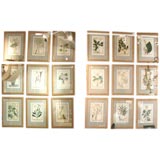
A Collection of 50 Roman Medicinal Herb Etchings
Located in New York, NY
A Collection of Fifty Hand Tinted Etchings of Medicinal Herbs From a Roman Reference Book Dated
Category
Antique 18th Century and Earlier Italian Prints
Materials
Paper

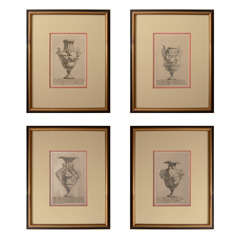
Suite of 4 Neoclassical Etchings of Urns by Salz dated 1745
By Salz
Located in Water Mill, NY
Suite of 4 Neoclassical etchings of urns by Salz dated 1745
Category
Antique 18th Century and Earlier Italian Prints
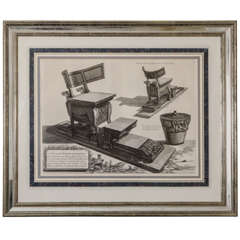
Framed Antique Etching by Piranesi of an Ancient Roman Curule Chair
By Giovanni Battista Piranesi
Located in New York, NY
Plate 81, "Sedia curule di marmo in prospettiva", from Giovanni Battista Piranesi's Vasi Candelabri Cippi Sarcofagi, first available in bound form in 1778.
Category
Antique 19th Century Italian Prints
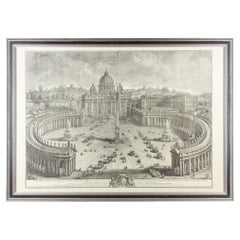
Antique Framed Etching of St. Peter
s Basilica by Giuseppe Vasi found in France
Located in Houston, TX
This antique framed etching of St. Peter's Basilica in the Vatican, by Guiseppi Vasi. The full
Category
Antique 18th Century Italian Prints
Materials
Paper
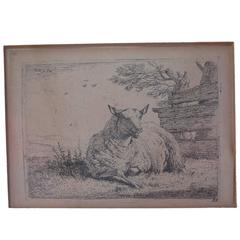
Karel Dujardin Etching of Recumbent Sheep, 1655
By Karel Dujardin
Located in Brooklyn, NY
Etching by Dutch/Italian artist Karel Dujardin (1622-1678). Numbered 35 in plate.
From the
Category
Antique Mid-17th Century Italian Prints
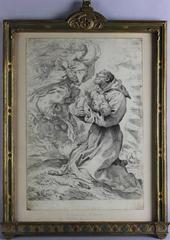
16th Century One-of-a Kind Etching by Pietro Faccini (ITALIAN 1562-1602)
By Pietro Faccini
Located in Gallatin, TN
PIETRO FACCINI (Bologne, Italy 1562-1602) Copper Plate Etching, Entitled VISION OF ST. FRANCIS
Category
16th Century More Art
Materials
Copper
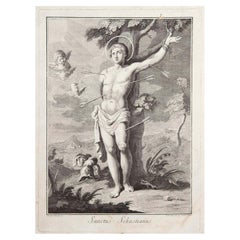
Mid-18th Century Venetian Etching of Saint Sebastian
By Pietro Antonio Novelli
Located in Richmond, London
An exquisite and rare etching of Saint Sebastian, after P. Novelli, engraved by P. da Colle
Venice
Category
Antique Mid-18th Century Italian Baroque Prints
Materials
Paper
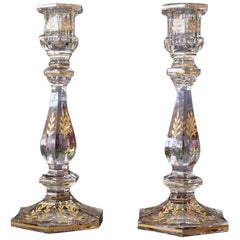
Pair of Glass Candle Sticks with Gold Etching of Flowers, circa 1900
Located in Geelong, Victoria
Pair of glass candle sticks with gold etching and enamel decoration of flowers and leaf detail, the
Category
Antique Early 1900s Italian Glass
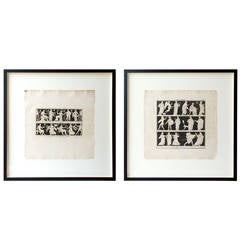
Pair of Original 18th Century Aquatint Etchings by Andrea Scacciati
By Andrea Scacciati
Located in Atlanta, GA
A pair of original 18th century aquatint etchings by Andrea Scacciati. Framed under UV protected
Category
Antique Mid-18th Century Italian Classical Greek Prints
- 1
Get Updated with New Arrivals
Save "Etchings Of Italy", and we’ll notify you when there are new listings in this category.
Etchings Of Italy For Sale on 1stDibs
At 1stDibs, there are many versions of the ideal etchings of Italy for your home. Each etchings of Italy for sale was constructed with extraordinary care, often using paper, metal and wood. If you’re shopping for a etchings of Italy, we have 30 options in-stock, while there are 1 modern editions to choose from as well. Whether you’re looking for an older or newer etchings of Italy, there are earlier versions available from the 18th Century and newer variations made as recently as the 21st Century. A etchings of Italy is a generally popular piece of furniture, but those created in Neoclassical, Modern and Georgian styles are sought with frequency. Many designers have produced at least one well-made etchings of Italy over the years, but those crafted by Francesco Curti, Giovanni Battista Piranesi and Giuseppe Maria Mitelli are often thought to be among the most beautiful.
How Much is a Etchings Of Italy?
A etchings of Italy can differ in price owing to various characteristics — the average selling price 1stDibs is $1,750, while the lowest priced sells for $241 and the highest can go for as much as $6,724.
Questions About Etchings Of Italy
- What is etching?1 Answer1stDibs ExpertSeptember 25, 2019
Etching is a method of making prints using metal plates onto which a design has been incised by acid.
- What is a Picasso etching?1 Answer1stDibs ExpertApril 5, 2022An etching is created by cutting down a metal plate with chemicals, including acid, to achieve the desired image. The metal plate is then inked and pressed onto a piece of paper. Picasso became fascinated with etchings when he moved to Paris in the early 1900s, and would go on to pioneer new techniques with etchings throughout his career. Shop a selection of Pablo Picasso pieces from some of the world’s top art dealers on 1stDibs.
- What are the types of etching?1 Answer1stDibs ExpertSeptember 25, 2019
There is dry and wet etching.
- How do you identify an etching?1 Answer1stDibs ExpertNovember 26, 2024To identify an etching, look in the corners and on the back for an artist's signature or publisher information. Cross-referencing markings with information shared on trusted online resources can allow you to determine the artist. From there, you can browse online and print catalogues of their work to find out the title and date of the etching. In terms of how to tell an etching apart from other types of prints, one telltale sign is the appearance of slightly blurry lines along the edges. Called plate marks, these lines form from the pressure exerted by the plate during the etching process. You may need a magnifying glass to spot the plate mark on a print. If you have any difficulty with the identification process, consider enlisting the help of a certified appraiser or experienced art dealer. Shop a collection of etchings on 1stDibs.
- What is vintage etching?1 Answer1stDibs ExpertApril 5, 2022Vintage etching is a term that refers to a specific type of print produced between 50 and 100 years ago. Printmakers produced etchings by carving images into a copper plate and then soaking it in an acid bath. Then, they applied ink to the plate and pressed it against paper or another material to create an image. On 1stDibs, find a collection of vintage etchings.
- What is an original etching?1 Answer1stDibs ExpertMarch 13, 2024An original etching is a print produced during the first production run of a print series. After making an etching plate, an artist will create a limited number of etchings. Collectively, these prints are the original etchings. They differ from restrike etchings made years later, sometimes after the death of the artist. On 1stDibs, shop a diverse assortment of etchings.
- What is etched glass?1 Answer1stDibs ExpertFebruary 22, 2021Etched glass is a type of decorative glass which is the result of small cuts made to the glass. The cuts, which appear white, typically form patterns or images.
- Where are the mosaics in Italy?1 Answer1stDibs ExpertApril 5, 2022In Italy, mosaics are in a number of Byzantine churches. The Church of Santa Cecilia in Rome, the Basilica of Saint Mark in Venice and the Basilica of Sant'Apollinare Nuovo in Ravenna are all home to well-known mosaics. On 1stDibs, shop a selection of mosaics.
- 1stDibs ExpertOctober 24, 2024To tell a lithograph from an etching, look closely along the edges of the print. Etching is a way of incising lines on a metal plate by first drawing on an acid-resistant coating, or ground, to reveal the metal beneath. Lithography uses a stone rather than a plate. As a result, etchings will usually have a faint imprint or indentation called a plate mark, while a lithograph will not. Researching the artist using trusted online resources may also be helpful, as some printmakers worked exclusively with etchings or lithographs. Find a large selection of lithographs and etchings on 1stDibs.
- Did Picasso make etchings?1 Answer1stDibs ExpertApril 5, 2022Yes, Pablo Picasso made etchings and took that foundation into an exploration of printmaking and the different methods of that medium. Picasso first began working on etchings in the early 1900s, quickly mastering the technique, and then he began expanding and pushing the boundaries to create a unique and signature style. On 1stDibs, find a variety of original artwork from top artists.
- Can I etch the back of a mirror?1 Answer1stDibs ExpertApril 5, 2022Yes, you can etch on the back of a mirror. Modern mirrors typically have a reflective layer that is deposited on the back of the glass. If you want to etch the back of a mirror you need to remove the reflective layer, which can be done with an engraving tool or with an etching solution. Shop a range of antique and modern mirrors on 1stDibs.
- 1stDibs ExpertAugust 26, 2024The difference between an etching and a print depends on how specific the terms are. Print is a general term for any type of artwork made by transferring an image onto another material, such as paper or fabric. A specific printmaking technique, etching is a way of incising lines in a metal plate by first drawing on an acid-resistant coating, or ground, to reveal the metal beneath. The plate is then submerged in acid, which “bites” the lines into the metal plate. On 1stDibs, find a large selection of etchings and other prints.
- 1stDibs ExpertOctober 15, 2024To tell if an etching is valuable, one approach is to conduct research using trusted online resources. The maker, age, image quality, historical significance and overall condition all play a role in determining the potential value of an etching. By seeing how much similar etchings have sold for in the past, you can get a rough idea of how much your piece may be worth. However, experts generally recommend having a certified appraiser or experienced art dealer evaluate prints for a more accurate valuation. Find a wide range of etchings on 1stDibs.
- 1stDibs ExpertApril 3, 2024The difference between a lithograph and an etching is that while both are types of prints, they are made using different techniques. With respect to lithography, the image to be printed is drawn or painted on a stone or metal plate with an oil-based substance, such as a greasy crayon or tusche (an oily wash). The stone is then covered with water, which is repelled by the oily areas. Oil-based ink is then applied to the wet stone, adhering only to the oily image. Afterward, the stone is covered with a sheet of paper and run through a press.
Etching is a way of incising lines in a metal plate by first drawing on an acid-resistant coating, or ground, to reveal the metal beneath. The plate is then submerged in acid, which “bites” the lines into the metal plate. The ground is then removed and the plate is inked for pressing.
Find a collection of lithographs for sale on 1stDibs. - 1stDibs ExpertAugust 29, 2024To tell if an etching is original, first gently run your hand along its surface. An original etching will usually have a slight indentation in the image area left behind by the pressure applied by the plate during the printing process. Next, grab a magnifying glass and view the image up close. On an original, you won't see small dots making up the picture, but many reproductions do display dots due to their printing methods. Finally, look at the signature. Most original etchings will be hand-signed. If the signature is printed on your piece, it may be a reproduction. Consult a certified appraiser or experienced art dealer for an expert opinion on your print. Find a wide variety of etchings on 1stDibs.
- 1stDibs ExpertAugust 26, 2024The difference between etching and aquatint is technique. Invented in the 1500s, etching is a way of incising lines in a metal plate by first drawing on an acid-resistant coating, or ground, to reveal the metal beneath. The plate is then submerged in acid, which “bites” the lines into the metal plate. The ground is then removed, and the plate is inked for pressing. Etched lines tend to reveal the movement of the artist’s hand more than a technique like engraving, since the image is created on softer ground. Aquatint, a technique named for its resemblance to watercolor or ink wash, is often combined with etching to create rich tonal variations. It’s a similar process to etching, but the resin ground is more granulated, so the acid handles the metal differently. Different degrees of darkness are created based on the amount of time the plate is in contact with the acid. Find a collection of etchings and aquatint prints on 1stDibs.
- 1stDibs ExpertMarch 22, 2022Rembrandt's etchings are important because of the influence they had on printmaking. The printing techniques that he employed allowed each of his prints to seem very unique while making it possible for him to mass produce his images. Printmakers that followed utilized the advancements he made in the field to create and distribute their own prints. Find a range of Rembrandt art on 1stDibs.
- Is Gucci made in Italy?1 Answer1stDibs ExpertMay 3, 2024Whether Gucci is made in Italy depends on the piece. The vast majority of the luxury fashion house's clothing, bags and accessories do come from workshops in Italy. However, Gucci manufactures its watches in Switzerland and some of its eyewear in Japan. Find a variety of Gucci apparel and accessories on 1stDibs.
- Is Prada from Italy or France?1 Answer1stDibs ExpertMarch 25, 2024Prada is from Italy, not France. Mario Prada founded the luxury fashion house in Milan's Galleria Vittorio Emanuele II in 1913. His original shop remains to this day, but the company now operates from its headquarters in a repurposed industrial space between Via Bergamo and Via Fogazzaro in Milan. On 1stDibs, explore a variety of Prada apparel, bags and accessories.
- Does Italy have good watches?1 Answer1stDibs ExpertDecember 5, 2024Many watch lovers believe that Italy has good watches. While perhaps not as famous a country for watch manufacturers as Switzerland, Italy is home to many distinguished luxury watchmakers. Among them are Bulgari, Emporio Armani, Gucci, Panerai and Salvatore Ferragamo. On 1stDibs, shop a range of Italian watches.
More Ways To Browse
Vintage Italian Cars
Vintage Japanese Toys
Vintage Knitting Baskets
Vintage Lamb Figurines
Vintage Lemonade Pitcher And Glasses
Vintage Leopold Desk
Vintage Lexington Dresser
Vintage Lighted Santa
Vintage Liquor Bottles
Vintage Marshall Fields Furniture
Vintage Metal Bistro Chair
Vintage Metal Toy Tractors
Vintage Mexican Sombrero
Vintage Military Toys
Vintage Milk Boxes
Vintage Moran Furniture
Vintage Mother Of Pearl Pill Box
Vintage Mushroom Pottery