Federal Pier Table
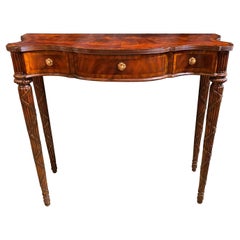
Antique 1840s Federal Console Tables
Mahogany

Recent Sales
Antique Early 19th Century American Federal Console Tables
Marble
Antique 19th Century American Federal Console Tables
Mahogany, Giltwood
Antique Early 19th Century American Federal Console Tables
Marble, Ormolu
20th Century American Federal Console Tables
Brass
Antique Early 19th Century Unknown Federal Console Tables
Mahogany

Antique 19th Century American Neoclassical Console Tables
Bronze
People Also Browsed
Early 20th Century English Edwardian Fireplaces and Mantels
Mahogany
20th Century English Edwardian Fireplaces and Mantels
Walnut, Wood, Oak
Antique 19th Century Italian Fireplaces and Mantels
Wood
Antique Early 19th Century American American Classical Fireplaces and Ma...
Mahogany
Vintage 1960s American Mid-Century Modern Lounge Chairs
Mohair, Walnut
A Close Look at Federal Furniture
Following the Revolutionary War, the American republic referenced the Roman Republic in its designs to celebrate its independence and declare itself a powerful new country. Imbued with neoclassical elements like those being promoted by architect Robert Adam in Great Britain, antique Federal-style furniture was the first distinctly American style in its melding of ancient influences, European aesthetics and national pride.
Dating roughly from 1790 to 1830, the style featured angular furniture with saber legs and smooth surfaces that contrasted with the curvy Rococo style that was previously in fashion. Eagles were common ornamental motifs on Federal-period furniture, as were cornucopia, lyres, garlands and scrolls, adding subtle flair to pieces characterized by clean lines, geometric symmetry, balanced shapes and a sense of grandeur.
Instead of sculptural carvings, authentic Federal-style furniture was adorned with inlays and patterned veneers that showcased the rich character of different grains and types of wood. As social life tended to be informal in the young country, furniture was often lightweight, so it could be easily rearranged in a drawing room or bedroom. Pieces like dining tables with drop leaves and sideboards became popular, replacing larger chests of drawers.
The Federal style varied by region: Artisans in Charleston, South Carolina, decorated chairs with carved backs, for instance, while those in Baltimore, Maryland, preferred painted details. Its major proponents included father-and-son cabinetmakers John and Thomas Seymour in Boston, Duncan Phyfe and Charles-Honoré Lannuier in New York and Samuel McIntire in Salem, Massachusetts.
Find antique Federal tables, mirrors, storage cabinets and other Federal furniture for sale on 1stDibs.
Finding the Right Console-tables for You
Few pieces of furniture are celebrated for their functionality as much as their decorative attributes in the way that console tables are. While these furnishings are not as common in today’s interiors as their coffee-table and side-table counterparts, console tables are stylish home accents and have become more prevalent over the years.
The popularity of wood console tables took shape during the 17th and 18th centuries in French and Italian culture, and were exclusively featured in the palatial homes of the upper class. The era’s outwardly sculptural examples of these small structures were paired with mirrors or matching stools and had tabletops of marble. They were most often half-moon-shaped and stood on two scrolled giltwood legs, and because they weren’t wholly supported on their two legs rather than the traditional four, their flat-backed supports were intended to hug the wall behind them and were commonly joined by an ornate stretcher. The legs were affixed or bolted to the wall with architectural brackets called console brackets — hence, the name we know them by today — which gave the impression that they were freestanding furnishings. While console tables introduced a dose of drama in the foyer of any given aristocrat — an embodiment of Rococo-style furniture — the table actually occupied minimal floor space (an attractive feature in home furniture). As demand grew and console tables made their way to other countries, they gained recognition as versatile additions to any home.
Contemporary console tables comprise many different materials and are characterized today by varying shapes and design styles. It is typical to find them made of marble, walnut or oak and metal. While modern console tables commonly feature four legs, you can still find the two-legged variety, which is ideal for nestling behind the sofa. A narrow console table is a practical option if you need to save space — having outgrown their origins as purely ornamental, today’s console tables are home to treasured decorative objects, help fill empty foyers and, outfitted with drawers or a shelf, can provide a modest amount of storage as needed.
The rich collection of antique, new and vintage console tables on 1stDibs includes everything from 19th-century gems designed in the Empire style to unique rattan pieces and more.
- Why is it called a pier table?1 Answer1stDibs ExpertNovember 13, 2024The reason why it is called a pier table comes from the original placement of the furniture. Pier tables emerged during the 16th and 17th centuries in Europe. Households often placed these tables along walls in between windows. In architectural terminology, the area between two windows is known as the pier. Find a wide range of pier tables on 1stDibs.