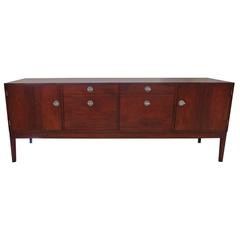
Finn Juhl Diplomat Sideboard
Recent Sales
Vintage 1960s Danish Scandinavian Modern Sideboards
Aluminum
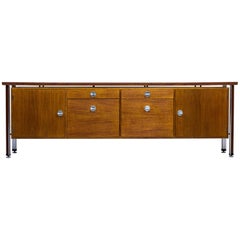

Vintage 1960s Danish Mid-Century Modern Sideboards
Rosewood
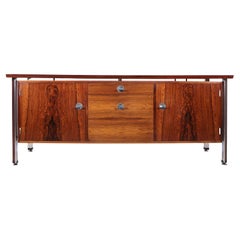
Mid-20th Century Danish Scandinavian Modern Sideboards
Aluminum, Steel
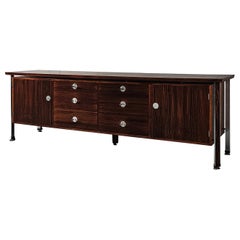
Mid-20th Century Danish Mid-Century Modern Tray Tables
Teak
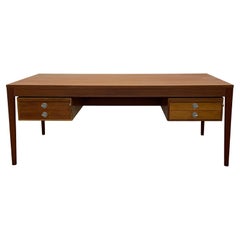
Mid-20th Century Danish Mid-Century Modern Credenzas
Aluminum
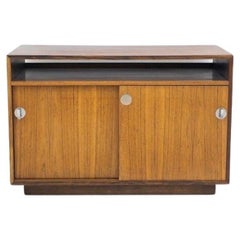
Vintage 1970s Danish Scandinavian Modern Sideboards
Aluminum
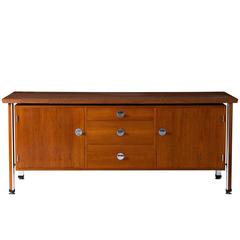
Mid-20th Century Danish Mid-Century Modern Sideboards
Rosewood
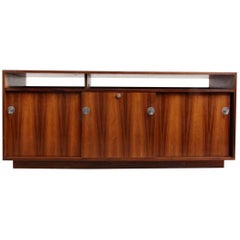
Mid-20th Century Danish Mid-Century Modern Sideboards
Aluminum
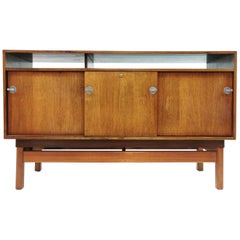
Vintage 1950s Danish Mid-Century Modern Credenzas
Aluminum, Stainless Steel
Vintage 1960s Danish Mid-Century Modern Sideboards
Rosewood
Finn Juhl for sale on 1stDibs
Along with Hans Wegner, Arne Jacobsen and Børge Mogensen, Finn Juhl was one of the great masters of mid-20th-century Danish design. Juhl was the first among that group to have his work promoted overseas, bringing the character of the nation’s furnishings — and the inherent principles of grace, craftsmanship and utility on which they were based — to an international audience.
A stylistic maverick, Juhl embraced expressive, free-flowing shapes in chair, credenzas and sofa designs much earlier than his colleagues, yet even his quietest pieces incorporate supple, curving forms that are at once elegant and ergonomic.
As a young man, Juhl hoped to become an art historian, but his father steered him into a more practical course of study in architecture. He began designing furniture in the late 1930s, a discipline in which, despite his education, Juhl was self-taught, and quite proud of the fact.
Juhl’s earliest works, designed in the late 1930s, are perhaps his most idiosyncratic. The influence of modern art is clear in his 1939 Pelican chair: an almost Surrealist take on the classic wing chair. Critics reviled the piece, however; one said it looked like a "tired walrus." Juhl had tempered his creativity by 1945, when the workshop of Danish cabinetmaker Niels Vodder began to issue his designs. Yet Juhl’s now-classic NV 45 armchair still demonstrates panache, with a seat that floats above the chair’s teak frame.
Juhl first exhibited his work in the United States in 1950, championed by Edgar Kaufmann Jr., an influential design critic and scion of America’s most prominent family of modern architecture and design patrons. (Kaufmann’s father commissioned Frank Lloyd Wright’s design of the house “Fallingwater.”)
Juhl quickly won a following for such signature designs as the supremely comfortable Chieftan lounge chair, the Judas table — a piece ornamented with stylish inlaid silver plaquettes — and the biomorphic Baker sofa. After an article authored by Kaufmann on Juhl and his work appeared in the U.S.-based magazine Interiors in 1948, he began receiving American commissions.
Kaufmann commissioned Juhl to create the exhibition design for, and contribute pieces to, the 1951 edition of the Good Design shows he organized for MoMA and Chicago’s Merchandise Mart. Baker Furniture asked Juhl to design for the firm, and he produced a collection of chairs, tables and cabinets, and, later, the 1957 sofa.
Scandinavian modernist seating, such as the chairs and sofas Juhl created for Baker, became immensely popular in postwar America, as the seeds of the Scandinavian style that Juhl sowed took root and spread in the United States. Juhl and his work featured prominently in the landmark show “Design from Scandinavia,” which opened in 1954 at the Virginia Museum of Fine Arts and traveled to 24 museums in the U.S. and Canada; over three years, it was seen by more than a million people.
Juhl’s furniture — as well as his ceramics, tableware and accessories — has an air of relaxed sophistication and elegance that is unique in the realm of mid-century design.
Find vintage Finn Juhl armchairs, coffee tables, desks and other furniture for sale on 1stDibs.
Finding the Right Sideboards for You
An antique or vintage sideboard today is a sophisticated and stylish component in sumptuous dining rooms of every shape, size and decor scheme, as well as a statement of its own, showcased in art galleries and museums.
Once simply boards made of wood that were used to support ceremonial dining, sideboards have taken on much greater importance as case pieces since their modest first appearance. In Italy, the sideboard was basically a credenza, a solid furnishing with cabinet doors. It was initially intended as an integral piece of any dining room where the wealthy gathered for meals in the southern European country.
Later, in England and France, sideboards retained their utilitarian purpose — a place to keep hot water for rinsing silverware and from which to serve cold drinking water — but would evolve into double-bodied structures that allowed for the display of serveware and utensils on open shelves. We would likely call these buffets, as they’re taller than a sideboard. (Trust us — there is an order to all of this!)
The sideboard is often deemed a buffet in the United States, from the French buffet à deux corps, which referred to a storage and display case. However, a buffet technically possesses a tiered or shelved superstructure for displaying attractive kitchenware and certainly makes more sense in the context of buffet dining — abundant meals served for crowds of people.
Every imaginable iteration of the sideboard has taken shape over the years. Furniture maker and artist Paul Evans, whose work has been the subject of various celebrated museum exhibitions, created ornamented, welded and patinated sideboards for Directional Furniture, collections such as the Cityscape series that speak to his place in revolutionary brutalist furniture design as much as they echo the origins of these sturdy, functional structures centuries ago.
If mid-century modern sideboards or vintage Danish sideboards are more to your liking than an 18th-century mahogany sideboard with decorative inlays in the Hepplewhite style, the particularly elegant pieces crafted by designers Hans Wegner, Edward Wormley or Florence Knoll are often sought by today’s collectors.
Whether you have a specific era or style in mind or you’re open to browsing a vast collection to find the right fit, 1stDibs has a variety of antique and vintage sideboards to choose from.