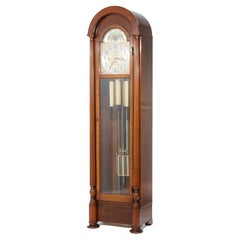
Five Tube Grandfather Clock
Recent Sales
Early 20th Century Neoclassical Grandfather Clocks and Longcase Clocks
Mahogany

A Close Look at Neoclassical Furniture
Neoclassical design emerged in Europe in the 1750s, as the Age of Enlightenment reached full flower. Neoclassical furniture took its cues from the styles of ancient Rome and Athens: symmetrical, ordered, dignified forms with such details as tapered and fluted chair and table legs, backrest finials and scrolled arms.
Over a period of some 20 years, first in France and later in Britain, neoclassical design — also known as Louis XVI, or Louis Seize — would supersede the lithe and curvaceous Rococo or Louis XV style.
The first half of the 18th century had seen a rebirth of interest in classical antiquity. The "Grand Tour" of Europe, codified as a part of the proper education of a patrician gentleman, included an extended visit to Rome. Some ventured further, to sketch the ruins of ancient Greece. These drawings and others — particularly those derived from the surprising and rich archaeological discoveries in the 1730s and ’40s at the sites of the Roman cities of Pompeii and Herculaneum — caused great excitement among intellectuals and aesthetes alike.
Neoclassical furniture is meant to reflect both grace and power. The overall appearance of neoclassical chairs, tables and cabinetry is strong and rectilinear. These pieces are, in effect, classical architecture in miniature: chair and table legs are shaped like columns; cabinets are constructed with elements that mirror friezes and pediments.
Yet neoclassicism is enlivened by gilt and silver leaf, marquetry, and carved and applied ornamental motifs based on Greek and Roman sculpture: acanthus leaves, garlands, laurel wreaths, sheaves of arrow, medallions and chair splats are carved in the shapes of lyres and urns. Ormolu — or elaborate bronze gilding — was essential to French design in the 18th and 19th centuries as a cornerstone of the neoclassical and Empire styles.
As you can see from the furniture on these pages, there is a bit of whimsy in such stately pieces — a touch of lightness that will always keep neoclassicism fresh.
Find antique neoclassical furniture today on 1stDibs.
Finding the Right Grandfather-clocks-longcase-clocks for You
Antique grandfather clocks and longcase clocks are staples of old-world design sensibilities, and, along with their storied history, these statuesque timepieces can bring a feeling of warmth to living rooms, dining rooms and other areas of your home.
Longcase clocks, which originated in England and were manufactured in the United States beginning in the 1700s, refer to tall clocks with a face and clock works positioned high in the housing while a large swinging pendulum movement is tucked inside the case, which is supported by a carved base called a plinth.
While guests making their way through your foyer (another ideal location for such a furnishing) might typically refer to your longcase clock as a “grandfather clock,” there are actually three varieties of these stylish floor clocks, which include granddaughter clocks (the shortest, generally not one solid piece of wood and around three to five feet tall), grandmother clocks (the slimmer middle ground, between five feet and six feet tall) and grandfather clocks, which are typically between six and seven feet tall.
Sculptural and statement-making, antique grandfather clocks created by the likes of the Seth Thomas Clock Company, the Howard Miller Clock Company, Hermle or other clockmakers are an alluring choice in filling up space in a room, while the shorter longcase clocks are just as useful if you need an element that is comparatively muted or you’re working with limited space.
Each generation of artisan clockmakers, working in various furniture styles over time, contributed its own flourishes to the design of longcase clocks. Antique grandfather clocks in the Georgian style share commonalities with neoclassical design. They were often made in dark woods such as mahogany and feature intricate carving. Mahogany is also common for Victorian-era grandfather clocks, although examples of this style can be found in oak and walnut too. Designers of contemporary grandfather clocks are using a range of materials.
It’s easy to get confused when determining the origins or value of an antique grandfather clock or other vintage longcase clock. While an antique appraiser will be able to tell quickly, searching for a manufacturer’s name engraved on the face and dial of the clock may be an easy way to learn about the history of your clock.
Find a distinctive variety of antique grandfather clocks and longcase clocks on 1stDibs, and browse our collection of unusually beautiful clocks, wall clocks, desk clocks and other vintage clocks too.