Francisco Goya The Prisoner
Recent Sales
1810s Old Masters Figurative Prints
Etching
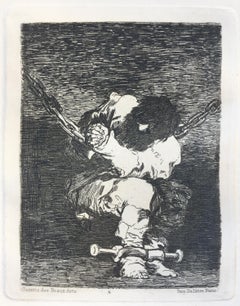

Francisco Goya for sale on 1stDibs
A Close Look at Old-masters Art
Encompassing centuries of change in Europe between 1300 and 1800, from booms of prosperity to bloody revolutions, Old Masters describes a wide range of artists. The informal term was derived from the title of an artist who trained in a guild long enough to become a master, such as Leonardo da Vinci, who studied in a Florence painters’ guild. However, Old Masters paintings, prints and other art is now used to refer to work made by any artist with a high level of skill in painting, drawing, sculpture or printmaking who worked during this era.
The 15th century’s expansive trade and commerce spread culture across borders. A vibrant period of art emerged, bolstered by studies of anatomy and nature that influenced a new visual realism. From Raphael and Michelangelo in the Renaissance to Rembrandt van Rijn and Johannes Vermeer in the Dutch Golden Age, artists expressed emotion, naturalism, color and light in new ways. El Greco and Paolo Veronese were leaders in the dramatic style of Mannerism, while Caravaggio and Peter Paul Rubens demonstrated the movement and meticulous detail of Baroque art.
Historically, most attention was concentrated on male artists, but recent research and exhibitions have elevated the impactful work of women such as Rachel Ruysch and Artemisia Gentileschi. In late-18th-century France, female artists like Adélaïde Labille-Guiard and Élisabeth Vigée Le Brun were prominent names. Nevertheless, access to the academies and guilds was highly restricted for women, and even those able to establish practices were expected to adhere to portraits and still lifes rather than the grand history paintings being created by men.
Find a collection of Old Masters prints, paintings, drawings and watercolors and other art on 1stDibs.
Finding the Right Figurative-prints-works-on-paper for You
Bring energy and an array of welcome colors and textures into your space by decorating with figurative fine-art prints and works on paper.
Figurative art stands in contrast to abstract art, which is more expressive than representational. The oldest-known work of figurative art is a figurative painting — specifically, a rock painting of an animal made over 40,000 years ago in Borneo. This remnant of a remote past has long faded, but its depiction of a cattle-like creature in elegant ocher markings endures.
Since then, figurative art has evolved significantly as it continues to represent the world, including a breadth of works on paper, including printmaking. This includes woodcuts, which are a type of relief print with perennial popularity among collectors. The artist carves into a block and applies ink to the raised surface, which is then pressed onto paper. There are also planographic prints, which use metal plates, stones or other flat surfaces as their base. The artist will often draw on the surface with grease crayon and then apply ink to those markings. Lithographs are a common version of planographic prints.
Figurative art printmaking was especially popular during the height of the Pop art movement, and this kind of work can be seen in artist Andy Warhol’s extensive use of photographic silkscreen printing. Everyday objects, logos and scenes were given a unique twist, whether in the style of a comic strip or in the use of neon colors.
Explore an impressive collection of figurative art prints for sale on 1stDibs and read about how to arrange your wall art.
- 1stDibs ExpertJanuary 10, 2025The meaning of the Los Caprichos painting varies from piece to piece, as the work is not actually a single painting but rather a series of 80 prints. Francisco Goya created the aquatint and etching series during the late 18th century. Generally, each print serves as a critique of Spanish society. Some specific themes Goya explored through the series include superstition, hypocrisy and ignorance. On 1stDibs, find a variety of Francisco Goya art.
- 1stDibs ExpertJanuary 10, 2025The titles of two of Goya's famous paintings are The Third of May, 1808 and Saturn Devouring His Son. Painted in 1814, The Third of May, 1808 depicts the execution of Spanish troops by Napoleon's forces. Goya produced the second painting later in his life, and many historians believe the violent abstracted portrayal of Saturn represents the artist's struggles with physical and mental illness. Both paintings are on view at the Museo del Prado in Madrid, Spain. On 1stDibs, shop a diverse assortment of Francisco Goya art.