Frank Stella M
Recent Sales
Vintage 1970s American Mid-Century Modern Wall-mounted Sculptures

Frank Stella M For Sale on 1stDibs
How Much is a Frank Stella M?
Frank Stella for sale on 1stDibs
Frank Stella was one of the central figures in postwar American art. A proponent of minimalism and non-representational abstraction, Stella was a painter, printmaker and sculptor.
A native of Massachusetts, Stella attended Phillips Academy in Andover and earned a BA from Princeton, where he studied art and color theory with Josef Albers and Hans Hofmann. Stella frequented New York galleries as a student and was intrigued by the work of Jackson Pollock and Franz Kline, both of whom were at the height of their creative powers in the late 1950s.
After moving to New York in 1958, Stella gravitated toward the geometric abstraction and restrained painting style of Barnett Newman and Jasper Johns.
Johns’s flat, graphic images of common objects such as targets and flags prompt viewers to question the essential nature of representation and whether these pictures are really paintings or simply new iterations of the items themselves. Stella pushed Johns’s reasoning further, considering paintings on canvas as objects in their own right, like sculptures, rather than representations. This led him to reject certain formal conventions, eschewing sketches and often using nontraditional materials, like house paint.
In 1959, Stella created his “Black Paintings,” series, in which bands of black paint are separated by thin, precise stripes of bare canvas. At a time when contemporary painting was all about wild gestures, thick paint and formal abandon, these pieces created a sensation. That same year, Stella's work was included in the exhibition "Sixteen Americans" at the Museum of Modern Art in New York, and he joined the roster of artists represented by Leo Castelli Gallery. In 1960, he began introducing color into his work and using unconventionally shaped canvases to complement his compositions.
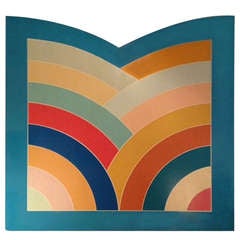
In his “Eccentric Polygon” series, from 1965 and ‘66, Stella embraces asymmetry and bold color, creating forms delineated by painted fields and by the edges of the canvas. This series was followed by the 1967–70 “Protractor” series, characterized by colorful circles and arcs. Named after the ancient cities whose circular plans Stella had noticed while traveling in the Middle East during the 1960s, these works usually comprised several canvases set flush against one another so that the geometric figures in each section came together in a larger, more complex whole.
Also in the mid-1960s, Stella started exploring printmaking, initially working with Kenneth Tyler, of Gemini G.E.L., and later installing printing equipment in his own studio. In 1968, he created the “V” series of lithographs, which included the print Quathlamba I. Following a solo exhibition at the Museum of Modern Art in 1970, Stella began working in three dimensions, adding relief elements to paintings, which could almost be considered wall-mounted sculptures.
Stella’s 1970–73 “Polish Village” series was inspired by documentary photos and architectural drawings of Polish synagogues that had been destroyed by Nazis during World War II. The resulting works — composed primarily of paint and cloth on plywood — are more rugged and less polished than his previous series.
Herman Melville's Moby Dick was Stella's muse for a series of three- dimensional works he created in the 1980s in which waveforms, architectural elements and Platonic solids play a prominent role. During this period, Stella embraced a new, exuberant style that is exemplified in "La Scienza della Fiacca."
In 1997, the artist oversaw the creation of the Stella Project, a 5,000-square-foot work inside the Moores Opera House at the University of Houston. A large free-standing sculpture by Stella stands outside the National Gallery of Art in Washington, D.C.
Stella’s work is in the collections of numerous important museums around the world, including New York’s Museum of Modern Art and Metropolitan Museum of Art; the Menil Collection, in Houston; the Hirshhorn Museum and Sculpture Garden, in Washington, D.C.; and the San Francisco Museum of Modern Art. He was awarded the National Medal of Arts by President Obama in 2009, and was given the Lifetime Achievement Award in Contemporary Sculpture by the International Sculpture Center in 2011.
Find original Frank Stella art for sale on 1stDibs.
A Close Look at Mid-century-modern Furniture
Organically shaped, clean-lined and elegantly simple are three terms that well describe vintage mid-century modern furniture. The style, which emerged primarily in the years following World War II, is characterized by pieces that were conceived and made in an energetic, optimistic spirit by creators who believed that good design was an essential part of good living.
ORIGINS OF MID-CENTURY MODERN FURNITURE DESIGN
- Emerged during the mid-20th century
- Informed by European modernism, Bauhaus, International style, Scandinavian modernism and Frank Lloyd Wright’s architecture
- A heyday of innovation in postwar America
- Experimentation with new ideas, new materials and new forms flourished in Scandinavia, Italy, the former Czechoslovakia and elsewhere in Europe
CHARACTERISTICS OF MID-CENTURY MODERN FURNITURE DESIGN
- Simplicity, organic forms, clean lines
- A blend of neutral and bold Pop art colors
- Use of natural and man-made materials — alluring woods such as teak, rosewood and oak; steel, fiberglass and molded plywood
- Light-filled spaces with colorful upholstery
- Glass walls and an emphasis on the outdoors
- Promotion of functionality
MID-CENTURY MODERN FURNITURE DESIGNERS TO KNOW
- Charles and Ray Eames
- Eero Saarinen
- Milo Baughman
- Florence Knoll
- Harry Bertoia
- Isamu Noguchi
- George Nelson
- Danish modernists Hans Wegner and Arne Jacobsen, whose emphasis on natural materials and craftsmanship influenced American designers and vice versa
ICONIC MID-CENTURY MODERN FURNITURE DESIGNS
- Eames lounge chair
- Nelson daybed
- Florence Knoll sofa
- Egg chair
- Womb chair
- Noguchi coffee table
- Barcelona chair
VINTAGE MID-CENTURY MODERN FURNITURE ON 1STDIBS
The mid-century modern era saw leagues of postwar American architects and designers animated by new ideas and new technology. The lean, functionalist International-style architecture of Le Corbusier and Bauhaus eminences Ludwig Mies van der Rohe and Walter Gropius had been promoted in the United States during the 1930s by Philip Johnson and others. New building techniques, such as “post-and-beam” construction, allowed the International-style schemes to be realized on a small scale in open-plan houses with long walls of glass.
Materials developed for wartime use became available for domestic goods and were incorporated into mid-century modern furniture designs. Charles and Ray Eames and Eero Saarinen, who had experimented extensively with molded plywood, eagerly embraced fiberglass for pieces such as the La Chaise and the Womb chair, respectively.
Architect, writer and designer George Nelson created with his team shades for the Bubble lamp using a new translucent polymer skin and, as design director at Herman Miller, recruited the Eameses, Alexander Girard and others for projects at the legendary Michigan furniture manufacturer.
Harry Bertoia and Isamu Noguchi devised chairs and tables built of wire mesh and wire struts. Materials were repurposed too: The Danish-born designer Jens Risom created a line of chairs using surplus parachute straps for webbed seats and backrests.
The Risom lounge chair was among the first pieces of furniture commissioned and produced by celebrated manufacturer Knoll, a chief influencer in the rise of modern design in the United States, thanks to the work of Florence Knoll, the pioneering architect and designer who made the firm a leader in its field. The seating that Knoll created for office spaces — as well as pieces designed by Florence initially for commercial clients — soon became desirable for the home.
As the demand for casual, uncluttered furnishings grew, more mid-century furniture designers caught the spirit.
Classically oriented creators such as Edward Wormley, house designer for Dunbar Inc., offered such pieces as the sinuous Listen to Me chaise; the British expatriate T.H. Robsjohn-Gibbings switched gears, creating items such as the tiered, biomorphic Mesa table. There were Young Turks such as Paul McCobb, who designed holistic groups of sleek, blond wood furniture, and Milo Baughman, who espoused a West Coast aesthetic in minimalist teak dining tables and lushly upholstered chairs and sofas with angular steel frames.
Generations turn over, and mid-century modern remains arguably the most popular style going. As the collection of vintage mid-century modern chairs, dressers, coffee tables and other furniture for the living room, dining room, bedroom and elsewhere on 1stDibs demonstrates, this period saw one of the most delightful and dramatic flowerings of creativity in design history.
Finding the Right Decorative-art for You
Antique, new and vintage decorative art is crucial to personalizing your interior.
Bringing art into your home will help you create a warm and welcoming atmosphere, whether you are expecting to regularly host guests for cocktails in your living room or you are inclined to soak up some “me time” on weekends by curling up with a book in your library. After all, a room isn’t quite complete until you hang some art on the walls.
Choosing a piece of art for your interior is a matter of finding something that resonates with you. You should also consider what will work with your current decor. Keep in mind that a wide range of objects counts as decorative art — antique and vintage prints, paintings, wall-mounted sculptures and more. There is so much to choose from! And art can feel as deeply personal with the vintage posters that promoted your favorite classic films as it can with framed photographs of your loved ones.
Decorative art can set the mood for a room and will typically make for great conversation. When you find wall decor and decorations that speak to you, why not introduce them into your space? It will give you and your guests the opportunity to meaningfully engage with the art every time you see it. You can play with different styles, eras and colors. Mix and match pieces to integrate a refreshing pop of color or create a theme by dedicating a room to a color palette or certain time period. A great way to tie your layout together is to choose wall art that complements your decor and color scheme.
Folk art is an interesting category for its wide range of works across various media and the array of textures it can offer. Paper art is another versatile option because it will be easy to find a home for portraits, collages, drawings and other works in your space. With decorative paper art, you can also get creative with how you arrange your wall art. There are plenty of options that include hanging the works salon-style.
On 1stDibs, find a constantly growing collection of antique and vintage decorative art today.
- Why is Frank Stella important?1 Answer1stDibs ExpertNovember 20, 2024Frank Stella is important because he was one of the central figures in postwar American art and influenced later artists as a proponent of minimalism and non-representational abstraction. Stella felt that paintings on canvas were objects in their own right, like sculptures. This led him to reject certain formal conventions, eschewing sketches and often using nontraditional materials, like house paint. His approach to art impacted the work of Clement Greenberg, Carl Andre, Kenneth Noland and many others. Find a collection of Frank Stella art on 1stDibs.