Gateleg Table Antique
1920s Scottish Gateleg Table Antique
Oak
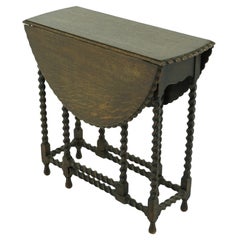

1910s British Gateleg Table Antique
Oak
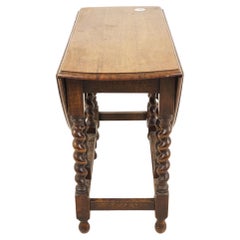
- 1
Gateleg Table Antique For Sale on 1stDibs
How Much is a Gateleg Table Antique?
Finding the Right Tables for You
The right vintage, new or antique tables can help make any space in your home stand out.
Over the years, the variety of tables available to us, as well as our specific needs for said tables, has broadened. Today, with all manner of these must-have furnishings differing in shape, material and style, any dining room table can shine just as brightly as the guests who gather around it.
Remember, when shopping for a dining table, it must fit your dining area, and you need to account for space around the table too — think outside the box, as an oval dining table may work for tighter spaces. Alternatively, if you’ve got the room, a Regency-style dining table can elevate any formal occasion at mealtime.
Innovative furniture makers and designers have also redefined what a table can be. Whether it’s an unconventional Ping-Pong table, a brass side table to display your treasured collectibles or a Louis Vuitton steamer trunk to add an air of nostalgia to your loft, your table can say a lot about you.
The visionary work of French designer Xavier Lavergne, for example, includes tables that draw on the forms of celestial bodies as often as they do aquatic creatures or fossils. Elsewhere, Italian architect Gae Aulenti, who looked to Roman architecture in crafting her stately Jumbo coffee table, created clever glass-topped mobile coffee tables that move on bicycle tires or sculpted wood wheels for Fontana Arte.
Coffee and cocktail tables can serve as a room’s centerpiece with attention-grabbing details and colors. Glass varieties will keep your hardwood flooring and dazzling area rugs on display, while a marble or stone coffee table in a modern interior can showcase your prized art books and decorative objects. A unique vintage desk or writing table can bring sophistication and even a bit of spice to your work life.
No matter your desired form or function, a quality table for your living space is a sound investment. On 1stDibs, browse a collection of vintage, new and antique bedside tables, mid-century end tables and more .
- What is a gateleg table?1 Answer1stDibs ExpertApril 29, 2020
First introduced in 16th century-England, a gateleg table is a popular kind of table that allowed for intimate dining. The tabletop of the gateleg table, which was initially round or oval versus the long tables and formal seating arrangements that preceded it, had a section that was fixed in place, while one or two sections of the surface were equipped with hinges. By design, a gateleg table could be extended so that more space could be allocated for work or for dining if needed. These hinged sections could be folded back into place on top of the fixed section or could easily be dropped down to hang vertically on their hinges when they weren’t in use. This function, which allowed the table’s drop leaves that weren’t in use to be pushed up against a wall, saved space in small homes because the table could be tucked away. Pivoted legs under the table — which formed a gate as they were joined at their tops and bottoms by crosspieces — supported the hinged sections.
- What does a gateleg table mean?1 Answer1stDibs ExpertMarch 16, 2020
“Gate” in “gateleg table” refers to the pivoted leg supports under the table that are connected at their ends by crosspieces. When raised, the table’s two drop leaves, which are usually D-shaped, are supported upon these gates. When gateleg tables originated in England in the 16th century, they were oval or round and were generally named after their shape (and weren’t yet called gateleg tables) in order to distinguish them from the long tables they’d replaced, as dining had by then been relegated to meals for the family, not an entire household and assembled guests.
- 1stDibs ExpertFebruary 17, 2023The difference between a gateleg table and a drop leaf table is the design of the section that you can raise to expand the piece. On a drop leaf table, the extension does not have any lower support. A gateleg table has a leg that swings out to rest beneath the extension. Find a selection of tables from some of the world's best sellers on 1stDibs.
- How do I identify an antique table?2 Answers1stDibs ExpertFebruary 22, 2021You can identify an antique table in a number of ways. The first clue that a table is antique is the joinery. If a piece of furniture is dovetailed by hand, it only has a couple of dovetails, which are uneven. Also, antique tables are not defined by perfect symmetry. Lastly, antique tables were typically made of oak, mahogany, and walnut.
 Bonnin Ashley Antiques IncFebruary 23, 2021In addition to the joinery you can check the bottoms of the drawers and the backs of the cabinets. If they were made prior to 1850 then the wood will most likely be dimensioned by hand. It will be uneven to the touch. The secondary wood that receives the veneer will have been scraped smooth but drawer bottoms, backs and bottoms are often left less finished.
 - What is an antique rent table?2 Answers1stDibs ExpertApril 5, 2022An antique rent table is a piece of furniture that landlords and tenants used to exchange rent. The rent money would be placed in one drawer, the table would rotate for the landlord to receive. It was considered polite and gentlemanly to pay rent this way. Shop a collection of antique rent tables from some of the world’s top sellers on 1stDibs.1stDibs ExpertApril 5, 2022A rent table is a small circular or polygonal table with drawers. Rent tables frequently had drawers labeled for the days of the week, and English landlords in the 18th century often used them to collect rent. On 1stDibs, shop antique rent tables from some of the world’s top sellers.
- 1stDibs ExpertMay 5, 2023To determine whether a side table is an antique, closely examine its details. Older pieces will typically have telltale features like wood pegs, hand-cut dovetails with some slight imperfections and mortise-and-tenon construction. Tables that are a consistent color throughout or have machine-cut moldings or carvings are unlikely to be antiques. A certified appraiser or knowledgeable antiques dealer can be a helpful resource when dating tables. Shop a collection of antique, vintage and modern side tables on 1stDibs.
- 1stDibs ExpertApril 5, 2022To identify your antique dining table, first check to see if there is a maker’s mark on the underside. If there are no identifying marks or stamps, a furniture appraiser can check the style and the hardwood used to identify your piece. Shop a collection of antique furniture from some of the world’s top sellers on 1stDibs.
- 1stDibs ExpertOctober 24, 2024To tell if a kitchen table is antique, look under the table and on the legs for a maker's mark. It may be carved, branded or stamped onto the surface or appear on a paper or metal label. Using the marking, you can consult trusted online resources to learn about the maker and view catalogues of their pieces, searching for tables similar to yours. If your kitchen table was produced at least 100 years ago, it is an antique. Keep in mind that not all antique furnishings have maker's markings. In the event that you're unable to locate a mark, a certified appraiser or knowledgeable antique dealer can evaluate your piece for you. On 1stDibs, explore a diverse assortment of tables.
- 1stDibs ExpertFebruary 13, 2023While you can look for markings and other details to try and determine the maker, the best way to identify an antique drop leaf table is to work with a certified appraiser. Trusted online venues and search engines can be helpful when conducting research on a specific collectible, piece of jewelry, art work or other item about which you may have questions, but qualified professionals, such as an antiques dealer or an appraiser at an auction house, have the knowledge and experience needed to make more accurate identifications. Shop a selection of antique, vintage and modern tables on 1stDibs.
Read More
20 Inviting Dining Rooms Perfectly Arranged for Entertaining
Top interior designers show — and tell — us how to create delectable spaces for hosting dinner parties.
This Alain Delon–Designed Table Is Almost as Handsome as He Was
Fans of the French film star may be surprised to learn that he had a flair for furniture with sleek lines and disco-era flash.
Uchronia’s Plant Stand Gives Pots a Pretty Perch with All the Trimmings
Like other pieces in the firm’s Candy Box collection, the cheerful limited-edition design showcases French craft.
The Ultimate Guide to Types of Tables for the Home
Whether you’re just moving in or ready to give your home a makeover, our guide will give you pointers on tables that are fitting for every room, nook and hallway.
Is Lionel Jadot the Willy Wonka of Upcycled Belgian Design?
From his massive collaborative workshop in a former paper factory, the designer concocts funky furniture from disused materials, as well as luxe hotel interiors like the new Mix Brussels.
Inspired by the Cosmos, Sandra Nunnerley’s Nova Table Has a Futuristic Feel
The designer’s innovative use of an unexpected material gives this console a lift.
This 19th-Century Gilded Desk Displays a Fanciful Kingdom in Marquetry
The stately piece brings both gravitas and whimsy to any work space.
In Guadalajara, These Luscious Side Tables Are Chiseled from Volcanic Rock
Use them as tables or stools, indoors or out.