George Hugo Tabor Doulton
Recent Sales
Antique 1880s English Aesthetic Movement Ceramics
Stoneware
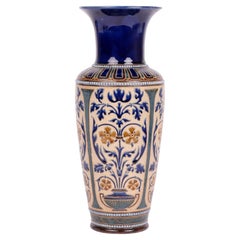

Antique 1880s English Aesthetic Movement Vases
Stoneware
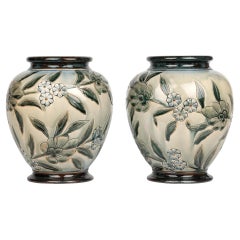
Doulton Lambeth for sale on 1stDibs
The name Doulton Lambeth is widely known to collectors of British ceramics — it refers to the vases, mugs, bowls and jugs decorated by the likes of artisans such as George Tinworth, Eliza Simmance, Edith Lupton and others for Royal Doulton's pioneering art pottery studio, which was established in the Lambeth section of suburban London by 1871.
Royal Doulton was founded in 1815 by John Doulton, Martha Jones and John Watts. It was initially established as Jones, Watts and Doulton and later traded under Doulton and Watts. The firm produced utilitarian stoneware, decorative objects, drain pipes and other goods and vessels. Amid the Victorian era’s rising concern for hygiene, food safety and sanitation, the company flourished. In 1854, it rebranded as Doulton and Co., colloquially referred to as Doulton Ware.
The firm took over a factory in Staffordshire, in northern England — the traditional home of British ceramics manufacturing — to produce tableware. Around the same time, Henry Doulton — John Doulton's son — opened an art pottery studio in Lambeth, where its Aesthetic Movement-era vases, urns and other forms were decorated with painted scenic images, flowers or historical motifs thanks to its collaborations with students at the nearby Lambeth School of Art.
Taking a cue from the venerable Meissen porcelain workshops in Germany, Doulton artisans began crafting figurines modeled on characters from literature and theater. The firm also helped popularize Toby Jugs and other “character mugs” — handled cups shaped like the heads of figures from folklore and popular culture.
In the late 1870s, Doulton bought the earthenware manufacturer Pinder, Bourne and Company and purchased a factory in Burslem in 1882. King Edward VII granted the factory his Royal Warrant in 1901.
Doulton was recognized with the Queen's Award for Technical Achievement in 1966, and the firm acquired Minton two years later. It eventually became a part of WWRD Holdings Limited (Waterford Crystal, Wedgwood and Royal Doulton), which is now owned by the Fiskars Corporation.
The Doulton Lambeth pottery for sale on 1stDibs includes serveware, decorative objects and more.
A Close Look at Aesthetic-movement Furniture
In 1880, polymath designer William Morris declared: “If you want a golden rule that will fit everybody, this is it: Have nothing in your houses that you do not know to be useful or believe to be beautiful.” His words encapsulated the Aesthetic Movement, which prized beauty above all and blurred the lines between fine art and the decorative arts, particularly through lavishly crafted furniture pieces.
The Aesthetic Movement, whose major proponents included author Oscar Wilde, flourished from the 1860s to the 1880s and was mostly popular in England and the United States. Design expositions like the 1876 Centennial International Exhibition in Philadelphia, as well as the publishing of how-to books for interior design, helped disseminate Aesthetic Movement bedroom furniture, serveware, coffee tables and other items, especially to the middle class.
The establishment of new art museums, art clubs and a rising passion for collecting at the time contributed to a growing appreciation for art. Morris’s founding of Morris Co. in 1862 and the commercializing of this “cult of beauty” by the Liberty store in London, starting in the late 19th century, further disseminated the idea of a domestic space that was thoughtfully and floridly designed.
Leading Aesthetic Movement furniture designers included E.W. Godwin, who drew on Japanese influences and whose work reflected a wider enthusiasm for imported East Asian art. British designer Christopher Dresser created textiles, ceramics and more that were also inspired by Japanese decorative art but were representative of additional diverse design sources that ranged from Egypt to Mexico.
The Aesthetic Movement’s eclecticism resulted in dazzling interiors. Japanese fans were positioned on Renaissance-inspired cabinets with brass hardware, while mantels made of rich walnut or finely carved ebonized wood and adorned with painted Minton tiles mingled with cast-iron chairs against a backdrop of floral wallpaper. In 1881, in New York City, stenciled checkerboard motifs and painted floral murals could be found under an opalescent glass chandelier in a luxurious dressing room designed by German émigré cabinetmaker-decorator George Alfred Schastey. Amid the rise of the industrial age, the style’s promotion of art in everyday life would inform the Arts and Crafts Movement and Art Nouveau.
Find a collection of antique Aesthetic Movement seating, tables, decorative objects and other furniture and antiques on 1stDibs.
Finding the Right Vases for You
Whether it’s a Chinese Han dynasty glazed ceramic wine vessel, a work of Murano glass or a hand-painted Scandinavian modern stoneware piece, a fine vase brings a piece of history into your space as much as it adds a sophisticated dynamic.
Like sculptures or paintings, antique and vintage vases are considered works of fine art. Once offered as tributes to ancient rulers, vases continue to be gifted to heads of state today. Over time, decorative porcelain vases have become family heirlooms to be displayed prominently in our homes — loved pieces treasured from generation to generation.
The functional value of vases is well known. They were traditionally utilized as vessels for carrying dry goods or liquids, so some have handles and feature an opening at the top (where they flare back out). While artists have explored wildly sculptural alternatives over time, the most conventional vase shape is characterized by a bulbous base and a body with shoulders where the form curves inward.
Owing to their intrinsic functionality, vases are quite possibly versatile in ways few other art forms can match. They’re typically taller than they are wide. Some have a neck that offers height and is ideal for the stems of cut flowers. To pair with your mid-century modern decor, the right vase will be an elegant receptacle for leafy snake plants on your teak dining table, or, in the case of welcoming guests on your doorstep, a large ceramic floor vase for long tree branches or sticks — perhaps one crafted in the Art Nouveau style — works wonders.
Interior designers include vases of every type, size and style in their projects — be the canvas indoors or outdoors — often introducing a splash of color and a range of textures to an entryway or merely calling attention to nature’s asymmetries by bringing more organically shaped decorative objects into a home.
On 1stDibs, you can browse our collection of vases by material, including ceramic, glass, porcelain and more. Sizes range from tiny bud vases to massive statement pieces and every size in between.