Gorham Sterling Loving Cup
Recent Sales
Antique Late 19th Century American Belle Époque Sterling Silver
Sterling Silver
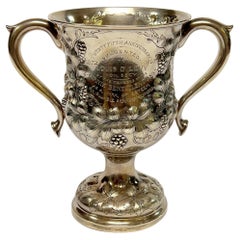

Antique Late 19th Century American Victorian Sterling Silver
Sterling Silver
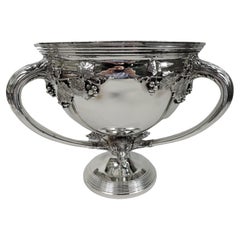
Gorham Sterling Loving Cup For Sale on 1stDibs
How Much is a Gorham Sterling Loving Cup?
Gorham Manufacturing Company for sale on 1stDibs
For nearly 160 years, the Gorham Manufacturing Company turned out a wide range of beautiful silver flatware, tea sets, serving bowls and other silver pieces, indelibly influencing the field of decorative arts in ways that still resonate.
When silversmiths Jabez Gorham and Henry Webster started making coin silver teaspoons and jewelry out of a small workshop in Providence, Rhode Island, in 1831, the pair likely had no idea that their modest operation would one day become the largest silver manufacturer in the world.
While some name changes and personnel shifts preceded the foundry officially being established as Gorham Manufacturing Company decades later, growth of the business between its early days and the mid–19th century can largely be attributed to the work of Jabez’s son John, who assumed control of Gorham in the 1840s.
John Gorham introduced steam power at the manufactory. He entered into a partnership with Michael Gibney, the first American silversmith to register a design patent for a flatware pattern. Gorham wanted to expand the business, seeking to produce forks and spoons adorned with decorative flourishes adapted from British patterns. The company hammered out the silver flatware, which it sent to Gibney in New York to apply decorative patterns before returning to Gorham. Consequently, Gorham found Gibney’s work unsatisfactory, and he purchased his own rolling press to do the work himself.
The partnership between John and Michael soured but the company thrived. Sales grew to more than $20,000 per year, and the staff of silversmiths expanded. To keep up with demand, Gorham had to retire its horse-powered rolling press and import a steam-powered drop press from England — the first used in the United States. Designs created at Gorham drew on natural-world motifs as well as artistic traditions from all over the world — alongside its tableware, the company would soon be producing cups and pitchers adorned with polar bears and forest creatures, while tea services and other serving pieces were crafted in a range of styles that included Art Nouveau, Egyptian Revival and Rococo.
Around 1860, Gorham delved into bronze casting. When it opened a division dedicated to bronze work, Gorham collaborated with sculptors such as Daniel Chester French, Anna Hyatt Huntington and Alexander P. Proctor.
By the 1920s, Gorham had employed thousands of workers and had partnered with Danish modernist silversmith Erik Magnussen. However, the Great Depression ground production to a halt. The company was sold to Textron, Inc. in the late 1960s and it changed hands several times before it sold to Department 56 in 2005.
Today, the work of Gorham Manufacturing Company continues to be exhibited in galleries and museums. The RISD Museum in Providence houses a collection of nearly 5,000 works.
On 1stDibs, find a range of antique Gorham Manufacturing Company serveware and decorative objects.
Finding the Right Sterling-silver for You
Dining and entertaining changed drastically when we began to set our tables with sterling silver for holiday gatherings, wedding receptions, engagement parties and, in some of today’s homes, everyday meals.
Often called the “Queen of metals,” silver has been universally adored for thousands of years. It is easy to see why it has always been sought after: It is durable, strong and beautiful. (Louis XIV had tables made entirely of silver.) Sterling silver is an alloy that is made of 92.5 percent silver — the “925” stamp that identifies sterling-silver jewelry refers to this number. The other 7.5 percent in sterling silver is typically sourced from copper.
Neoclassical-style sterling-silver goods in Europe gained popularity in the late 18th century — a taste for sterling-silver tableware as well as tea sets had taken shape — while in the United States, beginning in the 19th century, preparing the dinner table with sterling-silver flatware had become somewhat of a standard practice. Indeed, owning lots of silver goods during the Victorian era was a big deal. Back then, displaying fine silver at home was a status symbol for middle-class American families. And this domestic silver craze meant great profitability for legendary silversmith manufacturers such as Reed Barton, Gorham Manufacturing Company and the International Silver Company, which was incorporated in Meriden, Connecticut, in 1898, a major hub of silver manufacturing nicknamed “Silver City.”
Today, special occasions might call for ceremonial silver designed by Tiffany Co. or the seductive sterling-silver cutlery from remarkable Danish silversmith Georg Jensen, but there really doesn’t have to be an event on the calendar to trot out your finest tableware.
Event- and wedding-planning company maestro Tara Guérard says that some “investment pieces,” such as this widely enamored alloy, should see everyday use, and we’re inclined to agree.
“Sterling-silver flatware is a must-have that you can use every single day, even to eat cereal,” she says. “Personally, I want a sterling-silver goblet set for 12 to 20; I would use them every time I had a dinner party. Ultimately, there are no criteria for buying vintage pieces: Buy what you love, and make it work.”
Whether you’re thinking “ceremonial” or “cereal,” browse a versatile collection of vintage, new and antique sterling-silver wares on 1stDibs today.