Groves Brothers Fabric
Recent Sales
Mid-20th Century Gustavian Club Chairs
Wood
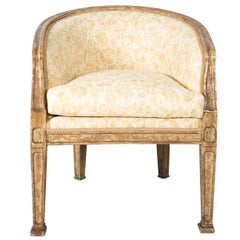

A Close Look at Gustavian Furniture
With clean lines and muted colors, antique Gustavian furniture is understated and elegant. It represents a more restrained version of the transition from Rococo to neoclassicism that was happening in France under Louis XVI. The style developed under Swedish King Gustav III, who reigned from 1771 until his assassination in 1792, and his son Gustav IV, who ruled until 1809. Although Gustavian furniture is mostly used to refer to pale painted cabinets, commodes, armchairs and other items, it involved a range of influences.
Gustavian-style furniture was inspired by discoveries at Pompeii and Herculaneum as well as the grandeur of European palaces like Versailles, with local softwoods such as pine and birch. There was also an emphasis on natural light; crystal chandeliers and large mirrors played a role in radiating the fleeting daylight of winter, giving it a distinctive aesthetic.
Where earlier furniture was curvy and florid, this new era was more architectural, with tapered and fluted legs and rectangular and oval shapes. Luminous gilt contrasted with the palette of soft blues on upholstery and painted surfaces. Leading furniture builders included Gottlieb Iwersson, Louis Masreliez and Erik Öhrmark. The latter, a French-born Swedish decorator, designed the Sulla chair, a seat that was demonstrative of technical skill and precise craftsmanship and drew on Greek klismos chairs. Masreliez’s Sulla chair was made by Öhrmark and featured decorative ornamentation produced by Jean-Baptiste Masreliez, Louis’s younger brother.
While the wealthy had furniture carved with neoclassical details like scallops and rosettes, more affordable options were adorned with faux finishes that mimicked marble and stenciled patterns. The simple elegance of Gustavian furniture would have a long impact on Swedish design, informing the 20th-century appreciation for function and form. In the 1950s, IKEA mass-produced copies of a Gustavian commode designed by cabinetmaker Georg Haupt, who created pieces for the Royal Palace, making the furniture a fixture of everyday Swedish life.
Find a collection of antique Gustavian seating, tables, decorative objects and other furniture on 1stDibs.
Finding the Right Club-chairs for You
Traditionally covered in leather and abundantly luxurious, antique and vintage club chairs are among the most comfortable pieces of furniture that you could ever bring into your living room. The classic club chair is one of the 52 types of chairs to know when decorating your home.
While the club chair was especially popular in France during the 1920s — known there as fauteuil confortable (or “comfortable armchair”) — modern versions are derived from those used in 19th-century English gentlemen’s clubs, which is believed to be the origin of their name. A riff on the traditional armchair, these seats typically have low backs, extra-wide armrests and more than sufficient padding to support extended lounging.
Well-known modern interpretations of the club chair can be found in Marcel Breuer’s pared-down Wassily lounge chair and in the cube-like seats of the LC collection, designed by Charles-Édouard “Le Corbusier” Jeanneret, Pierre Jeanneret and Charlotte Perriand. Debuting in 1956, the celebrated Eames lounge chair was a fresh, subversive new take on the classic English club chair and a culmination of experimentation by Charles and Ray Eames, its inventive creators.
When shopping for any style of club chair, be it a mid-century modern club chair, an Art Deco club chair or another type, you’ll want to think about the room you have in mind for this distinct seating. Club chairs occupy a lot of real estate, as they’re usually larger than standard chairs. (You’ll want to make certain that there is at least one foot of space around the chair, for example, to ensure the sitter doesn’t feel cramped and that there is room to move freely around the furnishing.) And although they were originally upholstered in leather, contemporary iterations of the club chair can be found in fabric and plastic.
Introduce a decadent atmosphere and a whole lot of comfort in your living room or reading nook. Explore a collection of antique, new and vintage club chairs on 1stDibs.