Henri Boccara Painting
Recent Sales
1930s Neo-Expressionist Figurative Paintings
Oil, Cardboard
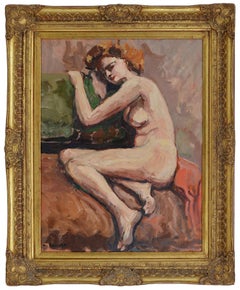

A Close Look at Neo-expressionist Art
A resurgence of interest in Expressionism, Pop art, Surrealism, Abstract Expressionism and other movements gained steam among artists of the 1970s and ’80s, in part as a reaction to the austerity of the prevailing minimalism and Conceptual art of the era. A decadent, bold and brash art style called Neo-Expressionism saw painters returning to figural representation, creating highly textured works that were imbued with intensely personal narratives.
Neo-Expressionist paintings are sensuous in nature and highly subjective in meaning. Expressive brushwork, highly pigmented colors and layered forms and materials lent sculptural attributes to the work and were used to depict symbolic narratives from history, mythology and the artist’s personal experience.
Prominent figures such as Jean-Michel Basquiat led the Neo-Expressionist movement in the United States with paintings and prints that were raw, emotional and often violent in nature. In Germany, Die Neuen Wilden (the “New Fauves”) was the name given to a group of postwar artists that included the likes of sculptor Georg Baselitz and Gerhard Richter, a painter and photographer who explored the possibilities of both abstraction and realism, sometimes in a single piece. The work of the New Fauves — labeled as such for its return to Fauvism’s textured brushwork and use of vibrant colors — shares commonalities with Neo-Expressionism, and Baselitz was a pioneer of the movement in Europe. In addition, Willem de Kooning’s pulsating action paintings and Julian Schnabel’s experimentation with the materiality of paintings also took shape during this period.
“I was trying to make paintings different from the paintings that I saw a lot of at the time, which were mostly minimal, and they were highbrow and alienating, and I wanted to make very direct paintings that most people would feel the emotion behind when they saw them,” said Basquiat.
Neo-Expressionism generated some polarizing opinions, with some celebrating the revival of personal subjectivity in art while others criticizing the movement for being too commercially driven and nostalgic. But most experts agree that Neo-Expressionism was a huge commercial success and culturally impactful, paving the way for the postmodern work of artists like Richter and Sigmar Polke.
Find original Neo-Expressionist paintings, prints, mixed-media works and other art on 1stDibs.
Finding the Right Figurative-paintings for You
Figurative art, as opposed to abstract art, retains features from the observable world in its representational depictions of subject matter. Most commonly, figurative paintings reference and explore the human body, but they can also include landscapes, architecture, plants and animals — all portrayed with realism.
While the oldest figurative art dates back tens of thousands of years to cave wall paintings, figurative works made from observation became especially prominent in the early Renaissance. Artists like Michelangelo, Leonardo da Vinci and other Renaissance masters created naturalistic representations of their subjects.
Pablo Picasso is lauded for laying the foundation for modern figurative art in the 1920s. Although abstracted, this work held a strong connection to representing people and other subjects. Other famous figurative artists include Francis Bacon and Lucian Freud. Figurative art in the 20th century would span such diverse genres as Expressionism, Pop art and Surrealism.
Today, a number of figural artists — such as Sedrick Huckaby, Daisy Patton and Eileen Cooper — are making art that uses the human body as its subject.
Because figurative art represents subjects from the real world, natural colors are common in these paintings. A piece of figurative art can be an exciting starting point for setting a tone and creating a color palette in a room.
Browse an extensive collection of figurative paintings on 1stDibs.
- 1stDibs ExpertFebruary 7, 2024Some of Henri Matisse's most famous paintings include Le Bonheur de Vivre, Blue Nude (Souvenir de Biskra), Woman with a Hat, Music, The Green Stripe and L'Atelier Rouge. Matisse also worked as a draftsman, printmaker and sculptor. Regardless of what medium he was working in, the French artist was a master of color. Although classically trained at the Académie Julian in Paris, he abandoned traditional techniques and genres to pioneer a style all his own, marked by quick gestural strokes and fluid contours. Find an assortment of Henri Matisse art on 1stDibs.
- 1stDibs ExpertFebruary 27, 2024Henri Matisse stopped painting due to health concerns. In 1941, the French artist required surgery for cancer and used a wheelchair afterward. The physical limitations of his disability made it difficult for the artist to continue to produce both paintings and sculptures. However, he adapted by cutting shapes from colored paper for creative new works. On 1stDibs, find a selection of Henri Matisse art from some of the world's top dealers and galleries.
- 1stDibs ExpertSeptember 23, 2024Henri Rousseau's style of painting is called Post-Impressionism. Artists working in this style turned away from the realistic depictions of subjects common in Impressionism and began experimenting with bold colors and textures. Experts also categorize some of Rousseau's works as examples of Primitivism, a movement where artists used inspiration from tribal and folk art to inform their works. On 1stDibs, shop a range of Henri Rousseau art.
- 1stDibs ExpertApril 22, 2024Henry Fuseli's famous painting is called The Nightmare. The Swiss painter completed the work in 1871. It depicts an incubus sitting atop the prone body of a sleeping woman. You can see it on display at the Detroit Institute of Arts in Detroit, Michigan. On 1stDibs, shop a selection of Henry Fuseli art.