Herend Porcelain Tea Service
Recent Sales
2010s Hungarian Rococo Tea Sets
Porcelain
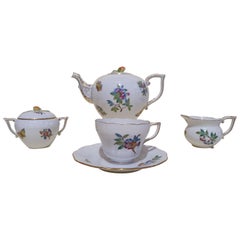

21st Century and Contemporary Country Tea Sets
Porcelain
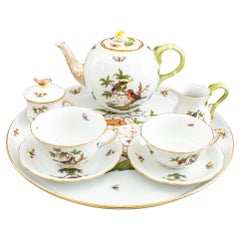
Mid-20th Century Hungarian Porcelain
Porcelain
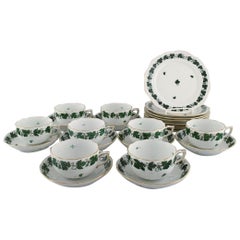
20th Century Hungarian Porcelain
Porcelain
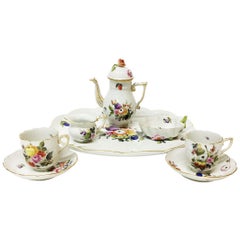
Vintage 1950s Hungarian Tea Sets
Porcelain
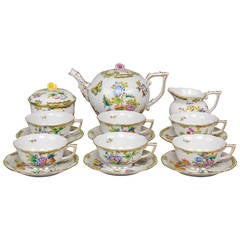
Mid-20th Century Hungarian Tea Sets
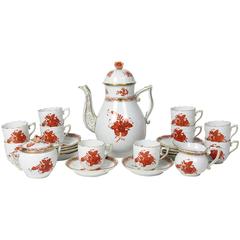
Herend for sale on 1stDibs
Herend Porcelain occupies a singular place in the world of luxury European ceramics. The firm's vast range of figurines and distinctive patterns are visually striking and notably different from those of other major porcelain producers like Meissen or Sèvres. Whereas the latter tend to feature discrete decorative elements that appear to float on a white background, Herend favors large, bold designs for its porcelain, with its serving pieces, dishes and other works incorporating historical scenes, animals or vegetation.
Vince Stingl established what would become the Herend Porcelain Manufactory in 1826 in the town of Herend, Hungary, to produce earthenware. When he went bankrupt in the late 1830s, Mór Fischer, who took over, switched the focus from earthenware to porcelain to take advantage of the growing European market for fine china.
By 1849, Herend counted among its clients members of the Habsburg dynasty and the Hungarian aristocracy. Thanks to its participation in several important international exhibitions and fairs — including the 1851 Crystal Palace Exhibition in London, the 1853 Exhibition of the Industry of All Nations in New York and the 1855 Exposition Universelle in Paris — its wares became a popular choice for courtly dining in the middle of the 19th century, and its patrons included Francis Joseph I of Austria and Queen Victoria of England, for whom its Viktória pattern was named.
The company foundered in the latter half of the 19th century under the leadership of Fischer’s two sons. But it was given new life, artistically and financially, when Fischer’s grandson, Jenő Farkasházy, himself a trained ceramist, took the helm around 1900. Farkasházy designed new patterns and revived classic ones. After World War II, Herend was nationalized by the Communist government but kept alive its tradition of skilled craftsmanship by continuing to produce its classic patterns. In 1993, after the fall of the Iron Curtain, the factory was privatized once again and today is owned by its management and workers.
Authentic Herend animal figurines — their groupings of white rabbits, cats or pheasants — are often covered head to toe with the factory’s famed “fish-scale” pattern, also known as Vieux Herend, which produces the effect of a dense coat of feathers or fur. The fish-scale pattern also appears on this chocolate cup and saucer decorated in the Cornucopia pattern.
Find antique Herend porcelain on 1stDibs.
Finding the Right Tea-sets for You
Ready to serve high tea and brunch for your family and friends? Start with the right antique, new or vintage tea set.
Tea is a multicultural, multinational beverage and isn’t confined to any particular lifestyle or age group. It has humble beginnings, and one of its best-known origin stories places the first cups of tea in 2700 B.C. in China, where it was recognized for its medicinal properties. Jump ahead to 17th-century England, when Chinese tea began to arrive at ports in London. During the early 1800s, tea became widely affordable, and the concept of teatime took shape all over England. Today, more than 150 million people reportedly drink tea daily in the United States.
Early tea drinkers enjoyed their beverage in a bowl, and English potters eventually added a handle to the porcelain bowls so that burning your fingers became less of a teatime hazard. With the rise in the popularity of teatime, tea sets, also referred to as tea service, became a hot commodity.
During Queen Victoria’s reign, teakettles and coffeepots were added to tea services that were quite large — indeed, small baked goods were served with your drink back then, and a tea set could include many teacups and saucers, a milk pot and other accessories.
During the early 1920s, a sterling-silver full tea service and tray designed by Tiffany Co. might include a hot-water kettle on a stand, a coffeepot, teapot, a creamer with a small lip spout, a waste bowl and a bowl for sugar, which the British were stirring into tea as early as the 18th century.
But you don’t have to limit your tea set to Victorian or Art Deco styles — shake up teatime with an artful contemporary service. If the bold porcelain cups and saucers by Italian brand Seletti are too unconventional for your otherwise subdued tea circle, find antique services on 1stDibs from Japan, France and other locales as well as vintage mid-century modern tea sets and neoclassical designs.