Jarvie Sterling
Recent Sales
Early 20th Century American Arts and Crafts Candlesticks
Sterling Silver
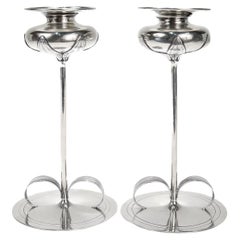

Marcus Co. for sale on 1stDibs
Throughout the early 20th century, Marcus Co. established a reputation as one of the finest American producers of Art Nouveau jewelry. The firm’s innovative techniques included the use of plique-à-jour enameling. During the 1900s, this rare method was used by only three other jewelry companies in the United States — Tiffany Co., Riker Bros. and Whiteside and Blank.
Marcus Co. was founded in 1892, in New York City, by Herman Marcus and his son William. Herman was born and raised in Germany, where he worked as a jeweler for Ellemeyer, the court jewelers of Dresden, before moving to the United States in 1850.
After arriving in New York City, Herman worked as a designer at several prestigious luxury firms, including Ball, Black Co., Tiffany Co. and was a partner at Starr and Marcus before he went into business with William. Later, they were joined by Herman’s other son, George.
Herman worked with his sons until his death in 1899, when William and George expanded the firm to include a silversmithing department to make serveware. However, Marcus Co. focused mainly on jewelry design and manufacturing, offering Revival-style pieces.
In 1900, the company exhibited a series of striking orchid motif brooches at the Exposition Universelle in Paris. The brooches attracted critical acclaim for their plique-à-jour enameling and intricate detail — characteristics that would become Marcus Co.’s signature.
The company’s Art Nouveau jewelry took shape during the 1920s and 1930s. Cocktail rings, engagement rings, necklaces and cufflinks featured fine diamonds, natural pearls and gems rarely seen during that period, such as peridots, zircons, spinels and chrysoberyls. Marcus Co.’s designs were comparable by critics to fine art jewelry made by René Lalique and attracted high-profile clientele like business tycoon John D. Rockefeller.
Despite Marcus Co.’s success, the firm closed briefly during World War II. In 1962, they merged with the company Black, Starr Frost.
Marcus Co. pieces are still highly coveted among jewelry collectors. The firm’s Art Nouveau plique-à-jour accessories, a technique that sees enamel powder applied to cells on a thin sheet of copper foil or mica and then etched away — instead applying the enamel directly to metal — are particularly collectible. In 2011, a Morning Glory plique-à-jour pendant brooch and chain made in 1900 sold at a Sotheby’s auction for $302,500.
On 1stDibs, discover antique Marcus Co. brooches, rings and decorative objects.
A Close Look at Arts-and-crafts Furniture
Emerging in reaction to industrialization and mass production, the Arts and Crafts movement celebrated handcrafted design as a part of daily life. The history of Arts and Crafts furniture has roots in 1860s England with an emphasis on natural motifs and simple flourishes like mosaics and carvings. This work is characterized by plain construction that showcases the hand of the artisan.
The earliest American Arts and Crafts furniture dates back to the start of the 20th century. Designers working in this style in the United States initially looked to ideas put forth by The Craftsman, a magazine published by Wisconsin native Gustav Stickley, a furniture maker and founder of the Craftsman style. Stickley’s furniture was practical and largely free of ornament. His Craftsman style drew on French Art Nouveau as well as the work he encountered on his travels in England. There, the leading designers of the Arts and Crafts movement included William Morris, who revived historical techniques such as embroidery and printed fabrics in his furnishings, and Charles Voysey, whose minimal approach was in contrast to the ornamentation favored in the Victorian era.
American Arts and Crafts work would come to involve a range of influences unified by an elevation of traditional craftsmanship. The furniture was often built from sturdy woods like oak and mahogany while featuring details such as inlaid metal, tooled leather and ceramic tiles. The style in the United States was led by Stickley, whose clean-lined chairs and benches showcased the grain of the wood, and furniture maker Charles Rohlfs, who was informed by international influences like East Asian and French Art Nouveau design.
Hubs in America included several utopian communities such as Rose Valley in Pennsylvania and the Byrdcliffe Arts and Crafts Colony in New York, where craftspeople made furniture that prioritized function over any decoration. Their work would influence designers and architects including Frank Lloyd Wright, who built some of the most elegant and iconic structures in the United States and likewise embraced a thoughtful use of materials in his furniture.
Find antique Arts and Crafts chairs, tables, cabinets and other authentic period furniture on 1stDibs.
Finding the Right Candlesticks for You
Vintage, new and antique candlesticks and candleholders do not simply infuse a dining room with a soft, warm glow. They also add dimension, conjure drama and draw attention to a table or mantel. Despite their practical origins, today, decorative candlesticks and their holders elevate spaces by matching interiors or adding color and bold shapes.
For those who enjoy the rich pageantry of the Old Masters, candlesticks in the Baroque and Rococo styles offer intricacy and opulence. The design of Baroque candlesticks — thanks to the influence of the Catholic Church — often boasted complex shapes and featured biblical figures. While bronze candlestick holders have a long history dating back to the ancient world, many 17th-century candlesticks were made of luxurious silver. Armed with a disposable income and a desire to show off their status, the newly emerging middle class acquired candlestick holders as intricate art pieces, beautiful and opulent in their own right.
The Art Deco movement of the early 20th century saw candlesticks designed with simplicity and symmetry in mind. Art Deco candlesticks boast all manner of forms, ranging from sleek curves to bodies of ribbed crystal or bronze that take the shape of animals.
While some 20th-century-era candlesticks are akin to statues in their grandeur, these decorative items became especially fashionable in the mid-20th century for atmospherically illuminating dinner tables. Mid-century modern candlesticks frequently epitomize the streamlined functionality that we’ve come to associate with the era.
Find a comprehensive collection of vintage, new and antique candlesticks on 1stDibs.