Jewelry Box George Zee
Recent Sales
Mid-20th Century Chinese Chinese Export Jewelry Boxes
Brass
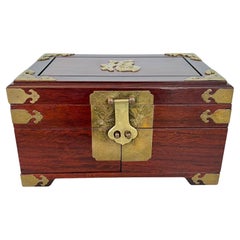

A Close Look at Chinese-export Furniture
Expanded trade between Europe and East Asia, starting in the 16th century, led to a booming market for exported goods, particularly furniture. This was bolstered by the establishment of the Dutch and English East India Companies at the beginning of the 17th century. From folding screens and chairs to lacquer tables and silver, Chinese Export furniture was in demand and regularly copied and imitated, leading to styles like chinoiserie and Chinese Chippendale.
The expansion of exporting that had strengthened the arts during the Ming dynasty continued into the Qing dynasty era — Chinese designers made many furniture pieces specifically for export, resulting in distinctive designs that mixed traditional techniques with forms appealing to foreign buyers. For instance, cabinetmakers in Canton (modern-day Guangzhou) were prolific in crafting hardwood furniture for export in European styles that involved the expert joinery techniques of Chinese furniture. Designs for Chinese Export porcelain, cabinets, decorative objects and other furniture were often more ornately adorned than they would be for a local audience, such as with mother-of-pearl overlays or surfaces featuring lavish pictorial scenes or gold on black motifs. Some were even commissioned by wealthy European families to be adorned with their coat of arms.
Because lacquer furniture was especially prized, and the resin used to create it was difficult to import as it would harden during the long voyage, artisans in China and Japan exported numerous lacquer pieces. Long before lacquer made its way to Japan, the Chinese treated the material differently. They used it to create smooth, glossy surfaces, but also for carving, an art that began in the 12th century and is exclusively Chinese. These pieces are called cinnabar lacquer after the powdered mercury sulfide (cinnabar) employed to produce their characteristic red hue. A popular form for export was a compact cabinet with drawers, usually displayed on a small table. Undecorated furniture built in Europe was also shipped to China to be lacquered. The international exchange of design would influence furniture into the 19th century and later, informing styles such as Art Deco and Art Nouveau.
Find a collection of antique Chinese Export tables, beds, cupboards, table lamps and more furniture on 1stDibs.
Materials: Brass Furniture
Whether burnished or lacquered, antique, new and vintage brass furniture can elevate a room.
From traditional spaces that use brass as an accent — by way of brass dining chairs or brass pendant lights — to contemporary rooms that embrace bold brass decor, there are many ways to incorporate the golden-hued metal.
“I find mixed metals to be a very updated approach, as opposed to the old days, when it was all shiny brass of dulled-out silver tones,” says interior designer Drew McGukin. “I especially love working with brass and blackened steel for added warmth and tonality. To me, aged brass is complementary across many design styles and can trend contemporary or traditional when pushed either way.”
He proves his point in a San Francisco entryway, where a Lindsey Adelman light fixture hangs above a limited-edition table and stools by Kelly Wearstler — also an enthusiast of juxtapositions — all providing bronze accents. The walls were hand-painted by artist Caroline Lizarraga and the ombré stair runner is by DMc.
West Coast designer Catherine Kwong chose a sleek brass and lacquered-parchment credenza by Scala Luxury to fit this San Francisco apartment. “The design of this sideboard is reminiscent of work by French modernist Jean Prouvé. The brass font imbues the space with warmth and the round ‘portholes’ provide an arresting geometric element.”
Find antique, new and vintage brass tables, case pieces and other furnishings now on 1stDibs.
Finding the Right Jewelry-boxes for You
If you have jewelry, chances are you have an antique or vintage jewelry box. This simple item was born from a simple need. It offers jewelry lovers a place to store their most cherished treasures. The idea behind a good jewelry box is that precious items deserve a place of honor.
It’s no surprise, then, that jewelry boxes (also called jewelry caskets or trinket boxes) have existed for as long as we’ve worn jewelry. It’s among the most popular decorative boxes we have in our homes, and we can find early versions that date at least as far back as Ancient Egypt. All Egyptians adorned themselves with necklaces, rings, earrings and other accessories, and the era’s jewelry boxes resembled small treasure chests. Later, fine jewelry became cost prohibitive and the only people with jewelry boxes were those who could afford jewelry.
Following the Industrial Revolution, jewelry was no longer made by hand. Mass production and the demand of the growing middle class rendered jewelry more accessible. Jewelry of the Romantic period, which refers to early Victorian jewelry, is reflective of these economic shifts. Jewelry from this time tends to be feminine and ornate, and embellished with seed pearls, coral and turquoise. Naturally, it was stored in elaborate, decorative Victorian-era jewelry boxes that were sometimes crafted from hand-painted porcelain or sterling silver.
Nowadays, jewelry boxes do more than keep jewelry safe and organized. They’re popular collector’s items that have become as treasured as the contents themselves.
Designer jewelry boxes — Chanel jewelry boxes, Hermès jewelry boxes and others created by celebrated fashion labels — are widely sought by jewelry lovers who covet a chic case for their jewelry essentials. An eye-catching vintage jewelry box, which is at least 20 but less than 100 years old, is a valuable decorative object, a sign of luxury and elegance that adds character and texture to any bedroom. Some jewelry boxes are even embellished with a few jewels of their own.
If you’re not tucking your jewelry into a drawer or shallow tray atop your vanity, perhaps an Art Deco trinket box with charming brass hardware or a sculptural, hand-carved rosewood mid-century modern jewelry box lined with linen and velvet will do?
Today’s jewelry boxes come in a variety of styles and sizes and are made of metal, wood, plastic and other materials. Give your cherished jewelry the good home it deserves — find an extensive collection of antique and vintage jewelry boxes today on 1stDibs.