Kay Bojesen Soldier
Recent Sales
Vintage 1950s Danish Scandinavian Modern Toys and Dolls
Wood
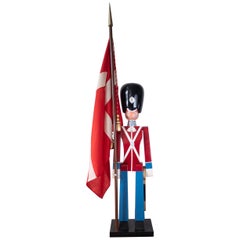

Mid-20th Century Mid-Century Modern Toys and Dolls
Wood
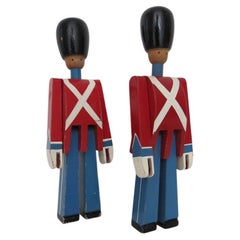
Vintage 1950s Danish Scandinavian Modern Toys and Dolls
Wood
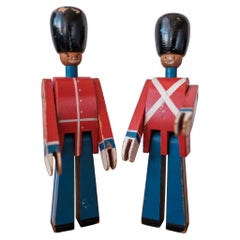
Vintage 1950s Danish Scandinavian Modern Toys and Dolls
Wood
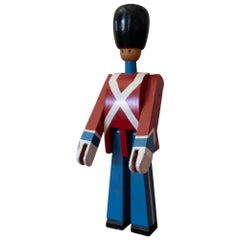
Vintage 1950s Danish Scandinavian Modern Toys and Dolls
Wood
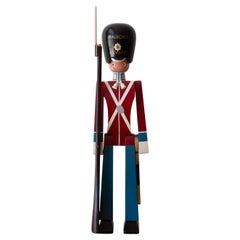
Mid-20th Century Swedish Scandinavian Modern Figurative Sculptures
Wood
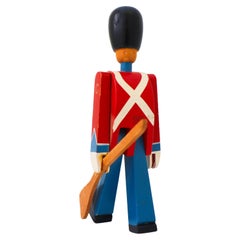
Mid-20th Century Danish Scandinavian Modern Bookends
Wood
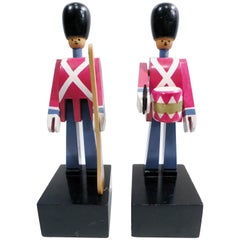
Kay Bojesen for sale on 1stDibs
Silversmith and designer Kay Bojesen became world-famous for creating wooden toys that had a soul and an impish sense of humor. With more than 2000 pieces to his name, he was one of Denmark's most prolific artisans in the 20th century. He is best known for his playful and cheerful monkeys, royal lifeguards and other wooden toys, but his repertoire of products also includes jewelry, cutlery, teapots and silver goblets. Kay Bojesen graduated as a silversmith in 1910 after completing his apprenticeship with silversmith Georg Jensen. As one of the first Danish artisans to do so, he embraced functionalism. He was among the pioneers who organized Den Permanente association – a cooperative of artists that included a shop and exhibition space, which over the decades came to represent the best in Danish and Scandinavian design. The year 1919 became the start of a New Era for Kay Bojesen. His son Otto was born and this life event sparked Kay Bojesen's imagination. In the 1930s, he started to indulge his interest in wood. He created a range of wooden toys that all lived up to his ideal that design should be round, soft and have a good feel to it. His idea was not to create lifelike copies of real animals or to be too sophisticated or focus too much on detail, but instead to create imaginative toys in designs based on a child's world where “lines need to smile”. With this basic philosophy in mind, Kay Bojesen created his beloved wooden toys that appeal to the child within us all. Kay Bojesen retained his childish curiosity till the end and left an important design heritage behind.
A Close Look at Scandinavian-modern Furniture
Scandinavian modernism is perhaps the warmest and most organic iteration of modernist design. The work of the designers associated with vintage Scandinavian modern furniture was founded on centuries-old beliefs in both quality craftsmanship and the ideal that beauty should enhance even the humblest accessories of daily life.
ORIGINS OF SCANDINAVIAN MODERN FURNITURE DESIGN
- Emerged in the 1930s
- Scandinavian design and Nordic design originated primarily in Denmark, Sweden, Finland, Iceland and Norway
- Introduced in the United States in mid-20th century
- Informed by the Bauhaus; influenced American mid-century modernism
CHARACTERISTICS OF SCANDINAVIAN MODERN FURNITURE DESIGN
- Bold, clean lines and simple, sturdy symmetries
- Use of natural materials — native woods such as pine, ash and beech
- Open, airy spaces
- Promotion of functionality
- Emphasis on craftsmanship; rooted in cabinetry profession and traditional construction techniques
- Minimal ornamentation (little to no embellishment)
- A neutral or light color palette owing to prominence of light woods
SCANDINAVIAN MODERN FURNITURE DESIGNERS TO KNOW
- Alvar Aalto
- Hans Wegner
- Kaare Klint
- Arne Jacobsen
- Greta Magnusson Grossman
- Finn Juhl
- Arne Vodder
- Verner Panton
ICONIC SCANDINAVIAN MODERN FURNITURE DESIGNS
VINTAGE SCANDINAVIAN MODERN FURNITURE ON 1STDIBS
The gentle, organic contours that are typical of Scandinavian design appear in the furnishings and decor created by Danish, Finnish and Swedish designers not as a stylistic gesture, but rather as a practical, ergonomic — and, as importantly, elegant — response to the human form.
Each nation produced exceptional talents in all areas of the applied arts, yet each had its forté. Sweden was home to Greta Magnusson Grossman and Bruno Mathsson — creators of the classic Grasshopper lighting series and Berlin daybed, respectively — but the country excelled most notably at ceramics. In the 1920s at the great Gustavsberg porcelain manufactory, Wilhelm Kåge introduced pieces in the Scandinavian style based on influences from folklore to Cubism; his skills were passed on to his versatile and inspired pupils Berndt Friberg and Stig Lindberg.
Likewise, Finland produced a truly ingenious Scandinavian modern furniture designer in the architect Alvar Aalto, a master at melding function and artistic form in works like the Paimio chair, created in collaboration with his first wife, Aino. Yet Finnish glassware was pre-eminent, crafted in expressive, sculptural designs by Tapio Wirkkala and Timo Sarpaneva.
The Danes excelled at chairs. Hans Wegner and Arne Jacobsen were exemplars of the country’s facility with wood, particularly teak.
Wegner created such iconic pieces as the Round chair and the Wishbone chair; Jacobsen — while the revolutionary architect and furniture innovator produced the best-selling plywood Ant chair — designed two classic upholstered pieces of the 1950s: the Swan chair and Egg chair. The list of great Danes could go on and on, including Finn Juhl, a stylistic maverick and maker of the bold Chieftain chair; Poul Kjaerholm, with his lean metal-and-rattan aesthetic; and Verner Panton, who introduced a vibrant Pop note into international design.
Today, decades after their heyday, the prolific, ever-evolving Scandinavian modernists continue to amaze and delight, and interior designers all over the world use their pieces to bring warmth to any given space.
On 1stDibs, you will note both instantly recognizable vintage Scandinavian modern chairs, sofas, rugs and tables — those that have earned iconic status over time — and many new discoveries.