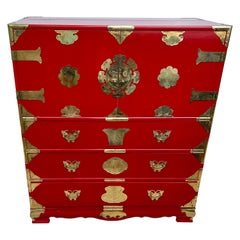
Korean Tansu Chest Red
Recent Sales
Mid-20th Century Korean Campaign Furniture
Wood

A Close Look at Campaign Furniture
Sometimes called “knock-down” furniture, campaign furniture was designed to be folded, collapsed, taken apart and packed flat to load onto a ship or a camel’s back. Although mobile furniture for military campaigns dates back to the Romans, the British Army in its global conquests in the 18th and 19th centuries defined the style with sturdy and elegant pieces. Even in a tent thousands of miles from London, a four-poster bed, dining table and seating could simulate the comforts of home.
Antique and vintage campaign-style furniture was also initially designed as propaganda. The mahogany and teak structures were part of a purposeful demonstration of power in these campaigns, with the colonizing military officers imposing their culture and view of what they considered “civilized” on a given land and its peoples. Designers and manufacturers including Thomas Butler, Ross Co. of Dublin, and Morgan Sanders contributed to the rapid production of this furniture as the British Empire expanded through Africa, Asia and Australia.
Campaign furniture was utilitarian as well as refined, fitted with recessed brass handles and brass angles on stackable chests and other case pieces to protect vulnerable corners. The Wellington chest was one of the most famous pieces to come out of this style, named for the Duke of Wellington, who slept in his campaign bed long after his battles were over.
The flexibility of campaign-style furniture would influence 20th-century Scandinavian modernists such as Kaare Klint, Mogens Koch and Arne Norell. For his 1930s Safari chair, Klint drew on the simple Roorkhee chair, named for a town in northern India. The lightweight and adaptable campaign-style seat was created in the late 19th century and had no fixed joinery. The Roorkhee’s influence can also be seen in the Wassily chair, a pared-down work of tubular metal and durable canvas conceived by legendary Bauhaus instructor Marcel Breuer.
Now, 21st-century designers like Jomo Tariku and Dokter and Misses are creating pieces that recognize the contributions of African artisans to campaign furniture in order to reframe this style without overlooking its difficult past.
Find a collection of authentic antique and vintage campaign bedroom furniture, chairs, decorative objects and other pieces on 1stDibs.
Finding the Right Asian-art-furniture for You
From Japanese handmade earthenware pottery, originating circa 14,500 B.C. and adorned with elaborate corded patterns known as jōmon, to natural elm case pieces and storage cabinets built in Qing dynasty–era China to mid-century Thai rice-paper charcoal rubbings, antique and vintage Asian art and furniture make for wonderful additions to all kinds of contemporary interiors.
Eastern elements elevate any home’s decor. Introduce zen sensibility to your living room, dining room and bedroom with the neutral color palettes and the natural materials such as rattan, bamboo and elm that we typically associate with traditional Asian furniture. Decorative handwoven embroideries and textiles originating from India and elsewhere on the continent, which can be draped over a bed or sofa or used as a wall hanging, can be as practical as they are functional, just as you wouldn’t seek out Japanese room-divider screens — often decorated with paintings but constructed to be lightweight and mobile — merely for privacy.
With everything from blanket chests to lighting fixtures to sculptures and carvings, it’s easy to tastefully bring serenity to your living space by looking to the treasures for which the East has long been known.
For British-born furniture designer Andrianna Shamaris, the Japanese concept of beauty in imperfection isn’t limited to her Wabi Sabi collection. She embraces it in her New York City apartment as well. In the living area, for instance, she retained the fireplace’s original black marble while swathing its frame and the rest of the room in bright white.
“We left the fireplace very clean and wabi-sabi, so that it blended into the wall,” says Shamaris, who further appointed the space with a hand-carved antique daybed whose plush pillows are upholstered in antique textiles from the Indonesian island of Sumba.
In the growing antique and vintage Asian art and furniture collection on 1stDibs, find ceramics from China, antiquities from Cambodia and a vast range of tables, seating, dining chairs and other items from Japan, India and other countries.