Lalanne Mouton
Recent Sales
1970s Contemporary Figurative Sculptures
Mixed Media

Late 20th Century Figurative Sculptures
Bronze
François-Xavier Lalanne for sale on 1stDibs
François-Xavier Lalanne was born in 1927 in Agen. After the war, he moved to Paris where he studied at the Académie Julian to become a painter. On the occasion of his first exhibition at the Cimaise Gallery in Paris in 1952, Lalanne met Claude Dupeux (Lalanne), his future wife. After meeting her, he gave up painting and started working with her.
The first joint exhibition for Claude and François-Xavier, titled "Zoophite," took place in 1964 at the J. Gallery. They revealed their creations — hybrids of sculptures and everyday objects. In 1966, they introduced themselves under the name Les Lalanne.
The two artists each created their own works but shared a common universe inspired by the animal and plant world and often exhibited together.
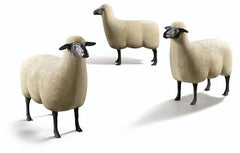
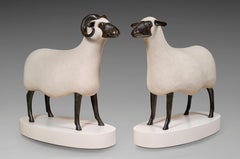
François-Xavier invented a bestiary composed of monkeys, rhinos, donkeys, camels, toads, hippos and cats. Among them, the sheep was undoubtedly his favorite animal. Alone or in a flock, with or without a head, sheathed in the fleece of sheep or not, his sheep sculptures can also constitute seats. His will, shared by Claude, was to desacralize the sculpture to give it a familiar dimension.
François-Xavier is also known for his public commissions. For example, in France he created two concrete pigeons in the city of Grande-Borne in Grigny, and Les Pleureuses (“The Mourners”) is a monumental fountain created in 1986 by François-Xavier and Claude that was installed at the Hakone Open-Air Museum in Japan.
In 1968, François-Xavier was made a Knight of Arts and Letters. His works have been acquired by great collectors such as Yves Saint Laurent and Pierre Bergé, the Rothschilds and Charles and Marie-Laure de Noailles. The work of Les Lalanne is exhibited throughout the world, presented in both galleries and museums. The retrospective organized in 2010 by the Musée des Arts Décoratifs is one of the last major exhibitions of the duo. After a long career, François-Xavier died in 2008 in Ury.
Find authentic François-Xavier Lalanne sculptures, prints and other art and furniture on 1stDibs.
(Biography provided by Bailly Gallery Geneva-Paris)
Finding the Right Figurative-sculptures for You
Figurative sculptures mix reality and imagination, with the most common muse being the human body. Animals are also inspirations for these sculptures, along with forms found in nature.
While figurative sculpture dates back over 35,000 years, the term came into popularity in the 20th century to distinguish it from abstract art. It was aligned with the Expressionist movement in that many of its artists portrayed reality but in a nonnaturalistic and emotional way. In the 1940s, Alberto Giacometti — a Swiss-born artist who was interested in African art, Cubism and Surrealism — created now-iconic representational sculptures of the human figure, and after World War II, figurative sculpture as a movement continued to flourish in Europe.
Lucian Freud and Francis Bacon were some of the leading figurative artists during this period. Artists like Jeff Koons and Maurizio Cattelan propelled the evolution of figurative sculpture into the 21st century.
Figurative sculptures can be whimsical, uncanny and beautiful. Their materials range from stone and wood to metal and delicate ceramics. Even in smaller sizes, the sculptures make bold statements. A bronze sculpture by Salvador Dalí enhances a room; a statuesque bull by Jacques Owczarek depicts strength with its broad chest while its thin legs speak of fragility. Figurative sculptures allow viewers to see what is possible when life is reimagined.
Browse 1stDibs for an extensive collection of figurative sculptures and find the next addition to your collection.