Marcel Breuer Cesca Vinyl
Recent Sales
Vintage 1980s Bauhaus Armchairs
Chrome
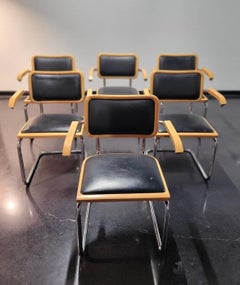

Marcel Breuer for sale on 1stDibs
The architect and designer Marcel Breuer was one the 20th century’s most influential and innovative adherents of modernism. A member of the Bauhaus faculty, Breuer — like such colleagues as the architects Walter Gropius and Ludwig Mies van der Rohe, and the artists and art theoreticians László Moholy-Nagy and Josef Albers — left Europe in the 1930s to champion the new design philosophy and its practice in the United States.
Born in Hungary, Breuer became a Bauhaus student in 1920 and quickly impressed Gropius, the German school’s founder, with his aptitude for furniture design. His early work was influenced by the minimalist Dutch design movement De Stijl — in particular the work of architect Gerrit Rietveld.
In 1925, while he was head of the Bauhaus furniture workshop, Breuer realized his signature innovation: the use of lightweight tubular-steel frames for chairs, tables and sofas — a technique soon adopted by Mies and others. Breuer’s attention gradually shifted from design to architecture, and, at the urging of Gropius, he joined his mentor in 1937 on the faculty of Harvard and in an architectural practice.
In the 1940s, Breuer opened his own architectural office, and there his style evolved from geometric, glass-walled structures toward a kind of hybrid architecture — seen in numerous Breuer houses in New England — that pairs bases of local fieldstone with sleek, wood-framed modernist upper floors. In his later, larger commissions, Breuer worked chiefly with reinforced concrete and stone, as seen in his best-known design, the brutalist inverted ziggurat built in New York in 1966 as the home of the Whitney Museum of American Art.
Breuer’s most famous furniture pieces are those made of tubular steel, which include the Wassily chair — named after Wassily Kandinsky and recognizable for its leather-strap seating supports — and the caned Cesca chair.
Breuer also made several notable designs in molded plywood, including a chaise and nesting table for the British firm Isokon and a student furniture suite commissioned in 1938 for a dormitory at Bryn Mawr College. Whether in metal or wood, Breuer’s design objects are elegant and adaptable examples of classic modernist design — useful and appropriate in any environment.
Find vintage Marcel Breuer seating, storage cabinets and lighting on 1stDibs.
A Close Look at Bauhaus Furniture
The Bauhaus was a progressive German art and design school founded by the architect Walter Gropius that operated from 1919 to 1933. Authentic Bauhaus furniture — sofas, dining chairs, tables and more — and the school’s followers married industrial and natural materials in simple, geometric forms. The goal of the Bauhaus was to erase the distinction between art and craft while embracing the use of new technologies and materials.
ORIGINS OF BAUHAUS FURNITURE DESIGN
- Art and design school established in Germany in 1919
- Promotion of a union of art, craft and technology
- Design intended for mass production
- School’s workshops focused on cabinetry, metalworking, typography, textiles and more
- Informed by De Stijl, Constructivism, Art Nouveau, Arts and Crafts, and modernism; influenced mid-century modernism, Scandinavian modernism
CHARACTERISTICS OF BAUHAUS FURNITURE DESIGN
- Emphasis on craft
- Simplicity, order, clarity and a prioritization of functionalism
- Incorporation of geometric shapes
- Minimalist and refined, little to no ornamentation
- Use of industrial materials such as tubular chrome, steel and plastic as well as leather, cane and molded plywood in furniture and other products
BAUHAUS FURNITURE DESIGNERS YOU SHOULD KNOW
- László Moholy-Nagy
- Ludwig Mies van der Rohe
- Anni Albers
- Josef Hoffmann
- Marcel Breuer
- Marianne Brandt
AUTHENTIC BAUHAUS FURNITURE ON 1STDIBS
The name Bauhaus is derived from the German verb bauen, “to build.” Under the school’s innovative curriculum, students were taught the fine arts, such as painting and sculpture, as well as practical skills like carpentry and metalworking.
The school moved from Weimar in 1925 to the city of Dessau, where it enjoyed its heyday under Gropius, then Hannes Meyer and Ludwig Mies van der Rohe. The period from 1932 to 1933 when it operated in Berlin under Mies was its final chapter. Despite its brief existence, the Bauhaus has had an enduring impact on art and design in the United States and elsewhere, and is regarded by many as the 20th century’s chief crucible of modernism.
The faculty roster at the Bauhaus reads like a who’s who of modernist creative genius — it included such artists as Paul Klee, Wassily Kandinsky and László Moholy-Nagy along with architects and designers like Mies and Marcel Breuer, who became known for his muscular brutalist-style concrete buildings in the postwar years. In 1925, while he was head of the Bauhaus carpentry workshop, Breuer gave form to his signature innovation: the use of lightweight tubular-steel frames for chairs, side tables and sofas — a technique soon adopted by Mies and others. Breuer’s Cesca chair was the first-ever tubular steel frame chair with a caned seat to be mass produced, while the inspiration for his legendary Wassily chair, a timeless design and part of the collection crafted to furnish the Dessau school, was the bike he rode around campus.
Bauhaus design style reflects the tenets by which these creators worked: simplicity, clarity and function. They disdained superfluous ornament in favor of precise construction. Seating pieces such as side chairs, armchairs or club chairs for example, were made with tubular metal or molded plywood frames, and upholstery was made from leather or cane. Above all, designs in the Bauhaus style offer aesthetic flexibility. They can be the elements of a wholly spare, minimalist space, the quiet foundation of an environment in which color and pattern come from one’s own collection of art and artifacts.
Today, from textiles to typefaces, architecture, furniture and decorative objects for the home, Bauhaus creations continue to have an outsize influence on modern design.
Find a collection of authentic Bauhaus furniture on 1stDibs.
Finding the Right Armchairs for You
Armchairs have run the gamut from prestige to ease and everything in between, and everyone has an antique or vintage armchair that they love.
Long before industrial mass production democratized seating, armchairs conveyed status and power.
In ancient Egypt, the commoners took stools, while in early Greece, ceremonial chairs of carved marble were designated for nobility. But the high-backed early thrones of yore, elevated and ornate, were merely grandiose iterations of today’s armchairs.
Modern-day armchairs, built with functionality and comfort in mind, are now central to tasks throughout your home. Formal dining armchairs support your guests at a table for a cheery feast, a good drafting chair with a deep seat is parked in front of an easel where you create art and, elsewhere, an ergonomic wonder of sorts positions you at the desk for your 9 to 5.
When placed under just the right lamp where you can lounge comfortably, both elbows resting on the padded supports on each side of you, an upholstered armchair — or a rattan armchair for your light-suffused sunroom — can be the sanctuary where you’ll read for hours.
If you’re in the mood for company, your velvet chesterfield armchair is a place to relax and be part of the conversation that swirls around you. Maybe the dialogue is about the beloved Papa Bear chair, a mid-century modern masterpiece from Danish carpenter and furniture maker Hans Wegner, and the wingback’s strong association with the concept of cozying up by the fireplace, which we can trace back to its origins in 1600s-era England, when the seat’s distinctive arm protrusions protected the sitter from the heat of the period’s large fireplaces.
If the fireside armchair chat involves spirited comparisons, your companions will likely probe the merits of antique and vintage armchairs such as Queen Anne armchairs, Victorian armchairs or even Louis XVI armchairs, as well as the pros and cons of restoration versus conservation.
Everyone seems to have a favorite armchair and most people will be all too willing to talk about their beloved design. Whether that’s the unique Favela chair by Brazilian sibling furniture designers Fernando and Humberto Campana, who repurposed everyday objects to provocative effect; or Marcel Breuer’s futuristic tubular metal Wassily lounge chair; the functionality-first LC series from Charlotte Perriand, Le Corbusier and Pierre Jeanneret; or the Eames lounge chair of the mid-1950s created by Charles and Ray Eames, there is an iconic armchair for everyone and every purpose. Find yours on 1stDibs right now.
- What is Marcel Breuer known for?1 Answer1stDibs ExpertMarch 22, 2022Marcel Breuer is known for his work as an architect and furniture designer during the 20th century. During his life, he created many famous chairs that remain popular today, including the Wassily lounge chair, the Cesca chair and the D40 cantilever chair. You’ll find a range of Marcel Breuer furniture on 1stDibs.