Marie Antoinette Sofa
Recent Sales
Vintage 1930s French Louis XVI Loveseats
Wood, Upholstery, Velvet
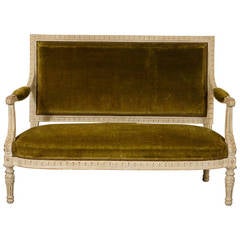

Marie Antoinette Sofa For Sale on 1stDibs
How Much is a Marie Antoinette Sofa?
A Close Look at Louis-xvi Furniture
Reflecting the final era of royal opulence before the upheaval of the French Revolution, antique Louis XVI furniture features more angular shapes than the Rococo curves of the Louis XV style, harkening back to the imposing grandeur of Louis XIV.
Dating between 1750 and 1800, an era that overlapped with the last king of France whose reign was cut short by the guillotine, Louis XVI furniture, known as the goût grec, is emblematic of the neoclassical revision that French furniture underwent during the second half of the 18th century.
Authentic Louis XVI furniture characteristics include clean lines and carved details such as scrolls and acanthus flourishes that were inspired by ancient Greece and Rome. This was informed by a burgeoning interest in antiquity in the 18th century, owing to new archaeological excavations at sites including Pompeii and Herculaneum. It largely eclipsed the more East Asian–influenced ornamentation of Louis XV for something more geometric and symmetrical.
The Louis XVI style was defined by what was being created for the palatial rooms at Versailles and Fontainebleau, particularly for the queen, with cabinetmaker Jean-Henri Riesener being a favorite of Marie-Antoinette’s for his luxurious pieces accented with gilded bronze and marquetry. Furniture maker Jean-Baptiste-Claude Sené was also a major designer of the period, with his pieces for the royal residences adorned with giltwood and neoclassical touches like tapered columns for chair legs and laurel leaf carvings. Cabinetmaker Adam Weisweiler occasionally incorporated into his furniture porcelain panels produced by Sèvres, a popular manufacturer of European ceramics that served the crown with serveware, vases and other decorative objects.
Find a collection of antique Louis XVI seating, tables, cabinets and other furniture on 1stDibs.
Finding the Right Loveseats for You
Antique and vintage loveseats are functional and totally charming furniture in homes large and small these days. They first appeared in the 17th and 18th centuries, though they were not yet known by this endearing term.
These petite, two-seat sofas were originally intended to comfortably sit a woman clad in what were the era’s large and elaborate dresses — ornate hooped garments with copious folds of fabric, embroidery and lace. However, because the original seats featured just enough space for two, they quickly became popular for couples that were courting. Loveseats meant that the couples could engage in close conversation, but furniture makers ensured that there was enough space between sitters to prioritize modesty.
In the early days of loveseats, the furnishings were minimalist in appearance and could often be found in an s-shape, with the two sides facing each other. The spare seating was initially little more than a wooden bench, as loveseats weren’t yet upholstered or cushioned. Design of the seating evolved over time, and this wide chair was eventually padded and tufted for comfort. During the 1800s, loveseats were a luxurious addition to the homes of the wealthy, and even today, antique 19th-century loveseats are still quite alluring. In any lavishly decorated parlor of the Victorian era, you might find a pair of partygoers tucked into a particularly plush iteration of these cozy perches, one boasting arched crests of carved mahogany over its sculpted seats, with front cabriole legs resolving in paw feet.
In modern homes, loveseats — even antique Victorian loveseats — pair well with oversize sofas or are ideal replacements for sofas, particularly if you’re working on organizing and furnishing a smaller space. A loveseat is a stylish addition to a home library or a reading nook and can easily be situated at the foot of the bed in your bedroom. In the living room, you may wish to position your vintage loveseat and couch around a central focal point, such as a distinguishing architectural feature or a fireplace. But be sure to leave some walking room between your seating and any nearby coffee tables or side tables. Allow for around two feet for guests to pass between a couch and chair or loveseat and at least a foot between a loveseat and coffee table.
Find a wide variety of antique, new and vintage loveseats today on 1stDibs.
- 1stDibs ExpertApril 5, 2022Élisabeth Vigée Le Brun painted the famous portrait of Marie Antoinette that most people think of when they hear the name of Louis XVI's wife. Other artists who painted her include Jean-Baptiste André Gautier d’Agoty, Joseph Ducreux, Adolf Ulrik Wertmüller and Alexander Kucharski. On 1stDibs, find a large selection of portrait art.