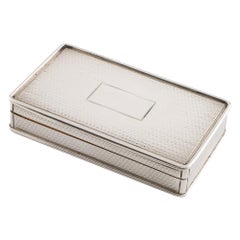
Masonic Snuff Box
Recent Sales
Antique 1830s British William IV Sterling Silver
Silver

A Close Look at William-iv Furniture
It was unexpected that, at the age of 64, William IV was crowned king of England. He had two older brothers, yet the death of Prince Frederick put him in line for the British throne when George IV died in 1830. His reign was brief, as he died on June 20, 1837, but it was a pivotal time of change, with parliamentary reform leading to the present-day constitutional monarchy. Antique William IV–style furniture reflects this period of transition, with forms that bridged the neoclassicism of the preceding Regency style and the more extravagant Victorian style that would follow.
Inspired by ancient Greece and Rome, William IV designs were often more imposing than Regency furniture and featured decorative attributes. There were sofas balanced on lion’s feet and tables with brass fittings. But furnishings of this period were largely marked by straight lines and subdued ornamentation compared to those of the George IV era. William IV had an unassuming way about him and was much more formal, whereas the ruler who preceded him was a king of extravagance. George IV had an affinity for French decor and was heavily invested in overhauling the private residences at Windsor Castle.
Carvings on William IV four-poster beds and cabinets included scrolling shapes, lotus leaves and acanthus, while popular pieces like tilt-top tables and upholstered seating on caster legs provided flexible interiors. Richly toned woods like mahogany and rosewood were used for sideboards, bedposts boasting reeded details and dining chairs with intricate chair backs and turned front legs.
William IV left no legitimate heirs, so his young niece, Victoria, became queen. She would lead an era of taste in which the innovations of the Industrial Revolution allowed for manufacturing showier furniture to fill elaborate interiors. With its comparatively refined forms and restrained designs, William IV style was a pause before a time of radical aesthetic change.
Find a collection of authentic William IV tables, armchairs, decorative objects and other 19th-century furniture and antiques on 1stDibs.
Finding the Right Sterling-silver for You
Dining and entertaining changed drastically when we began to set our tables with sterling silver for holiday gatherings, wedding receptions, engagement parties and, in some of today’s homes, everyday meals.
Often called the “Queen of metals,” silver has been universally adored for thousands of years. It is easy to see why it has always been sought after: It is durable, strong and beautiful. (Louis XIV had tables made entirely of silver.) Sterling silver is an alloy that is made of 92.5 percent silver — the “925” stamp that identifies sterling-silver jewelry refers to this number. The other 7.5 percent in sterling silver is typically sourced from copper.
Neoclassical-style sterling-silver goods in Europe gained popularity in the late 18th century — a taste for sterling-silver tableware as well as tea sets had taken shape — while in the United States, beginning in the 19th century, preparing the dinner table with sterling-silver flatware had become somewhat of a standard practice. Indeed, owning lots of silver goods during the Victorian era was a big deal. Back then, displaying fine silver at home was a status symbol for middle-class American families. And this domestic silver craze meant great profitability for legendary silversmith manufacturers such as Reed Barton, Gorham Manufacturing Company and the International Silver Company, which was incorporated in Meriden, Connecticut, in 1898, a major hub of silver manufacturing nicknamed “Silver City.”
Today, special occasions might call for ceremonial silver designed by Tiffany Co. or the seductive sterling-silver cutlery from remarkable Danish silversmith Georg Jensen, but there really doesn’t have to be an event on the calendar to trot out your finest tableware.
Event- and wedding-planning company maestro Tara Guérard says that some “investment pieces,” such as this widely enamored alloy, should see everyday use, and we’re inclined to agree.
“Sterling-silver flatware is a must-have that you can use every single day, even to eat cereal,” she says. “Personally, I want a sterling-silver goblet set for 12 to 20; I would use them every time I had a dinner party. Ultimately, there are no criteria for buying vintage pieces: Buy what you love, and make it work.”
Whether you’re thinking “ceremonial” or “cereal,” browse a versatile collection of vintage, new and antique sterling-silver wares on 1stDibs today.