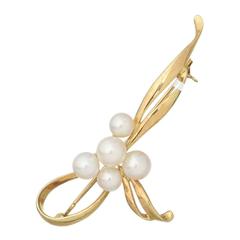
Mikimoto Pearl Brooch
21st Century and Contemporary Brooches
Yellow Gold
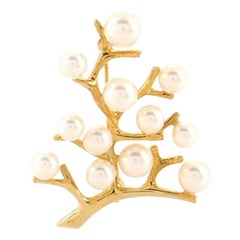

21st Century and Contemporary Brooches
Yellow Gold
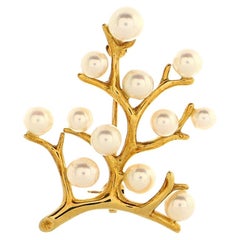
21st Century and Contemporary Brooches
White Gold
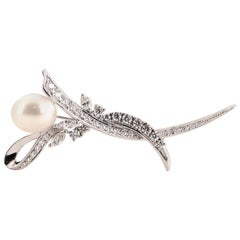
Antique Late 19th Century English Victorian Brooches
18k Gold
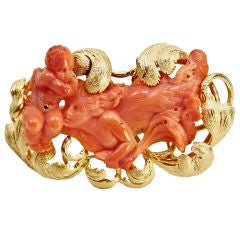
20th Century Japanese Brooches
Cultured Pearl, Pearl, 18k Gold, Yellow Gold
- 1
Mikimoto Pearl Brooch For Sale on 1stDibs
How Much is a Mikimoto Pearl Brooch?
Mikimoto for sale on 1stDibs
Born to a noodle-shop owner, Japanese jeweler Kokichi Mikimoto (1858–1954) worked in the seafood business before shifting his focus to pearl cultivation. In 1893, he successfully developed the world’s first cultured pearls with a semispherical specimen. His further experimentation would include black and white South Sea pearls. This development gave Mikimoto a supply of what had once been a notoriously rare natural element and earned him the nickname “The Pearl King.” As he once said, “My dream is to adorn the necks of all women around the world with pearls.”
In 1899 in Tokyo’s Ginza district, Mikimoto opened his first, eponymous store in a white-stone building reminiscent of the color of pearls. He quickly earned a reputation for dazzling designs that blended Japanese craftsmanship and European influence. Mikimoto sent his jewelers to Europe to study the latest trends in jewelry and design; they brought back knowledge of Art Deco and Art Nouveau styles, which were incorporated into designs featuring Mikimoto’s pearls.
But Mikimoto’s creations were not met with enthusiasm by all. In 1921, a London newspaper called the designer’s jewelry “only imitations of real pearls” and claimed the company was “misleading” its customers. It developed into a lawsuit in the French courts, which ruled in Mikimoto’s favor, and raised the jeweler’s global profile.
He also brought his work international acclaim through exhibitions and world’s fairs, including the 1926 Sesquicentennial Exposition in Philadelphia where he unveiled a replica of the Liberty Bell covered with pearls. In 1927, Mikimoto met with Thomas Edison, who gave the jeweler’s invention probably its best compliment: “It is one of the wonders of the world that you were able to culture pearls. . . . This isn’t a cultured pearl, it’s a real pearl.”
Following World War II, Mikimoto opened stores around the world, with locations now in Paris, New York City, Los Angeles and Shanghai. Though its founder died in 1954, the Mikimoto company has continued to build on the legacy he established, producing collections of pearl necklaces and other pearl-centric jewelry that span a wide range of styles.
In 2017, the brand reopened its flagship Tokyo store, tapping architect Hiroshi Naito to design a new glittering facade whose 40,000 tiny glass plates are meant to evoke the movement of the ocean as they catch the light. The place where Mikimoto had his legendary success over a century ago is now known as Mikimoto Pearl Island and includes a museum on his life and pearls. A highlight is the “Boss’s Necklace,” which was the first made by Mikimoto and is the model for all the brand’s classic strands that have followed.
Find Mikimoto pendant necklaces, choker necklaces and a range of other jewelry on 1stDibs.
The Legacy of Pearl in Jewelry Design
The pearl has been synonymous with ladylike elegance since the Tudor period — learn what to look for when shopping for vintage and antique pearl jewelry as well as how to tell the origin of a pearl with our handy primer.
Every woman at some point in her life desires a simple strand of pearls. They are elegant, timeless, versatile — just ask Coco Chanel or Jacqueline Kennedy — and valuable. In 1917, Pierre Cartier famously traded a double-strand of natural pearls for a Fifth Avenue mansion, the Cartier brand’s flagship store ever since. And if you were born in the beginning of summer, pearl is the June birthstone.
It is possible to tell where a pearl originated from its appearance. Akoyas are usually round and white — the classic pearl, if you will. South Sea pearls are normally larger and vary in color; orangey yellow ones are not uncommon. Tahitian pearls are mostly black but can also be gray or brown, and between the Akoya and the South Sea varieties in size. Freshwater pearls, or Orientals, run the gamut in terms of color and size, but in shape, they tend to resemble Rice Krispies. Another important distinction is a round pearl versus a baroque pearl. A round pearl is self-explanatory, but there are two types of baroque pearls: symmetrical and asymmetrical. In general, the symmetrical variation commands a higher valuation. Within a strand of pearls, uniformity is prized — the more the individual pearls resemble one another, the more valuable the strand.
According to the Gemological Institute of America (GIA), the earliest recorded mention of a pearl was in 2206 BC by a Chinese historian. Centuries later, Christopher Columbus made it a point to visit pearl fisheries during his 15th-century exploration of the Caribbean. Since the late-19th century, the Japanese have been at the forefront of cultivating pearls, when jeweler Kokichi Mikimoto successfully cultured the world’s first pearl in 1893.
On 1stDibs, find vintage and antique pearl necklaces, pearl earrings and other accessories.
Finding the Right Brooches for You
Vintage brooches, which refer to decorative jewelry traditionally pinned to garments and used to fasten pieces of clothing together where needed, have seen increasing popularity in recent years.
While jewelry trends come and go, brooches are indeed back on the radar thanks to fashion houses like Gucci, Versace, Dior and Saint Laurent, all of which feature fun pinnable designs in their current collections. Whether a dazzlingly naturalistic Art Nouveau dragonfly, a whimsical David Webb animal, a gem-studded bloom or a streamlined abstract design, these jewels add color and sparkle to your look and a spring to your step.
Given their long history, brooches have expectedly taken on a variety of different shapes and forms over time, with jewelers turning to assorted methods of ornamentation for these accessories, including enameling and the integration of pearls and gemstones. Cameo brooches that originated during the Victorian age are characterized by a shell carved in raised relief that feature portraits of a woman’s profile, while 19th-century micromosaic brooches, comprising innumerable individually placed glass fragments, sometimes feature miniature depictions of a pastoral scene in daily Roman life.
At one time, brooches were symbols of wealth, made primarily from the finest metals and showcasing exquisite precious gemstones. Today, these jewels are inclusive and universal, and you don’t have to travel very far to find an admirer of brooches. They can be richly geometric in form, such as the ornate diamond pins dating from the Art Deco era, or designer-specific, such as the celebrated naturalistic works created by Tiffany Co., the milk glass and gold confections crafted by Trifari or handmade vintage Chanel brooches of silk or laminated sheer fabric. Chanel, of course, has never abandoned this style, producing gorgeously baroque CC examples since the 1980s.
Brooches are versatile and adaptable. These decorative accessories can be worn in your hair, on hats, scarves and on the lower point of V-neck clothing. Pin a dazzling brooch to the lapel of your blazer-and-tee combo or add a cluster of smaller pins to your overcoat. And while brooches have their place in “mourning jewelry,” in that a mourning brooch is representative of your connection to a lost loved one, they’re widely seen as romantic and symbolic of love, so much so that a hardcore brooch enthusiast might advocate for brooches to be worn over the heart.
Today, find a wide variety of antique and vintage brooches for sale on 1stDibs, including gold brooches, sapphire brooches and more.
- 1stDibs ExpertMarch 22, 2022Yes, Mikimoto pearls tend to at least hold their value over time. In some cases, the value of the brand's pearl jewelry increases over time due to demand and the effects of inflation. Keep in mind that the value of any piece of jewelry depends on its condition. Properly storing and caring for your pieces can help to ensure that they retain their value for years to come. On 1stDibs, shop a selection of Mikimoto pearl jewelry.
- Are Mikimoto pearls Akoya?2 Answers1stDibs ExpertAugust 17, 2021No, not all Mikimoto pearls are Akoya. Mikimoto also uses Black South Sea cultured pearls, White South Sea cultured pearls, Golden South Sea cultured pearls, and Conch pearls to create their jewelry. Shop Mikimoto Akoya pearl jewelry on 1stDibs.1stDibs ExpertMarch 22, 2022Yes, Mikimoto pearls are Akoya, meaning they come from Akoya oysters. The brand largely pioneered the production of cultured pearls, which are genuine pearls developed with human assistance. Mikimoto creates Akoya pearl necklaces, pendants, earrings, bracelets, rings and brooches. On 1stDibs, shop a variety of Mikimoto pearl jewelry.
- 1stDibs ExpertOctober 12, 2021How much a Mikimoto pearl necklace is worth will depend on the size of the strand, the number of pearls used and the design. It could range from $920 to $21,000, with a wide variety of price points in between. From pendant and choker to multi-strand and rope versions, find Mikimoto pearl necklaces on 1stDibs.