Milk Glass Decanter
Recent Sales
Vintage 1970s Italian Mid-Century Modern Barware
Murano Glass
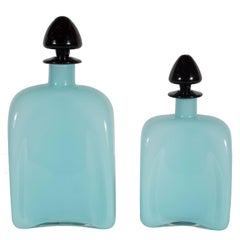

Vintage 1960s American Barware
Milk Glass
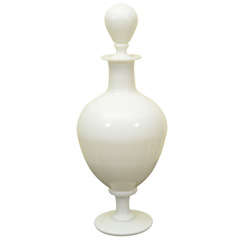
Vintage 1960s Czech Mid-Century Modern Barware
Milk Glass
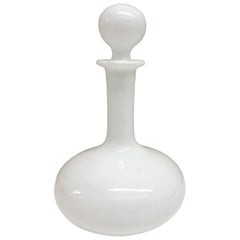
Vintage 1960s Czech Mid-Century Modern Barware
Milk Glass
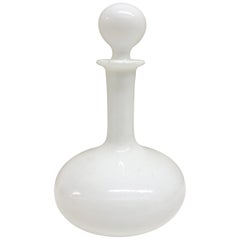
Vintage 1960s Hungarian Mid-Century Modern Barware
Blown Glass
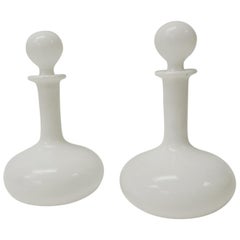
Vintage 1960s Danish Mid-Century Modern Glass
Milk Glass
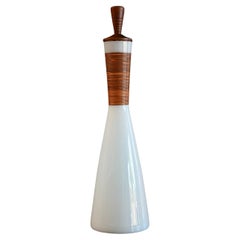
A Close Look at Mid-century-modern Furniture
Organically shaped, clean-lined and elegantly simple are three terms that well describe vintage mid-century modern furniture. The style, which emerged primarily in the years following World War II, is characterized by pieces that were conceived and made in an energetic, optimistic spirit by creators who believed that good design was an essential part of good living.
ORIGINS OF MID-CENTURY MODERN FURNITURE DESIGN
- Emerged during the mid-20th century
- Informed by European modernism, Bauhaus, International style, Scandinavian modernism and Frank Lloyd Wright’s architecture
- A heyday of innovation in postwar America
- Experimentation with new ideas, new materials and new forms flourished in Scandinavia, Italy, the former Czechoslovakia and elsewhere in Europe
CHARACTERISTICS OF MID-CENTURY MODERN FURNITURE DESIGN
- Simplicity, organic forms, clean lines
- A blend of neutral and bold Pop art colors
- Use of natural and man-made materials — alluring woods such as teak, rosewood and oak; steel, fiberglass and molded plywood
- Light-filled spaces with colorful upholstery
- Glass walls and an emphasis on the outdoors
- Promotion of functionality
MID-CENTURY MODERN FURNITURE DESIGNERS TO KNOW
- Charles and Ray Eames
- Eero Saarinen
- Milo Baughman
- Florence Knoll
- Harry Bertoia
- Isamu Noguchi
- George Nelson
- Danish modernists Hans Wegner and Arne Jacobsen, whose emphasis on natural materials and craftsmanship influenced American designers and vice versa
ICONIC MID-CENTURY MODERN FURNITURE DESIGNS
- Eames lounge chair
- Nelson daybed
- Florence Knoll sofa
- Egg chair
- Womb chair
- Noguchi coffee table
- Barcelona chair
VINTAGE MID-CENTURY MODERN FURNITURE ON 1STDIBS
The mid-century modern era saw leagues of postwar American architects and designers animated by new ideas and new technology. The lean, functionalist International-style architecture of Le Corbusier and Bauhaus eminences Ludwig Mies van der Rohe and Walter Gropius had been promoted in the United States during the 1930s by Philip Johnson and others. New building techniques, such as “post-and-beam” construction, allowed the International-style schemes to be realized on a small scale in open-plan houses with long walls of glass.
Materials developed for wartime use became available for domestic goods and were incorporated into mid-century modern furniture designs. Charles and Ray Eames and Eero Saarinen, who had experimented extensively with molded plywood, eagerly embraced fiberglass for pieces such as the La Chaise and the Womb chair, respectively.
Architect, writer and designer George Nelson created with his team shades for the Bubble lamp using a new translucent polymer skin and, as design director at Herman Miller, recruited the Eameses, Alexander Girard and others for projects at the legendary Michigan furniture manufacturer.
Harry Bertoia and Isamu Noguchi devised chairs and tables built of wire mesh and wire struts. Materials were repurposed too: The Danish-born designer Jens Risom created a line of chairs using surplus parachute straps for webbed seats and backrests.
The Risom lounge chair was among the first pieces of furniture commissioned and produced by celebrated manufacturer Knoll, a chief influencer in the rise of modern design in the United States, thanks to the work of Florence Knoll, the pioneering architect and designer who made the firm a leader in its field. The seating that Knoll created for office spaces — as well as pieces designed by Florence initially for commercial clients — soon became desirable for the home.
As the demand for casual, uncluttered furnishings grew, more mid-century furniture designers caught the spirit.
Classically oriented creators such as Edward Wormley, house designer for Dunbar Inc., offered such pieces as the sinuous Listen to Me chaise; the British expatriate T.H. Robsjohn-Gibbings switched gears, creating items such as the tiered, biomorphic Mesa table. There were Young Turks such as Paul McCobb, who designed holistic groups of sleek, blond wood furniture, and Milo Baughman, who espoused a West Coast aesthetic in minimalist teak dining tables and lushly upholstered chairs and sofas with angular steel frames.
Generations turn over, and mid-century modern remains arguably the most popular style going. As the collection of vintage mid-century modern chairs, dressers, coffee tables and other furniture for the living room, dining room, bedroom and elsewhere on 1stDibs demonstrates, this period saw one of the most delightful and dramatic flowerings of creativity in design history.
Finding the Right Barware for You
Whether it’s streamlined or sophisticated, a bar area is always a welcoming feature in any home interior. A cheery well-made drink with friends and family has the potential to yield some unforgettable moments alongside those that aren’t easily remembered. And the only way to conjure that exemplary cordial is by putting the proper antique or vintage barware to work.
Essential barware equipment ranges from sterling-silver barspoons for mixing your cocktails in tall collins glasses to jiggers, shakers and strainers that allow you to whip up martinis and old-fashioneds.
From a design standpoint, some barware, such as our array of Art Deco glass whiskey sets or mid-century modern silver-banded tumblers crafted by Dorothy Thorpe, can help position your bar as a bold and attractive centerpiece to a room. At the very least, a carefully curated collection of barware can elevate with subtlety the bar’s nearby fixtures, as a handcrafted crystal decanter might do for your vintage 1960s bar cart.
As cocktail hour draws near, find inspiration in our gorgeous gallery of home bars in locales ranging from London to New York to San Francisco, and browse the exquisite selection of antique, new and vintage barware and glassware on 1stDibs.
- 1stDibs ExpertMay 3, 2024There is no single most sought-after milk glass. Collectors often seek pieces made by certain companies, such as Fenton, Imperial, Kemple, L. E. Smith, Anchor Hocking and Westmoreland. Hobnail milk glass tends to be a popular choice, and floral trade vases and covered dishes with animal-shaped lids are favorites among collectors as well. Shop a selection of milk glass on 1stDibs.
- Are glass decanters valuable?1 Answer1stDibs ExpertMarch 31, 2023Whether glass decanters are valuable depends on the piece. The maker, age, rarity and condition of a decanter will influence its value, and whether or not collectors desire pieces like it will also have an effect on how much a given glass decanter will be worth. A certified appraiser can evaluate a particular decanter and provide an estimate of its value. On 1stDibs, find a range of glass decanters.
- 1stDibs ExpertNovember 20, 2024To tell if milk glass is valuable, look at recent sales history on trusted online platforms to see what prices similar pieces have fetched. The maker, style, type, age and condition of an item will largely determine how much it is worth. Because there are so many examples of milk glass and many factors affect potential value, having a certified appraiser or experienced antique dealer assist you with the valuation process can be helpful. On 1stDibs, find a diverse assortment of milk glass.
- 1stDibs ExpertNovember 13, 2024To identify Indiana milk glass, familiarize yourself with the company's patterns. Two well-known examples are the Orange Blossom line of milk glass, which has an intricate raised floral motif, and the Princess range, which features alternating bands of crisscrossing and vertical lines. Most Indiana milk glass is unmarked, so you'll need to study the patterns on pieces to determine if the American manufacturer produced them. You can find images of Indiana milk glass on trusted online resources to compare to your piece. Because it can be difficult to make a positive identification without training and experience, you may wish to consult a certified appraiser or knowledgeable antique dealer. Shop a collection of Indiana glass on 1stDibs.
- 1stDibs ExpertAugust 15, 2024To tell if milk glass is valuable, study its details closely. If you spot visible seams, called mold lines, it may indicate that your piece is older and potentially worth more than newer examples of milk glass. You can also look for labels and signatures and then use trusted online resources to determine who produced the milk glass based on these markings. From there, you can search for pieces similar to yours to get a rough idea of their value. Alternatively, you can have a certified appraiser or knowledgeable antiques dealer inspect your glassware and give you an estimate. Find a variety of milk glass on 1stDibs.
- 1stDibs ExpertNovember 26, 2024To identify Westmoreland milk glass, search your piece for a maker's mark. Pieces produced from the early 20th century through the 1940s will usually display a W inside a keystone. Those made between 1946 and 1981 typically feature an interlocked W and G, which stands for Westmoreland Glass. Newer items generally have the full Westmoreland name on them. Keep in mind that some early examples of Westmoreland milk glass may be unmarked. Usually, if you hold these pieces up to natural light, you will notice bright colors along the edge of the glass. They will also often produce a bell-like ringing sound when struck. If your piece has these characteristics, a certified appraiser or experienced antique dealer can help confirm if it is a Westmoreland. On 1stDibs, explore a collection of milk glass.
- 1stDibs ExpertApril 5, 2022To clean a cut-glass decanter, fill your sink with warm water and mild dish soap. Place the decanter in the sink and wipe it with a soft cloth. Rinse thoroughly with warm water and dry with a soft towel. On 1stDibs, shop a range of antique and vintage decanters.
- 1stDibs ExpertOctober 30, 2024To know if your milk glass is worth anything, you can take one of two approaches. One option is to conduct online research using trusted resources. Looking at historical prices for pieces similar to yours in terms of their age, maker, style, type and condition, you can often estimate how much your glassware is worth. For a more specific valuation, you can take the second approach and enlist the help of a certified appraiser or knowledgeable antique dealer. On 1stDibs, explore a variety of milk glassware.
Read More
How Noguchi Elevated Ashtrays to Objets d’Art
Smoking might have fallen out of fashion, but these ashtrays have enduring design appeal.
Tapio Wirkkala Bucked the Trends of Mid-Century Nordic Design
The Finnish talent created nature-inspired pieces, from furniture to jewelry, with phenomenal staying power.