Nymphenburg Horse
Recent Sales
Mid-20th Century German Romantic Figurative Sculptures
Porcelain
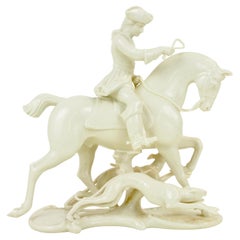

Nymphenburg Porcelain for sale on 1stDibs
Nymphenburg — one of Europe’s most venerable porcelain factories — was founded near Munich in 1747 by Maximilian III Joseph, the elector of Bavaria. It didn’t begin producing under the name we know today, however, until 1761, when it was moved to Nymphenburg Palace.
Porcelain was invented in East Asia around 2,000 years ago, and its formula, which requires a special clay called kaolin, became a closely guarded secret. It wasn’t until the early 1700s that chemists at Meissen, Germany, in the employ of Augustus II the Strong, the elector of Saxony, discovered a process for making true, as opposed to soft-paste, porcelain. Soon factories across Europe were producing fine porcelain services and sculpture for an elite clientele.
Nymphenburg was one of these factories, manufacturing elaborate services for dinner, dessert, coffee and tea, and sculptures for the Bavarian nobility. Round objects, such as Nymphenburg plates and vases, were turned on potter’s wheels, while more complex ones, like figures, were slip cast in molds. This technique ensured that the pieces’ dimensions were precise and consistent. Once shaped, they were fired and, after that, hand-decorated by experienced china painters, who finished each to exacting standards.
Among Nymphenburg’s most famous objects are its lively and charming Rococo-style figurines, most often depicting Commedia dell'Arte characters or exotic Chinese figures. Today, the company makes versions of its historic figurines with updated forms and decorations by such designers as Christian Lacroix and Vivienne Westwood.
It also still makes one of its earliest, and eternally popular, china patterns: the floral Cumberland, created in 1765 by Franz Anton Bustelli as the electoral court service. Cumberland is one of more than 20,000 patterns housed today in Nymphenburg’s archive, enabling owners of incomplete sets to find replacements. In addition, the company has engaged contemporary designers such as Ted Muehling and Hella Jongerius to create witty new designs that celebrate the firm’s history while giving it a fresh spin.
Find authentic Nymphenburg Porcelain decorative objects, tableware and other items on 1stDibs.
Finding the Right Figurative-sculptures for You
Figurative sculpture is a modern art form in which artists create work that is typically representative of the visible world. However, sculptures that are considered to be figurative in style can definitely be inclusive of abstract elements. A wide range of antique, new and vintage figurative sculptures has been made over the years by both well-known and emerging artists, and these pieces can prove striking and provocative as part of your home decor.
Realistic representation in visual art has a very long history. And while figurative artists, whether figurative painters or sculptors, find inspiration in humans, animals and real-life objects, good figurative sculptures can make us think differently about how the real world should look. Just as figurative paintings might include Photorealistic human likenesses, they can also include elements of Surrealism and can suggest a creative and alternative reality. Figurative sculptures aren’t always realistic impressions of our world — depictions of the human form in classical Greek sculpture, for example, might emphasize beauty and physical perfection.
There are a variety of figurative sculptures on 1stDibs created by artists working in a number of styles, including Art Deco, Art Nouveau, mid-century modern and more. A large figurative sculpture can introduce an excellent focal point in a guest bedroom, while smaller works might draw the eye to spaces such as wall shelving or a bookcase that people may otherwise overlook.
When decorating your living room, dining room, home office and study areas with figurative sculptures, don’t be afraid to choose bold colors to inject brightness into neutral spaces. Texture is another factor to consider when purchasing figurative sculptures. A highly textural work of ceramics or wood will catch the eye in a sleek modern space, whereas a smooth, flat glass sculpture can offer an often much-needed contrast in a room that already has many textures.
On 1stDibs, find antique, new or vintage figurative sculpture or other kinds of sculpture for your home decor today.