Packard Watch
Recent Sales
Antique 19th Century American Art Deco Pocket Watches
14k Gold, Yellow Gold
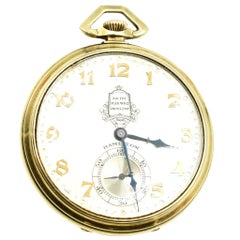

Vintage 1930s American Art Deco Wrist Watches
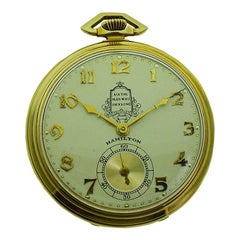
Packard Watch For Sale on 1stDibs
How Much is a Packard Watch?
Hamilton for sale on 1stDibs
In an era when the safety of America’s bustling railroads absolutely depended on accurate timepieces for its conductors, watchmaker Hamilton pioneered cutting-edge, impossibly precise watches in a complex that spanned one square city block of Lancaster, Pennsylvania, during the late 19th century.
As railroad tracks were laid across the United States and steam locomotives began traversing vast distances, the American railroad system ran into a problem. Back then, time was not standardized across the country. Therefore, in 1883, the railroad companies established the four time zones as we know them today. But, despite setting these zones, train conductors were not always synchronized, leading to deadly accidents on the railroads.
Enter watchmaker Hamilton, founded in 1892. Railway workers would be required to wear a pocket watch, as the timepieces were responsible for keeping conductors on schedule, and the watchmaking industry — and early American pocket-watch manufacturers such as Hamilton, Elgin National Watch Company and the Waltham Watch Company — benefitted.
Hamilton’s pocket watches were extremely alluring to train conductors, who began buying them en masse. The East Coast company’s timepieces eventually earned the moniker “The Watch of Railroad Accuracy.”
Hamilton transitioned from pocket watches to wristwatches in 1914, as it supplied timepieces to American troops fighting in World War I. Wristwatches, naturally, were more convenient to wear and use in battle. The new style of watch was also appealing to aviators, and Hamilton aeronautical watches became all the rage among pilots, specifically those flying for the new U.S. Airmail service.
The general public’s interest in Hamilton watches grew rapidly in the 1920s. Legendary polar explorer Admiral Richard E. Byrd timed his historic flights over glaciers and chunks of sea ice with a Hamilton pocket watch in the late 1920s, and a Hamilton timepiece used by Byrd during these expeditions went on display in 2018 at the National Watch Clock Museum.
Hamilton’s Piping Rock watch, an Art Deco–inspired design that featured elegant Roman numerals set in black for the hour markers, made its debut in 1928 and was gifted to the New York Yankees to celebrate their World Series win that year. The model was also featured in the film Shanghai Express alongside the brand’s Flintridge watch, further expanding Hamilton’s popularity. (Hamilton watches can also be seen in the films The Frogmen, Blue Hawaii, 2001: A Space Odyssey and Men in Black.)
In the second half of the 20th century, Hamilton became well known for several innovations: It developed the first-ever battery-operated electric watch, the Ventura, in 1957, as well as the first-ever digital wristwatch, the Hamilton Pulsar Time Computer, in 1970. Three years later, superspy and watch enthusiast James Bond donned a Pulsar in Live and Let Die.
Today, the company is part of the Swatch Group, and its headquarters and production facilities relocated from Pennsylvania to Switzerland in 2003.
Find vintage Hamilton watches for sale on 1stDibs.
A Close Look at Art-deco Jewelry
Fascination with the Jazz Age is endless, and even today jewelry designers continue to be inspired by authentic Art Deco jewelry and watches.
The Art Deco period, encompassing the 1920s and ’30s, ushered in a very distinct look in the design of jewelry. There were many influences on the jewelry of the era that actually began to take shape prior to the 1920s. In 1909, Serge Diaghilev brought the Ballet Russes to Paris, and women went wild for the company’s exotic and vibrant costumes It’s no wonder, then, that jade, lapis lazuli, coral, turquoise and other bright gemstones became all the rage. There already existed a fascination with the East, particularly China and Japan, and motifs consisting of fans and masks started to show up in Art Deco jewelry.
However, the event that had the greatest influence on Deco was the excavation of the tomb of King Tut in 1922. When the world saw what was hidden in Tut’s burial chamber, it sent just about everyone into a frenzy. Pierre Cartier wrote in 1923 that “the discovery of the tomb will bring some sweeping changes in fashion jewelry.” And he couldn’t have been more right. “Egyptomania” left an indelible mark on all of the major jewelry houses, from Cartier to Van Cleef Arpels, Boucheron and Georges Fouquet. (Cartier created some of the most iconic jewelry designs that defined this era.)
While a lot of Art Deco jewelry was black and white — the black coming from the use of onyx or black enamel and the white from rock crystal and diamonds — there is plenty of color in jewelry of the era. A perfect accent to diamonds in platinum settings were blue sapphires, emeralds and rubies, and these stones were also used in combination with each other.
Many designers employed coral, jade and lapis lazuli, too. In fact, some of the most important avant-garde jewelers of the period, like Jean Després and Jean Fouquet (son of Georges), would combine white gold with ebony and malachite for a jolt of color.
A lot of the jewelry produced during this time nodded to current fashion trends, and women often accessorized their accessories. The cloche hat was often accented with geometric diamond brooches or double-clip brooches. Backless evening dresses looked fabulous with sautoir necklaces, and long pearl necklaces that ended with tassels, popular during the Edwardian period, were favored by women everywhere, including Coco Chanel.
Find unique Art Deco necklaces, earrings, bracelets and other jewelry on 1stDibs.
Finding the Right Watches for You
Records show that, in Europe, by the 16th century, it was high time for portable clock devices. Right now, perhaps you’re shopping for your own. If so, find a vast range of fashionable and functional antique, vintage and luxury watches on 1stDibs.
While wall-mounted time tellers and grandfather clocks were much more convenient than the sundials of ancient history, watches were becoming crucial for an increasingly connected society whose members learned that the latest advancements in technology meant they could carry devices that kept time to within a minute a day. Tragically, the first pocket watches — albeit an improvement on the accessories that preceded them, which dangled from a chain worn around the neck — didn’t help much as far as accuracy or portability. Focused on style over substance, the upper class frequently carried lavish pieces that ran hours behind.
Eventually, watches migrated from owners’ pockets to their wrists. In the early days of watchmaking, watches were fragile enough that they necessitated protection from the elements. Now, wristwatches made of gold and steel can withstand the harshest climates — even 100 meters underwater, in the case of Rolex’s Submariner. Designer Gérald Genta, whose range of clients included Rolex, created for Audemars Piguet the first luxury sports timepiece to be made from stainless steel. First introduced in 1972, the Royal Oak was a perfect choice for blending the form and function that are now synonymous with sports watches.
Indeed, although exceedingly practical, the watches of today are far from bland. Bulgari’s iconic Serpenti watch was on everyone’s list after the collection’s bold bracelet, which technically debuted after the timepiece, graced the wrist of actress Elizabeth Taylor. If anything, elaborately crafted timepieces — the unmistakably boxy silhouette of Cartier Tank watches, the elegant and minimal Calatrava designed by legendary Swiss house Patek Philippe — are even more effective than the shape we associate with traditional watches. You’ll always know what time it is because you won’t be able to tear your eyes away from your new accessory.
Form watches — the all-encompassing moniker bestowed upon non-round watches — are making headlines and completing contemporary fashionable ensembles the world over. At the same time, both casual fans and careful collectors are drawn to the unbeatable charm of vintage styles, such as the icons designed by Omega that even James Bond can’t resist.
When shopping for a watch, it’s good to keep your needs as well as your specific personal style in mind: A smaller, subtle timepiece is a good fit for small wrists. When will you be wearing your new accessory? There’s a versatile model out there for everyday wear, while a rugged, feature-heavy watch is a safe bet if you’re prone to embarking on all-weather activities in the great outdoors.
Find exactly what you’re looking for in an unparalleled collection of antique, vintage and luxury watches on 1stDibs that includes Cartier watches, Rolex watches, Patek Philippe watches and more — we promise it will be worth your time.
- 1stDibs ExpertNovember 13, 2024To identify a vintage Hamilton watch, grab a magnifying glass and look for its model number, serial number and case number. Most timepieces produced by Hamilton will display one, two or all three of these numbers. The model and case numbers generally appear on the back of the case, and you can usually find the serial number on the lugs. You can enter these numbers into the search tool on the National Association of Watch Clock Collectors's official website to learn about your watch's age, style name and other characteristics. If you have any difficulty, a certified appraiser or knowledgeable dealer can help you. On 1stDibs, shop an assortment of vintage Hamilton watches.